Tunta
ingredient / ingredient-tunta
トゥンタ
Tunta is a white dehydrated potato with a dimpled surface made in the Aymara-speaking Altiplano, including Puno, Peru. It is obtained through freezing, immersion in a river, refreezing, peeling, and drying. In Quechua-speaking areas such as Cusco, Huancavelica, and Ayacucho it is called moraya, and among urban consumers it is also called chuño blanco, distinguished from chuño negro.
Photographs (captions in Japanese)
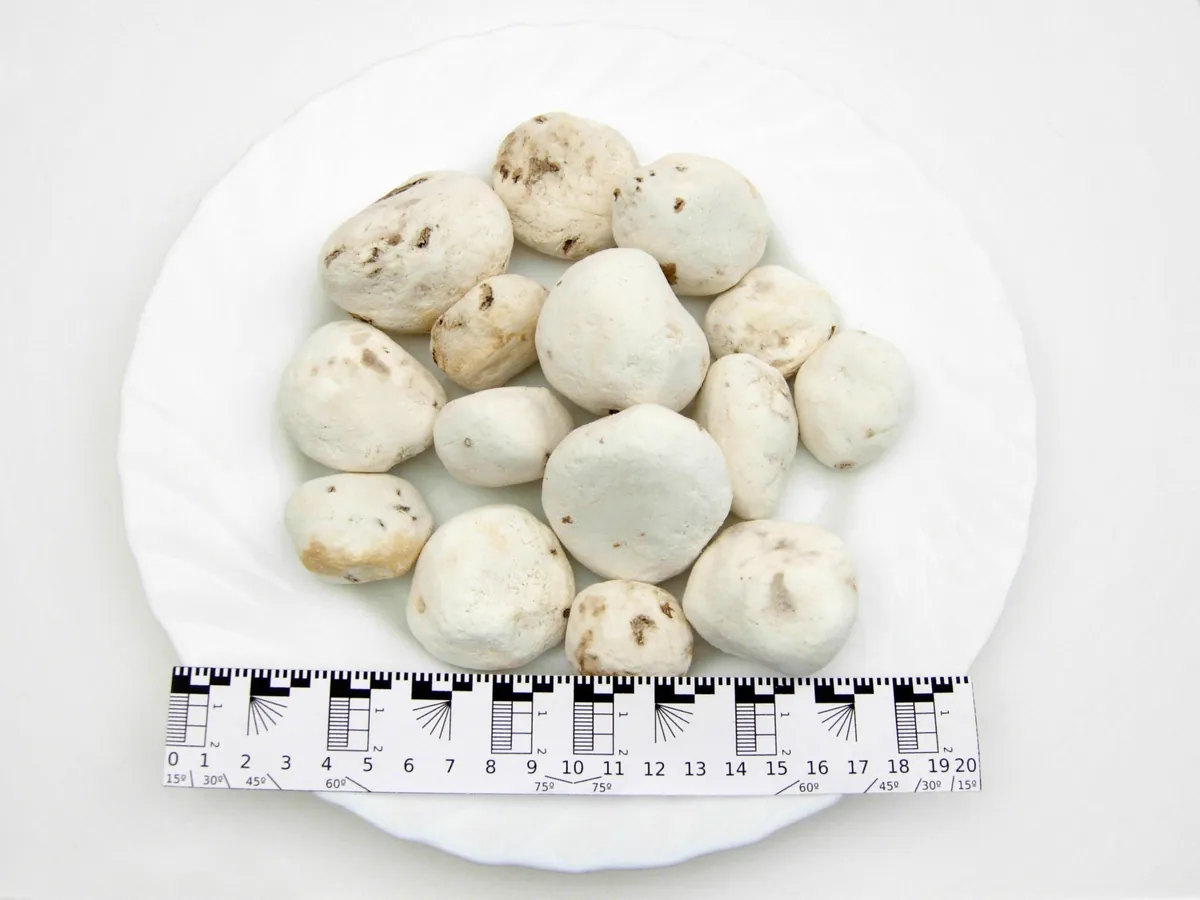
皿に盛った白色チューニョ(chuño blanco、アイマラ語圏ではタンタとも呼ばれる脱水ジャガイモ)。センチメートル定規が添えられ、大きさの比較ができる。
写っているもの: 該当分類群なし(脱水ジャガイモ加工品タンタ)部位・状態: 皿に盛った白色チューニョ(タンタ)の山、センチメートル定規付き
写真: Jaroslaw Filiochowski (jarfil)/ CC BY 2.5/ 原画像/ 台帳の原画像
写真の範囲と来歴
被写体の確認: 原典の記載による同定。原典スペイン語キャプションは「Montón de chuño blanco(白色チューニョの山)」と記載。ケチュア語圏では moraya、都市部では chuño blanco と呼び分けられる旨がentities.csvの対象記述に記載されている。
掲載画像: Wikimedia Commons の原寸ファイル。苦味研究所では切り抜き・色調変更なし。 表示用には幅1200px上限のWebPを配信し、台帳の原画像は上のリンクから確認できます。
On this page (10 sections)
Reading the bitterness
Tunta is a white dehydrated potato with a dimpled surface made in the Aymara-speaking Altiplano, including Puno, Peru. Potatoes are frozen, immersed for a long period in running river water, refrozen, peeled, and sun-dried. Peru’s national standard NTP 011.400 (2007) formally defines tunta as a white food obtained through this dehydration process, with dimples derived from traces of eyes on the source potatoes. In Quechua-speaking areas such as Cusco, Huancavelica, and Ayacucho it is called moraya; urban consumers also call it chuño blanco, distinguishing it from dark-brown chuño (chuño negro), made without peeling by freezing and sun-drying only.
Tunta is made from bitter native varieties papa amarga, which contain glycoalkaloids, including Piñaza, Lucki, and Locka; non-bitter native varieties papa dulce, including Imilla negra and Imilla blanca; and improved varieties including Canchán, Ch’aska, and Perricholi. Peru’s national standard distinguishes dark-brown chuño, made by repeating freezing and sun-drying without peeling, from white tunta, which undergoes prolonged river immersion, on both color and process.
A practical guide for producers and technicians records the statement 「アンデスの歴史においてtuntaはもっぱら苦味のある在来種papa amargaから作られてきた。河川での長時間の浸漬がグリコアルカロイドの洗い流しを助け、その消費を可能にしたためだ」 (in translation: "Throughout Andean history, tunta has been made exclusively from the bitter native variety papa amarga, because prolonged river immersion helped wash out glycoalkaloids and made its consumption possible."). However, this is a record of a shared discourse among producers, not quantitative evidence of the washing effect from chemical analysis.
The taste of good-quality tunta is described in producer quality standards as 「agradable, ligeramente insípido(心地よく、わずかに淡白)」 (in translation: "pleasant, slightly bland") and as pairing well with strongly flavored dishes. In a small 2023 empirical study using the improved variety silver, 「ligero amargor bastante insignificante(ごくわずかで取るに足らない程度の苦味)」 (in translation: "a slight, fairly insignificant bitterness") was reported in post-processing taste evaluation, suggesting that slight bitterness may remain within its mildness.
Sources for this overview
NTP 011.400:2007 Tubérculos procesados. Papa deshidratada. Tunta. Requisitos y definiciones
Checked for this overview: Confirmed the NTP standard definition of tunta. / Confirmed the variety definitions including papa amarga. / Confirmed the definitional difference between chuño and tunta.
Checked for this overview: Confirmed the list of varieties including local common names. / Confirmed the discourse concerning bitter native varieties and river immersion. / Confirmed the quality-standard taste description including agradable.
Checked for this overview: Confirmed the detection of slight bitterness in the silver variety.
Other names: tunta (es), moraya (es), chuño blanco (es, identification medium)
Structured claims — open a section to read each claim's confidence, evidence and limits
Composition and content (2)
Scope: The Peru altiplano
Note: Definitions 4.8/4.9 of the NTP standard and Table 2 of the CIP practical guide agree.
Show data
ingredient-tunta —is_derived_from→ "Native bitter varieties (papa amarga: S. juzepczukii, S. curtilobum, commonly known as Piñaza, Lucki, Locka, Choquepito, Parina, etc.), native non-bitter varieties (papa dulce: S. tuberosum spp. andigena, commonly known as Imilla negra, Imilla blanca, etc.), and improved varieties (S. tuberosum spp. andigena, commonly known as Canchán, Ch'aska, Perricholi, etc.)."Scope: Peru
Note: Based on definitions 4.1/4.4/4.5 of the NTP standard.
Show data
ingredient-chuno —differs_from→ ingredient-tuntaSensory (2)
Scope: Puno region (Peru)
Note: A description of quality standards by producers and technicians; not an experimental sensory test.
Show data
ingredient-tunta —has_sensory_attribute→ "Among the traits of good-quality tunta, alongside color (white to matte white) and smell (a mild aroma like an aquatic plant), the flavor 「agradable、ligeramente insípido(心地よく、わずかに淡白)」 (in translation: "pleasant, slightly bland") is listed, and it is described as absorbing the flavor of whatever ingredients are cooked together with it."Scope: The Huenque and Ilave river basins (Puno region, Peru)
Note: A record from a single small-scale field-demonstration study; not generalized.
Show data
ingredient-tunta —has_sensory_attribute→ "In processing evaluations across several modules including the improved variety silver, evaluating "sabor", a 「ligero amargor bastante insignificante(ごくわずかで取るに足らない程度の苦味)」 (in translation: "a slight, fairly insignificant bitterness") is reported to have been detected."How processing and cooking change it (1)
Scope: The Peru-Bolivia altiplano (above 3800m elevation)
Note: Based on definition 4.1 of NTP 011.400.
Show data
ingredient-tunta —is_prepared_by→ process-tunta-chuno-processingCulture (1)
Scope: The Peru altiplano
Note: The source's narrative is recorded as-is. It does not include any numerical toxicity or safety claims.
Show data
ingredient-tunta —has_historical_origin_narrative→ "A narrative recorded in a field guide for producers and technicians states: 「アンデスの歴史においてtuntaは専ら papa amarga(苦味在来種)から作られていた。河川での長時間の浸漬が『グリコアルカロイド』の洗い流しを助け、その消費を可能にしたため」 (in translation: "In Andean history, tunta was made exclusively from papa amarga (native bitter varieties), because prolonged soaking in the river helped wash out the 'glycoalkaloids,' making its consumption possible.")"