Cassava flour (farinha) processing
process / process-cassava-flour-processing
キャッサバ粉(ファリーニャ)の製造
Cassava flour (farinha) processing is a process that turns roots of bitter cassava varieties into coarse flour (farinha) or starch (fécula) through peeling, grating (ralação), pressing (prensagem, using a manual press, prensa manual, in modern small-scale agricultural processing or a woven basket-like press called a tipiti in traditional Amazonian Indigenous practice), crumbling (esfarelamento), sieving (peneiramento), moisture removal in an oven (enxugamento), and roasting (torração). The liquid separated by pressing is used in food and drink after heating, including as tucupi.
Photographs (captions in Japanese)
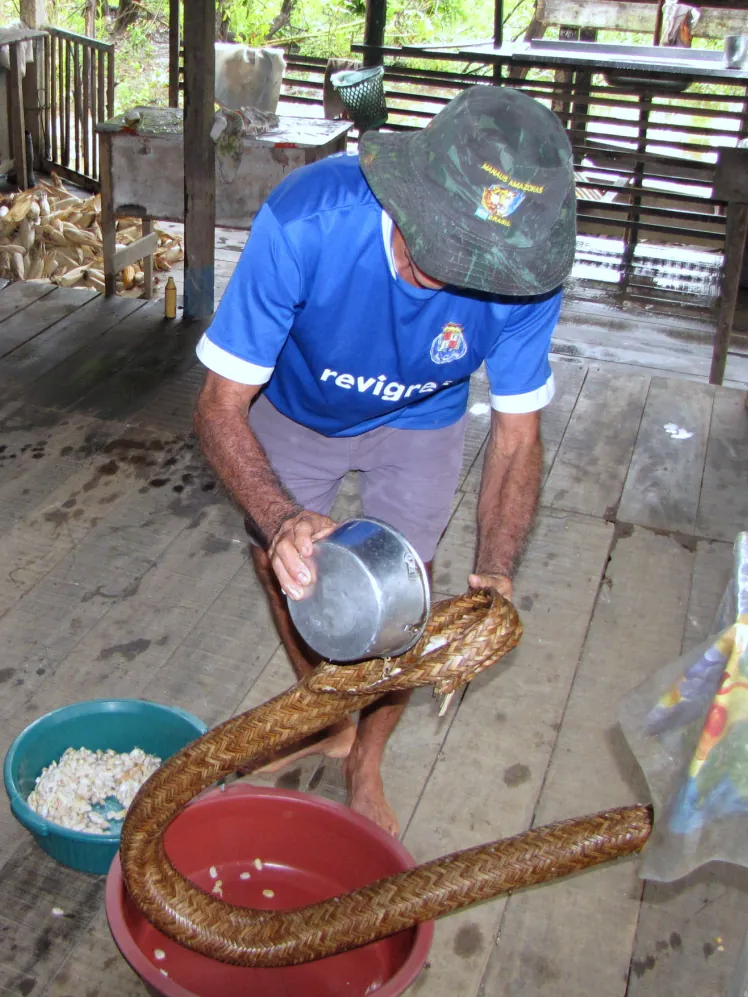
ブラジル・パラ州オビドスの農産加工プロジェクトで、tipiti(編み籠状の圧搾具)を用いてすりおろしたキャッサバを圧搾している場面。苦味種キャッサバの根を farinha(粗挽き粉)へ加工する連鎖のうち圧搾(prensagem)工程の実施場面。
写っているもの: Manihot esculenta(苦味種キャッサバ)由来の加工工程部位・状態: tipiti(編み籠状の圧搾具)を使った圧搾工程
写真: Incra/Oeste do Pará/ CC BY 2.0/ 原画像/ 台帳の原画像
写真の範囲と来歴
被写体の確認: 原典の記載による同定。
掲載画像: Wikimedia Commons の原寸ファイル。苦味研究所では切り抜き・色調変更なし。 表示用には幅1200px上限のWebPを配信し、台帳の原画像は上のリンクから確認できます。
On this page (6 sections)
Reading the bitterness
Processing roots of bitter cassava (mandioca-brava) into flour is recorded at a small-scale agricultural processing facility in the Recôncavo region of Bahia, Brazil, as a sequence of peeling (descascamento), grating (ralação), pressing (prensagem), crumbling (esfarelamento), sieving (peneiramento), moisture removal in an oven (enxugamento), and roasting (torração). Grating crushes the roots with a rotating steel-bladed cylinder, while sieving removes fibers and evens out particle size using galvanized mesh with a mesh count of 26–28. Moisture removal is carried out at 180–250°C and roasting at a gentler 120–150°C. The record also notes that coarser flour is generally found outside this region.
The grated mass (massa) is wrapped in nylon cloth and placed on stacked wooden lattice frames (estrado) in a manual hydraulic press (prensa manual) to separate the expressed liquid (manipueira). The practice record from Bahia adds that this liquid can be used as animal feed, fertilizer, or for irrigation. Pressing lowers the flour’s moisture content and is a key stage leading to the subsequent steps of crumbling, sieving, and drying in the oven.
In contrast, Indigenous communities in the Amazon region use a cylindrical press about 2 m long, called a "tipiti", woven from plant fibers such as cipó arumã and palmeira jacitara. It hangs from a handle at the top, and force applied below stretches the cylinder and squeezes liquid through the weave; its manufacture is recorded as requiring about 16 stems (equivalent to about 65 strips). In the case of the Canela people of Maranhão state, men were recorded as making it and women as using it. This is a traditional pressing technique distinct from the modern manual press in Bahia.
The liquid separated by pressing with a tipiti is processed through heating into tucupi, a soup-like seasoning liquid used in Amazonian cuisine. The source does not give technical details such as heating temperature or time, but a general-audience article on the Amazon region records an account of making the liquid edible through heating rather than using the raw expressed liquid directly.
Sources for this overview
Processamento de aipim e mandioca-brava
Checked for this overview: Confirmed the description of the steps from peeling through roasting and their temperature ranges. / Confirmed the description of pressing with a manual press and uses for the expressed liquid.
Conheça o tipiti, tecnologia indígena de uso secular na Amazônia
Checked for this overview: Confirmed the description of the tipiti’s structure, materials, and number of stems needed to make it. / Confirmed the description that the pressed liquid becomes tucupi after heating.
Tipiti (registro de acervo museológico)
Checked for this overview: Confirmed the record of the division between making and using it by gender among the Canela people.
Other names: tipiti (pt)
Structured claims — open a section to read each claim's confidence, evidence and limits
How processing and cooking change it (4)
Scope: The Recôncavo Baiano region (Bahia state, Brazil).
Note: A description of a small-scale agricultural processing facility in the Recôncavo region of Bahia, Brazil.
Show data
process-cassava-flour-processing —comprises→ "A sequence of peeling (descascamento), grating (ralação, crushing roots with a rotating steel-bladed cylinder), pressing (prensagem, wrapping the mass in nylon cloth and squeezing it with a manual press), breaking up the compressed mass (esfarelamento, reusing the grater), sieving (peneiramento, removing fibers and evening out particle size with galvanized mesh of mesh count 26–28), moisture removal in a rotating oven (enxugamento, 180–250°C), and roasting (torração, 120–150°C, with gentler heat)."Scope: Small-scale agricultural processing facilities in the Recôncavo Baiano region (Bahia state, Brazil).
Show data
process-cassava-flour-processing —uses→ "A method in which the grated mass (massa), wrapped in nylon cloth, is placed in a manual hydraulic press (prensa manual) to separate the expressed liquid (manipueira)."Scope: Indigenous communities of the Amazon region (Brazil)
Note: A traditional press of the Amazon region, distinct from the modern manual press (prensa manual) of Bahia state.
Show data
process-cassava-flour-processing —has_variant→ "Indigenous communities of the Amazon region use, in the pressing process, a cylindrical press called "tipiti" woven from plant fibers such as cipó arumã and palmeira jacitara (about 2m long, with handles at both ends; the upper handle is hung and a bar is used to apply downward force, stretching the cylinder and squeezing liquid out through the weave). There are recorded cases where men are described as making it and women as using it."Scope: The Amazon region (Brazil).
Note: Records only the account of making the liquid edible by heating, without discussing quantitative values for safety or toxicity.
Show data
process-cassava-flour-processing —provides_material_for→ "The liquid separated by pressing with a tipiti is heated and processed into tucupi, a soup-like seasoning liquid used in Amazonian cuisine."