Tunta and chuño processing
process / process-tunta-chuno-processing
アンデスの凍結乾燥ジャガイモ加工(チューニョ) / Tunta/chuño processing (Andean freeze-dehydration of potato)
Tunta and chuño processing is a traditional process in the Andean highlands (the Altiplano along the Peru–Bolivia border, above 3800 m) that turns potatoes, including the native bitter varieties called papa amarga, into dehydrated potatoes (tunta/chuño/moraya) through selection, freezing, prolonged immersion in flowing river water, refreezing, peeling, sun-drying, and finishing. It depends on winter nights below freezing and strong sunlight.
Photographs (captions in Japanese)
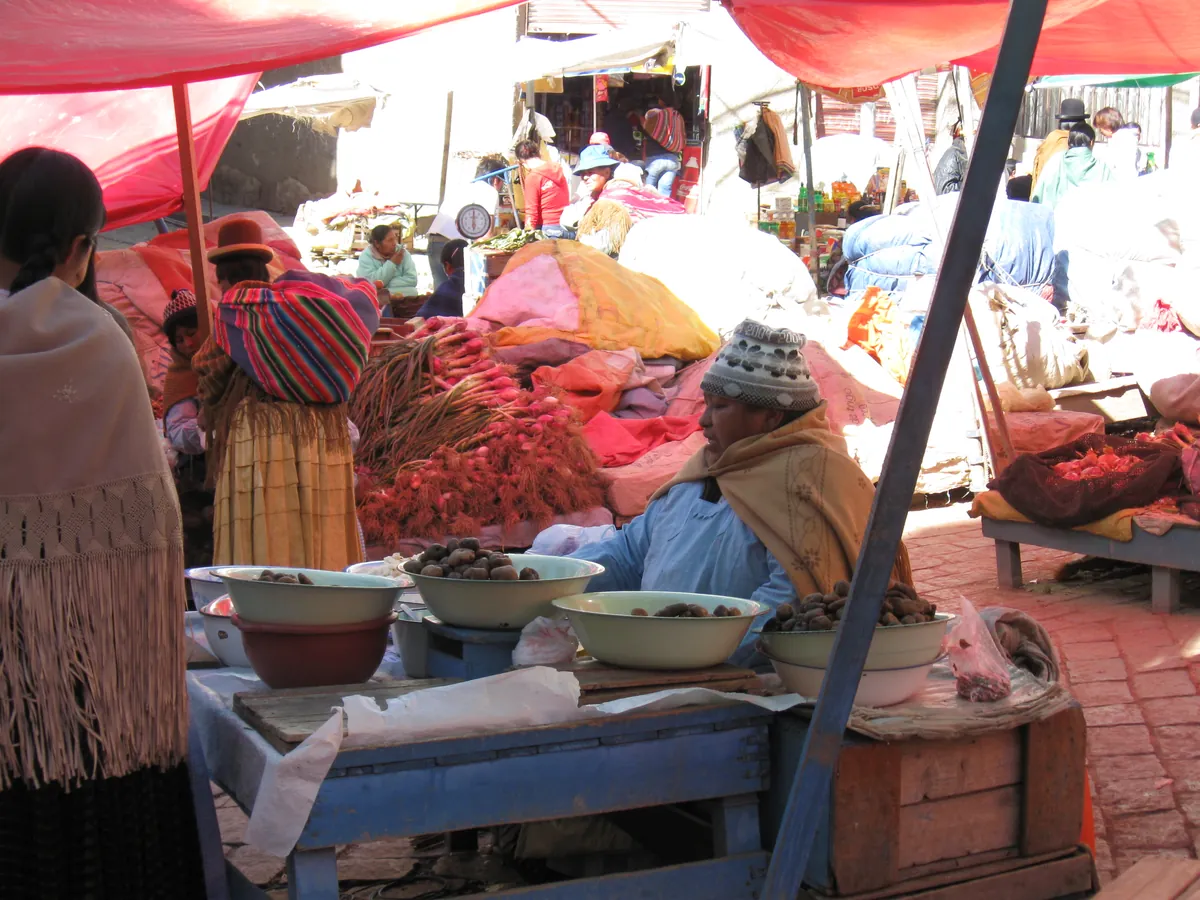
パパ(ジャガイモ)・チューニョ・トゥンタが水に浸された(remojada)状態。アンデス高地の伝統的なトゥンタ/チューニョ加工工程のうち、河川の流水への長期浸漬という工程の実施場面を示す。
写っているもの: Solanum tuberosum(ジャガイモ)の凍結乾燥加工部位・状態: 河川の流水への浸漬工程
写真: Alhen/ CC BY-SA 2.0/ 原画像/ 台帳の原画像
写真の範囲と来歴
被写体の確認: 原典の記載による同定。
掲載画像: Wikimedia Commons の原寸ファイル。苦味研究所では切り抜き・色調変更なし。 表示用には幅1200px上限のWebPを配信し、台帳の原画像は上のリンクから確認できます。
On this page (7 sections)
Reading the bitterness
In the Andean highlands of the Altiplano on the Peru–Bolivia border, above 3800 meters, a traditional technique continues to process potatoes into dehydrated potatoes (tunta/chuño/moraya) through a sequence of selection, freezing, river immersion, refreezing, peeling, and sun-drying. Peru’s national standard NTP 011.400 (2007) formally defines the "tunta" produced by this process as a rough-surfaced, white dehydrated food obtained through repeated freezing, immersion in flowing water, and sun-drying. Because the process depends on winter nights below freezing and strong sunlight, it is carried out only in limited seasons and at limited elevations.
A public guide (2008) describing producers’ practice in the Ilave River basin of Puno organizes tunta processing into 10 stages: receiving, selection, first freezing, water immersion, second freezing, peeling and washing, drying, rubbing and winnowing, selection and packing, and storage. By contrast, the background account in a 2021 paper on the same southern Peruvian highlands lists 8 stages: selection, initial freezing, fermentation immersion, peeling, wet fermentation, heat drying, quality selection, and storage. Sources differ on whether wet fermentation is an additional step and on the stated durations (3–4 nights versus 3–8 nights for initial freezing; 21–30 days versus 15–30 days of immersion plus a separate 21 days of wet fermentation). The basic structure of freezing, immersion, and drying is shared.
The first freezing is performed by exposing the potatoes to night temperatures below 5°C for 3–4 nights. Winter from May through July, called 「época de heladas(氷結期)」 (in translation: "frost season"), combines strong sunlight, low humidity, and little cloud cover, conditions described as supporting natural freezing and drying. A 2023 empirical study also records a similar first-freezing procedure of leaving the raw potatoes in an environment below 5°C for 3–4 nights.
The frozen potatoes are submerged in river enclosures made of nets and stakes, "jaula" and "poza", in a clear, gently flowing area for 21–30 days depending on variety (one report gives an average of about 25 days), and moved every 5 days. The steps are documented together with local tool names: a large strainer with a 50 cm iron frame called "wiscaña" for lifting the potatoes, "chuñahuis" for the open area used in freezing and drying, and a net-like cloth called "taquiña" for peeling by treading.
Sources for this overview
NTP 011.400:2007 Tubérculos procesados. Papa deshidratada. Tunta. Requisitos y definiciones
Checked for this overview: Confirmed the definition of tunta in the NTP standard (4.1).
Checked for this overview: Confirmed the description of 10 stages in the CIP practical guide. / Confirmed the conditions for the first freezing and the description of the climate. / Confirmed the description of the duration and method of river immersion. / Confirmed the description of tools including wiscaña.
Checked for this overview: Confirmed the 2021 paper’s background description of 8 stages and differences in the stated durations.
Checked for this overview: Confirmed the record of the freezing procedure in the 2023 empirical study. / Confirmed the record of an average immersion period of 25 days.
Other names: papa amarga (es, identification medium), wiscaña (es), chuñahuis (es, identification medium), taquiña (es, identification medium)
Follow the connections
Tunta →is prepared by→ Tunta and chuño processing
Structured claims — open a section to read each claim's confidence, evidence and limits
How processing and cooking change it (5)
Scope: The Peru-Bolivia altiplano (above 3800m elevation)
Note: Based on definition 4.1 of NTP 011.400.
Show data
ingredient-tunta —is_prepared_by→ process-tunta-chuno-processingScope: The Ilave river basin, Puno region (Peru)
Note: A description from an official guide that systematized the practices of producers in the Ilave river basin, Puno region.
Show data
process-tunta-chuno-processing —comprises→ "10 steps: receiving (recepción), sorting and classifying (selección y clasificación), first freezing (1er congelado), soaking in water (inmersión en agua), second freezing (2do congelado), peeling and washing (descascarado y lavado), drying (secado), rubbing and winnowing (rozado y venteo), sorting and packing (selección y envasado), and storage (almacenamiento)."Scope: Puno region (Peru) altiplano, above 3800m elevation
Note: The NTP standard, the CIP practical guide, and a 2023 field-demonstration study all describe the condition as below 5℃ for 3-4 nights.
Show data
process-tunta-chuno-processing —requires→ "Multiple rounds (3-4 nights) of freezing under night-time low temperatures below 5℃. Carried out during the winter months of May-July, called the "época de heladas" (frost season), under climate conditions of strong sunlight, low humidity, and little cloud cover."Scope: The Ilave and Huenque river basins, Puno region (Peru)
Show data
process-tunta-chuno-processing —requires→ "The frozen potatoes are submerged in flowing river water inside an enclosure (jaula/poza) made of netting and stakes, and soaked for 21-30 days depending on the variety (some reports give an average of around 25 days). Their position is moved every 5 days."Scope: The Ilave river basin, Puno region (Peru)
Show data
process-tunta-chuno-processing —requires→ "Traditional tools and local vocabulary: fishing nets (mallas); "chuñahuis", the term for the open ground used for freezing and drying; "wiscaña", a large strainer used to lift the potatoes out of the river (iron-ring diameter 50cm, net depth 70cm, handle 1.2m); and "taquiña", a netted cloth used for peeling by treading pressure."