日本語版

coffee roasting

process / process-coffee-roasting

コーヒー焙煎

Roasting coffee beans. Differences in the temporal dominance of taste and aroma by roast level are treated separately.

Photographs (captions in Japanese)
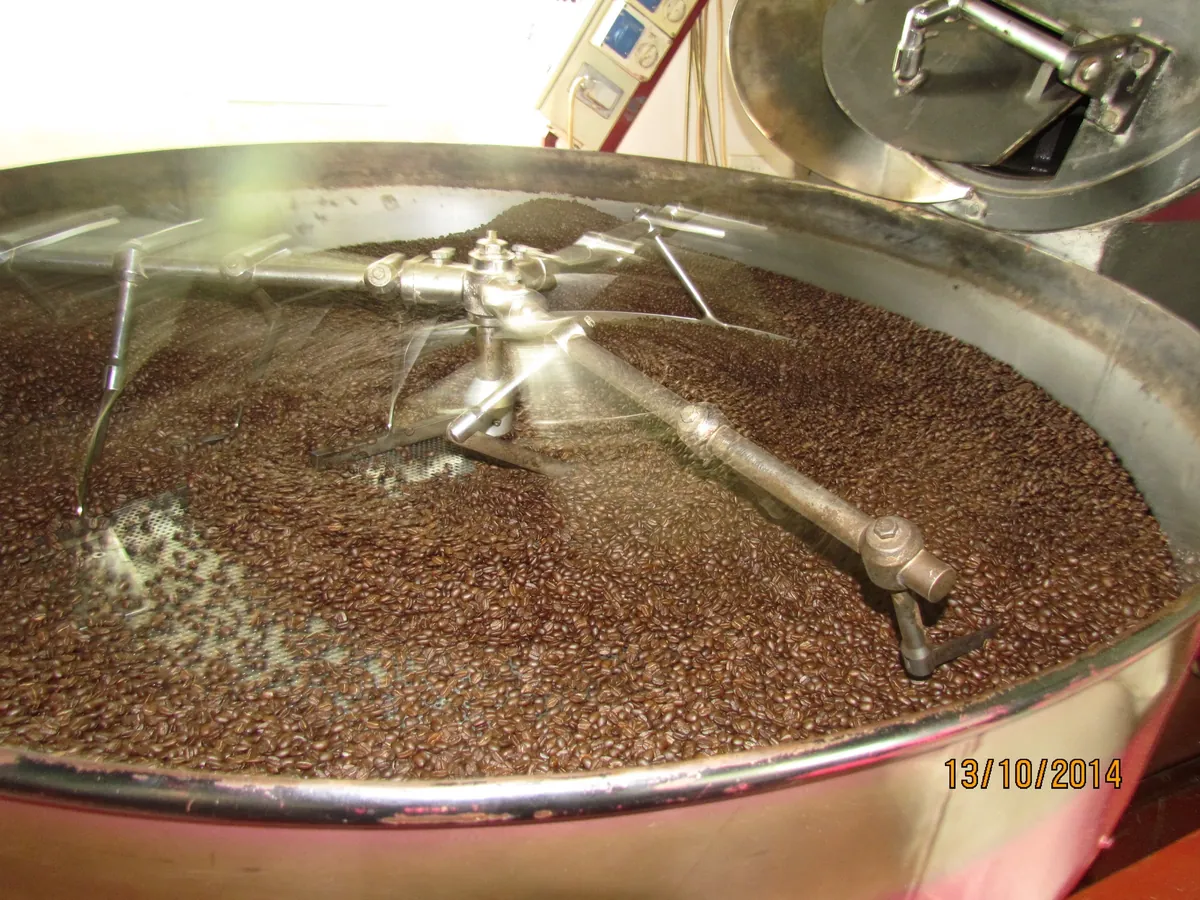
鍋状の器具でコーヒー豆を炒っている様子の写真

ウガンダでのコーヒー豆焙煎の実施場面。焙煎という工程が実際に行われている様子を示す写真。

写っているもの: Coffea(コーヒー豆)の焙煎工程部位・状態: 焙煎作業中の場面

写真: Erinamukuta/ CC BY-SA 4.0/ 原画像/ 台帳の原画像

写真の範囲と来歴

被写体の確認: 原典の記載による同定。

掲載画像: Wikimedia Commons の原寸ファイルを sips で長辺2400pxに縮小。苦味研究所では切り抜き・色調変更なし(リサイズのみ)。 表示用には幅1200px上限のWebPを配信し、台帳の原画像は上のリンクから確認できます。

On this page (10 sections)
  1. Overview
  2. Sources for this overview (2)
  3. Topic hubs
  4. Follow the connections
  5. Related entries (10)
  6. Sensory (3)
  7. Mechanism and receptors (1)
  8. How processing and cooking change it (1)
  9. Safety and regulation (2)
  10. Culture (5)
↑

Reading the bitterness

A study of medium- and dark-roasted Arabica coffee using TDS (temporal dominance of sensations) and intranasal PTR-ToF-MS measurements showed that the temporal pattern of dominant flavors during drinking differs by roast level. Bitterness and roasted aroma dominated periods of the medium roast, whereas bitterness and burnt aroma dominated the dark roast. Only 1 level of roasting conditions was examined for each, however, and the 『優勢率』 (“dominance rate”) shown by TDS is not a measure of sensory intensity itself.

An analysis of Arabica green beans from Doi Chaang in Chiang Rai Province, Thailand (honey process; cup score above 80) found that total phenolic and chlorogenic acid content decreased significantly as roasting increased from light to medium to dark, whereas caffeic acid, a breakdown product, increased. The lightness (L* value) of roasted beans correlated, according to the study, positively with chlorogenic acid content and negatively with caffeic acid content. The study was limited to 1 lot from a single farm and did not include human sensory evaluation.

A report analyzing volatile compounds in the same Doi Chaang Arabica by HS-SPME-GC/MS discusses changes in furfuryl alcohol content with roast level in connection with a description in other literature of 『焦げた・ロースト香が苦味として知覚される』 (“burnt and roasted aromas being perceived as bitterness”) arising through the Maillard reaction. This link appears in the discussion; the study itself did not measure bitterness in people.

Sources for this overview

  1. Effects of Roasting Level and Milk Addition on In Vivo Aroma Release and Perception of Coffee

    Cleve N; Gonzalez-Estanol K; Khomenko I; Pedrotti M; Cappellin L; Biasioli F; Beauchamp J / 2025 / journal article / full text checked

    Checked for this overview: Confirmed through TDS the dominant pattern of bitterness, roasted aroma, and burnt aroma for medium and dark roasts.

  2. Quality characteristics of Coffea arabica cultivated in Thailand in response to roasting levels profiling its functional material applications

    Lourith N; Kanlayavattanakul M / 2025 / journal article / full text checked

    Checked for this overview: Confirmed decreases in total phenolics and chlorogenic acid and an increase in caffeic acid as roast level rose. / Confirmed the discussion’s description of changes in furfuryl alcohol and 『苦味として知覚される』 (“perceived as bitterness”).

Follow the connections

coffee roasting →can change→ chlorogenic acid

coffee roasting →is associated with→ bitterness →can be measured separately …→ astringency

Hypotheses and recipe candidates for this entry are on the Japanese page.

Structured claims — open a section to read each claim's confidence, evidence and limits

Sensory (3)

coffee roasting can change The temporal composition of bitterness, roasty aroma, and burnt aroma that dominate during drinkingsupported

Scope: Comparison of Temporal Dominance of Sensations (TDS) between medium-roast and dark-roast Arabica

Note: For medium roast, bitterness and roasty aroma dominate; for dark roast, bitterness and burnt aroma dominate. TDS is not an intensity curve.

On TDS, bitterness and roasty aroma dominated for medium roast, and bitterness and burnt aroma dominated for dark roast.
Limitations: Each roast condition was tested at only 1 level. Dominance rate is not the sensory intensity itself.
Source: Effects of Roasting Level and Milk Addition on In Vivo Aroma Release and Perception of Coffee (Cleve N; Gonzalez-Estanol K; Khomenko I; Pedrotti M; Cappellin L; Biasioli F; Beauchamp J, 2025) · full text checked
Show dataprocess-coffee-roasting —can_change→ "The temporal composition of bitterness, roasty aroma, and burnt aroma that dominate during drinking"
claim: clm-coffee-roasting-tds / type: sensory / updated: 2026-08-31
coffee roasting is associated with bitternesscontextual

Scope: Volatile compound analysis of Doi Chang-grown arabica (HS-SPME-GC/MS, comparing light, medium, and dark roasts)

Note: The body of the paper connects the change in furfuryl alcohol content with roast level to a description, via the Maillard reaction, that 「焦げた・ロースト香が苦味として知覚される(perceived as a bitter taste)」. However, this description is a discussion grounded in other literature, not the study's own human sensory measurement, so it is treated as contextual.

Context: "The level of roasting directly impacted the furfural alcohol content...in harmony with a relatively burnt or roasted odour perceived as a bitter taste with a more caramelized aroma observed due to the Maillard reaction achieved with roasting."
Limitations: This study did not conduct a human sensory (bitterness) panel. "bitter taste" is a discussion-level expression grounded in other literature, not the study's own measured result.
Show dataprocess-coffee-roasting —is_associated_with→ sensation-bitter
claim: clm-doichang-roast-bitter-interp / type: sensory / updated: 2026-09-01
coffee roasting can change Sensory bitterness score (rated out of 10 by 12 trained assessors holding Q Arabica Grader certification)supported

Scope: Ethiopian arabica beans; comparison of ultra-high-pressure-processed cold brew and conventional cold brew

Note: As roast degree deepened from Agtron color value 73 (light) → 62 (medium) → 53 (dark), the bitterness score increased significantly (ultra-high-pressure: 2.00±0.10 → 3.35±0.30 → 5.50±0.40; conventional: 3.00±0.28 → 4.30±0.42 → 6.50±0.42; p<0.05 in both). This is an academic source that directly shows, with statistical significance from a human sensory panel, the relationship that deeper roasting means stronger bitterness. The same directional trend was confirmed regardless of extraction method (both of the 2 extraction conditions: ultra-high-pressure and conventional).

In a 10-point evaluation by 12 trained sensory assessors (holding Q Arabica Grader certification), the bitterness score increased significantly as roasting deepened across Agtron color values 73 → 62 → 53 (light → medium → dark roast) (ultra-high-pressure: 2.00±0.10 → 3.35±0.30 → 5.50±0.40; conventional: 3.00±0.28 → 4.30±0.42 → 6.50±0.42; p<0.05).
Limitations: An experiment using a single origin and a single bean lot. The result is limited to the extraction condition (cold brew); generalizing to hot brew is outside the scope of this paper.
Source: Comparison of Ultra-High-Pressure and Conventional Cold Brew Coffee at Different Roasting Degrees: Physicochemical Characteristics and Volatile and Non-Volatile Components (Shi Qihan; Xiao Ying; Zhou Yiming; Tang Wenxiao; Jiang Feng; Zhou Xiaoli; Lu Hongxiu, 2024) · full text checked
Show dataprocess-coffee-roasting —can_change→ "Sensory bitterness score (rated out of 10 by 12 trained assessors holding Q Arabica Grader certification)"
claim: clm-coffee-roast-bitterness-sensory-uhp / type: sensory / updated: 2026-09-02

Mechanism and receptors (1)

coffee roasting increases bitternessestablished

Scope: Chapter 7 (the chemistry of coffee's taste) of the SCA's official Coffee Sensory and Cupping Handbook (2021)

Note: Original text: "Sourness is preponderant in light roasts and bitterness in dark roasts." "bitterness actually increases with the roast level". It explicitly states that caffeine is only one part of coffee's bitterness compounds, and that bitterness increases even though caffeine decreases with roasting ("caffeine ... only accounts for a small percentage of coffee's bitterness").

States that acidity is dominant in light roasts and bitterness is dominant in dark roasts; bitterness increases as roast level rises, while caffeine content decreases with roasting, so caffeine accounts for only a small part of the bitterness.
Limitations: Only some of the individual analytical values and citation numbers are shown in the body text (footnote numbers 55-58, etc.); the footnote list itself within this handbook was not checked this time.
Source: Coffee Sensory and Cupping Handbook, Edition No. 01 (Fernández-Alduenda, Mario Roberto; Giuliano, Peter, 2021) · full text checked
Show dataprocess-coffee-roasting —increases→ sensation-bitter
claim: clm-w51-sca-roast-increases-bitterness / type: mechanism / updated: 2026-09-02

How processing and cooking change it (1)

coffee roasting can change chlorogenic acidsupported

Scope: Comparison of light roast (180°C), medium roast (200-220°C), and dark roast (230°C); total phenolic content quantified by the Folin-Ciocalteu method, and chlorogenic acid and caffeic acid quantified by UPLC

Note: The lightness L* value correlated positively with chlorogenic acid content (r=+0.9101) and negatively with caffeic acid content (r=-0.9360). This is a single lot (n=1) from a single farm, and no human sensory panel was conducted.

"High roasting level decreased the TPC, which was significantly (p<0.01) lower in dark-roasted coffee than in medium and light-roasted coffee...The chlorogenic acid content decreased with roasting, while in turn, the content of its degradation product, caffeic acid, was increased."
Limitations: Only a single lot (n=1) from a single farm. No human sensory panel was conducted.
Context: As an independent confirmation using a different origin and a different analytical method (UV-Vis), this study too reports a finding in the same direction: 『焙煎の熱によりクロロゲン酸が分解し、生豆より焙煎豆でCGA含量が下がる』 (in translation: "the heat of roasting breaks down chlorogenic acid, so CGA content is lower in roasted beans than in green beans"). However, this is not the study's own original elucidation of the mechanism but an interpretation citing Belay and Gholap (2009).
Limitations: The analytical method (UV-Vis) differs from the chromatography-based analysis of the Doi Chang study, and the breakdown of roast levels (light/medium/dark) is not reported either, so this remains a reproduction of the trend and does not allow a direct quantitative comparison.
Show dataprocess-coffee-roasting —can_change→ compound-chlorogenic-acid
claim: clm-doichang-roast-chlorogenic / type: processing / updated: 2026-09-01

Safety and regulation (2)

coffee roasting is graded by: The "Agtron Roast Color Kit" officially distributed by the SCA (Specialty Coffee Association). It consists of 8 color disks housed in a white vinyl case, numbered in 10% increments from "Very Light" (tile #95) to "Very Dark" (tile #25).contextual

Scope: Product description on the SCA's official store

Note: The SCA's own official description of a visual reference tool it distributes. The accompanying manual is authored by Carl Staub. It is positioned not as an academic definition of roast level but as an industry consensus-building tool for roasters and customers to reach a shared understanding of roast level.

States: "eight color disks, numbered in 10% increments ranging from 'Very Light' (tile #95) to 'Very Dark' (tile #25)" and "These eight industry standard disks are designed to enhance consistency and assure that both roasters and their customers are in agreement regarding degree of roast"
Limitations: This is a description of an instrument, not a classification basis backed by chemical or sensory data.
Source: SCA Agtron Roast Color Kit (Specialty Coffee Association) · full text checked
Show dataprocess-coffee-roasting —is_classified_by→ "The "Agtron Roast Color Kit" officially distributed by the SCA (Specialty Coffee Association). It consists of 8 color disks housed in a white vinyl case, numbered in 10% increments from "Very Light" (tile #95) to "Very Dark" (tile #25)."
claim: clm-sca-agtron-8disk / type: regulatory / updated: 2026-09-02
coffee roasting is graded by: According to trade-press reporting, SCA may use a 「universal roasted arabica coffee color curve(普遍的な焙煎アラビカコーヒーの色曲線)」 (“universal roasted arabica coffee color curve”) identified by UC Davis Coffee Center research (7 roast profiles × 3 origins = washed Ugandan, washed Indonesian, and honey-process Central American; 663 samples and 39 experimental roasts; measured in L*a*b* color space) to develop a roast-color standard based on visible-light measurement. The trade publication reports that SCA published a white paper in that direction and is developing a draft.preliminary

Scope: At the time of the UC Davis Coffee Center research announcement and the trade-press report on the SCA white paper.

Note: This research is at the proposal stage toward standardization, not an established new standard. The materials checked here did not state the procedure or timing for developing it. They also did not specify how existing Agtron 8-level classifications or terms such as French and Italian would be treated (separated into a research question in leads).

Using L*a*b* color space to measure 7 roast profiles × 3 origins, 663 samples, and 39 experimental roasts, the study reported a "universal roasted arabica coffee color curve" independent of roast profile and origin.
Limitations: Translating this curve into the terminology of an industry standard lies beyond the paper’s scope and is left to SCA’s separate standardization work.
Source: A universal color curve for roasted arabica coffee (Anokye-Bempah Laudia; Styczynski Timothy; Ristenpart William D; Donis-González Irwin R, 2025) · full text checked
The UC Davis Coffee Center color curve is introduced as a basis for standardization given the absence of universally accepted criteria for "light roast""medium roast""dark roast".
Limitations: A trade-press account. The article does not state the specific procedure or timing for developing the standard.
The article summarizes SCA’s publication of the white paper "Developing Roast Color Standards for the Specialty Coffee Industry", its plan to adopt a roast-level scale based on visible-light measurement, and the development of a draft standard.
Limitations: The white paper itself was not checked. This is a summary in a weekly report; the article does not give the procedure or timing for development.
Show dataprocess-coffee-roasting —is_classified_by→ "According to trade-press reporting, SCA may use a 「universal roasted arabica coffee color curve(普遍的な焙煎アラビカコーヒーの色曲線)」 (“universal roasted arabica coffee color curve”) identified by UC Davis Coffee Center research (7 roast profiles × 3 origins = washed Ugandan, washed Indonesian, and honey-process Central American; 663 samples and 39 experimental roasts; measured in L*a*b* color space) to develop a roast-color standard based on visible-light measurement. The trade publication reports that SCA published a white paper in that direction and is developing a draft."
claim: clm-sca-new-roast-color-standard-development / type: regulatory / updated: 2026-09-02

Culture (5)

coffee roasting has a standardized vocabulary entry in The 8-stage roast-level terminology listed in the 「知る・楽しむ」 (in translation: "Learn and Enjoy") section of the All Japan Coffee Association's official website — light roast, cinnamon roast, medium roast, high roast, city roast, full city roast, French roast, and Italian roast.contextual

Scope: A column article on the All Japan Coffee Association's official website

Describes the names and characteristics of the 8 stages (light roast, 「黄色がかった小麦色」 (in translation: "a yellowish wheat color"); French roast, 「強い苦味と独特の香りが楽しめる」 (in translation: "you can enjoy its strong bitterness and distinctive aroma"); Italian roast, 「色は黒に近い。強い苦味と濃厚な味わい」 (in translation: "the color is close to black; a strong bitterness and a rich, deep flavor"); and others), together with the general rule 「一般的には浅炒りほど酸味が強く、深炒りになるほど苦味を感じるようになります」 (in translation: "in general, the lighter the roast, the stronger the acidity, and the deeper the roast, the more bitterness is felt").
Limitations: There is no correspondence with instrument measurements, and the bitterness descriptions are the association's own statements, unsupported by any sensory test.
Source: 焙煎・配合・粉砕 (全日本コーヒー協会) · full text checked
Show dataprocess-coffee-roasting —has_standardized_vocabulary_entry_in→ "The 8-stage roast-level terminology listed in the 「知る・楽しむ」 (in translation: "Learn and Enjoy") section of the All Japan Coffee Association's official website — light roast, cinnamon roast, medium roast, high roast, city roast, full city roast, French roast, and Italian roast."
claim: clm-ajca-8stage-terms / type: cultural / updated: 2026-09-02
coffee roastingThe term The 8 terms for roast level, 「light・cinnamon・medium・high・city・full city・French・Italian」 (light, cinnamon, medium, high, city, full city, French, and Italian), are described as recorded in William Ukers's book 『All About Coffee』 (1928). first appears in: contextual

Scope: An article on the official SCA site (by Peter Giuliano) introducing Ukers’s (1928) description.

“In William Ukers' famous book "All About Coffee" from 1928, he mentioned eight roast levels: light, cinnamon, medium, high, city, full city, French, and Italian.” The source states this.
Limitations: Ukers’s original 1928 work itself was not accessed in this investigation.
Source: Coffee Decoded: Why is Roast Level so Important to Consumers? (Giuliano Peter) · full text checked
Show dataprocess-coffee-roasting —has_term_first_appearing_in→ "The 8 terms for roast level, 「light・cinnamon・medium・high・city・full city・French・Italian」 (light, cinnamon, medium, high, city, full city, French, and Italian), are described as recorded in William Ukers's book 『All About Coffee』 (1928)."
claim: clm-roast-terms-ukers-1928 / type: cultural / updated: 2026-09-02
coffee roasting — unresolved property: There is no universally agreed standard in the roasting industry for what "light roast," "medium roast," and "dark roast" mean; one roaster's "light roast" can even be darker than another roaster's "dark roast." The SCA itself states that terms carrying regional names, such as French, Italian, and Full City, can be "too arcane or flexible to be meaningful."supported

Scope: Concerns raised about roast-level terminology by the SCA, people connected with the UC Davis Coffee Center, and trade publications

Note: A peer-reviewed journal article (Anokye-Bempah et al. 2025) and multiple SCA official articles and trade-press articles independently raise the same concern. This fact calls into question the very premise that 「地域名のついた焙煎度呼称が実際にその地域の慣行を一意に指す」 (in translation: "a roast-level term carrying a regional name actually refers uniquely to that region's practice").

States: "there are no universally accepted industry standards for what is meant by 'light roast,' 'medium roast,' or 'dark roast'" and "Some roasters produce 'light roasts' that are darker than the 'dark roasts' produced by others"
Limitations: The paper itself is primarily concerned with color measurement using the L*a*b* color space; this quoted portion is background explanation.
Source: A universal color curve for roasted arabica coffee (Anokye-Bempah Laudia; Styczynski Timothy; Ristenpart William D; Donis-González Irwin R, 2025) · full text checked
States: "Terms like 'French,' 'Italian,' and 'Full City' may be too arcane or flexible to be meaningful."
Limitations: This is an opinion piece by an individual and was not published as the SCA's official, unified position.
Source: Coffee Decoded: Why is Roast Level so Important to Consumers? (Giuliano Peter) · full text checked
States: "there are no universally accepted standards for what is meant by 'light roast,' 'medium roast' or 'dark roast,'" and "roasters currently communicate roast levels in any number of ways, such as using European and U.S.-derived conventional names like 'Full City' or 'French,'"
Show dataprocess-coffee-roasting —has_unresolved_property→ "There is no universally agreed standard in the roasting industry for what "light roast," "medium roast," and "dark roast" mean; one roaster's "light roast" can even be darker than another roaster's "dark roast." The SCA itself states that terms carrying regional names, such as French, Italian, and Full City, can be "too arcane or flexible to be meaningful.""
claim: clm-roast-naming-no-universal-standard / type: cultural / updated: 2026-09-02
coffee roasting is presented as: Coffee historian Mark Pendergrast’s book 『Uncommon Grounds』 (1999) states of Europe in the past: 「フランス人・イタリア人・ポルトガル人・スペイン人は、アラビカに加えるようになったロブスタ特有の苦味を隠す、より深い焙煎を好んだ」 (“The French, Italians, Portuguese, and Spanish enjoyed darker roasts that hid some of the bitter-tasting robustas they now added to the arabica beans”). It also notes a north–south difference within Italy: 「南に行くほど焙煎は深くなる傾向があり、南部イタリア人はほとんど豆を炭化させる一方、北部イタリア人は中程度の焙煎を好んだ」 (“The farther south, the darker the roast tended to be, so that southern Italians nearly turned their beans to charcoal, while northern Italians enjoyed a moderate roast”).contextual

Scope: Pendergrast, 『Uncommon Grounds』, chapter "The European Coffee Scene", on Europe in the 1920s–30s.

Note: This is a cited general book on coffee history, not a peer-reviewed academic paper. The page number in the original book has not been checked (the passage was verified through a site reproducing the full text). This passage alone cannot establish whether today’s retail terms 「イタリアン・ロースト」「フレンチ・ロースト」 (“Italian roast” and “French roast”) descend directly from those historical regional practices (separated into a research question in leads).

"The French, Italians, Portuguese, and Spanish enjoyed darker roasts that hid some of the bitter-tasting robustas they now added to the arabica beans.""The farther south, the darker the roast tended to be, so that southern Italians nearly turned their beans to charcoal, while northern Italians enjoyed a moderate roast." The source states this.
Limitations: This is not peer-reviewed academic research. The page number in the original book has not been checked.
Source: Uncommon Grounds: The History of Coffee and How It Transformed Our World (Pendergrast Mark, 1999) · full text checked
Show dataprocess-coffee-roasting —is_presented_as→ "Coffee historian Mark Pendergrast’s book 『Uncommon Grounds』 (1999) states of Europe in the past: 「フランス人・イタリア人・ポルトガル人・スペイン人は、アラビカに加えるようになったロブスタ特有の苦味を隠す、より深い焙煎を好んだ」 (“The French, Italians, Portuguese, and Spanish enjoyed darker roasts that hid some of the bitter-tasting robustas they now added to the arabica beans”). It also notes a north–south difference within Italy: 「南に行くほど焙煎は深くなる傾向があり、南部イタリア人はほとんど豆を炭化させる一方、北部イタリア人は中程度の焙煎を好んだ」 (“The farther south, the darker the roast tended to be, so that southern Italians nearly turned their beans to charcoal, while northern Italians enjoyed a moderate roast”)."
claim: clm-pendergrast-europe-dark-roast-robusta / type: cultural / updated: 2026-09-02
coffee roasting — historical origin: The so-called "Nordic light roast" style traces back to specific, named individual roasters — Tim Wendelboe, who opened a roastery in Oslo, and Klaus Thomsen, co-founder of Copenhagen's Coffee Collective, among them. Wendelboe recounts that the turning point was noticing that his own roasted beans tasted burnt compared with the coffee samples brought in by exporters. Thomsen himself, while saying he does not like the term "Nordic roasting," acknowledges that this approach itself — roasting as light as possible and holding back coffee's inherent development — carries major worldwide influence.contextual

Scope: Interviews (2023) with specialty coffee roasters in Norway and Denmark

Note: A 2023 interview article from the trade publication Perfect Daily Grind. Note that while the roasting style itself carrying the regional name "Nordic" traces back to specific roasters and a specific period, the person who established the style himself voices disagreement with that very regional-name label. Whether a term carrying a regional name uniquely refers to that region's practice is not generalized here.

Records Wendelboe's remarks describing the trigger for his shift in roasting style, Thomsen's remark to the effect of "I don't like the term 'Nordic roasting,'" and his remark acknowledging the approach's own worldwide influence.
Limitations: This is an interview article, based on the retrospective accounts of the people involved.
Source: Are Nordic specialty coffee roasters still as innovative as they once were? (Gyllensten Benedicte, 2023) · full text checked
Show dataprocess-coffee-roasting —has_historical_origin→ "The so-called "Nordic light roast" style traces back to specific, named individual roasters — Tim Wendelboe, who opened a roastery in Oslo, and Klaus Thomsen, co-founder of Copenhagen's Coffee Collective, among them. Wendelboe recounts that the turning point was noticing that his own roasted beans tasted burnt compared with the coffee samples brought in by exporters. Thomsen himself, while saying he does not like the term "Nordic roasting," acknowledges that this approach itself — roasting as light as possible and holding back coffee's inherent development — carries major worldwide influence."
claim: clm-nordic-roast-named-individuals / type: cultural / updated: 2026-09-02

↑ Top of page · ← Encyclopedia (English entries)