nanohana (nabana)
ingredient / ingredient-nanohana
菜の花(なばな)
Edible flower buds, stems, and leaves of Brassica crops sold in Japan as "nabana" and "nanohana". A spring vegetable.
Photographs (captions in Japanese)
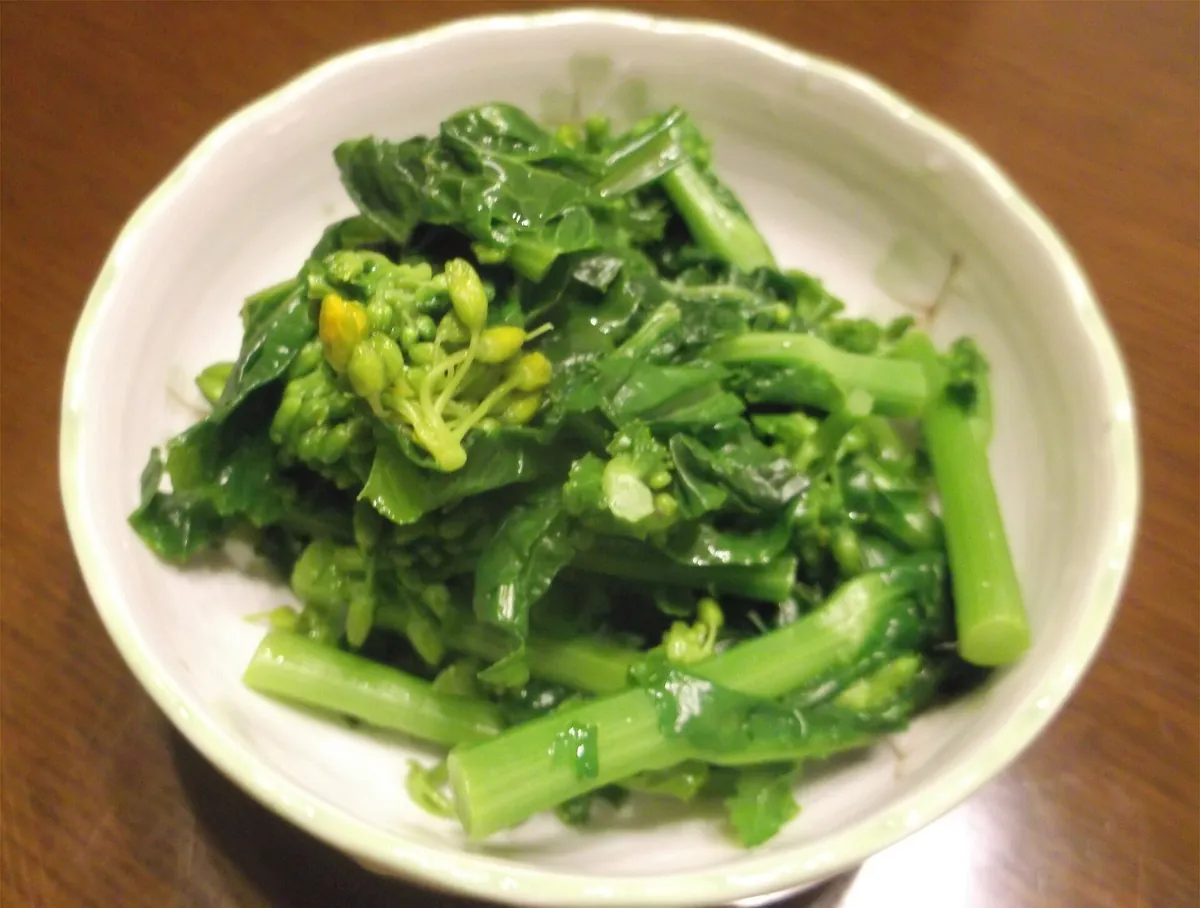
菜の花(なばな)のお浸し。茹でて水気を絞った菜の花の蕾・茎・葉を刻み、白い器に盛った状態で、黄色い蕾と緑の茎葉が見える。生の菜の花そのものの写真ではなく、加熱・調味後の加工形態を示す。
加工後写っているもの: Brassica(菜の花。種までは原典に記載なし)部位・状態: 茹でて和え物にした菜の花(なばな)のお浸し。蕾・茎・葉が刻まれた状態で器に盛られている
写真: Kentin/ CC BY-SA 4.0/ 原画像/ 台帳の原画像
写真の範囲と来歴
被写体の確認: 原典の記載による同定。この写真は加熱・調味済みの「お浸し」であり、収穫直後の生の菜の花(結束された束など)の状態を示す写真ではない。原料の栽培品種・産地は原典に記載がない。
掲載画像: Wikimedia Commons の1920px版。苦味研究所では切り抜き・色調変更なし。 表示用には幅1200px上限のWebPを配信し、台帳の原画像は上のリンクから確認できます。
On this page (9 sections)
Reading the bitterness
Nabana (nanohana) is a spring vegetable referring to the edible flower buds, stems, and leaves of Brassica crops sold in Japan as 「なばな」 (in translation: "nabana") and 「なのはな」 (in translation: "nanohana"). In a 2014 analysis, commercially available nabana samples contained the aliphatic glucosinolates gluconapin at 23.21±8.06 and glucobrassicanapin at 18.55±4.59 (both in micromoles per gram dry weight); these accounted for 49.7% and 39.7%, respectively, of the total glucosinolate amount measured, 46.73±13.04. Glucosinolates are a group of sulfur-containing compounds present in Brassicaceae plants and may be precursors of components involved in pungency and bitterness. The same survey reported that the contents of these two compounds were highest among the 15 Japanese Brassicaceae items examined.
A food-culture article by the Ministry of Agriculture, Forestry and Fisheries presents nabana's distinctive bitterness as a culinary accent and proposes dishes such as Japanese-style garlic steaming paired with the rich umami of clams. This way of eating contrasts mild bitterness with shellfish umami, but it is a proposal in an official promotional recipe and does not link glucosinolate amount with bitterness intensity through a sensory test.
Sources for this overview
秋から冬に市販される日本産アブラナ科野菜のグルコシノレート組成および含有量
Checked for this overview: The section checked for the figures for gluconapin and glucobrassicanapin contents and their proportions.
Checked for this overview: The section checked for the Ministry of Agriculture, Forestry and Fisheries article's description of distinctive bitterness as a culinary accent. / The section checked for the proposed dish pairing it with clam umami.
Follow the connections
nanohana (nabana) →contains→ glucosinolates →are not uniformly→ bitterness
Structured claims — open a section to read each claim's confidence, evidence and limits
Composition and content (1)
Scope: Nabana from the Japanese market (Fukushima, December 2008 and December 2010; Kagawa, February 2011). LC-MS method for desulfoglucosinolates
Note: The content of both GSLs was the highest among the 15 Japanese Brassica items surveyed, and the total GSL amount was second only to broccoli sprouts. This is compositional data; this paper does not address the sensory correspondence with bitterness.
Show data
ingredient-nanohana —contains→ compound-glucosinolatesSensory (2)
Scope: Layer: food. Young leaves of rapeseed grown in Denmark (27–29 days after sowing), 5 white-flowered and 2 yellow-flowered cultivars, evaluated raw by a trained panel (11 people in 2016, 7 in 2017). These are young leaves of Brassica napus, the same species as yōshu nabana (Western-type nanohana), not nanohana itself, so the findings do not apply to the flower buds' bitterness or to bitterness after cooking.
Note: The association is described on a principal component analysis plot, and the text gives no correlation coefficients or test values. In 2016, neither the cultivar difference nor the life-cycle difference in bitterness was significant (life-cycle means 7.5 vs 6.6); only 2017 was significant. The authors say the glucosinolate contributing most was glucobrassicin rather than the sinigrin or progoitrin types given in the literature, and that glucobrassicanapin also showed a strong relationship with bitterness in 2017. There was no difference in bitterness by flower color (white or yellow).
Show data
ingredient-nanohana —has_perceived_bitterness_associated_with→ compound-glucosinolatesScope: Layer: food. Flowering stalks (at harvest) of 5 cultivars of caixin grown in a greenhouse in Shenyang, China, raw. Electronic tongue (TS-5000Z) and a trained panel of 15 (0–10 scale). A related flowering-stalk vegetable, not nanohana itself. Cooking and water soaking are not covered.
Note: The sensory evaluation numbers are in a figure (Fig. 2D), not in the text, so this relies on the text's description. Glucosinolates were quantified only as a total by the palladium chloride method, and the relationship between individual compounds and bitterness is not shown. The explanation of bitterness is the authors' speculation (the wording is "may partially explain"). Electronic tongue results are not equated with human sensory evaluation.
Show data
ingredient-nanohana —has_perceived_bitterness_associated_with→ compound-glucosinolatesHow processing and cooking change it (3)
Scope: A Japanese-style garlic steamed dish published by the Ministry of Agriculture, Forestry and Fisheries
Note: A recipe proposed in official public communications, not a preference-superiority experiment.
Show data
ingredient-nanohana —is_presented_as→ "A dish that pairs mild bitterness with the rich umami of clams"Scope: Layer: food. A Q&A by the cooking expert Keiko Eguchi on a recipe information page of a food manufacturer.
Note: This is neither a sensory test nor a measurement of components, but the cooking expert's explanation from experience. The bitter components are not identified and no extracted amounts are given. No specific values for boiling time, water temperature, or soaking time are given.
Show data
ingredient-nanohana —can_be_debittered_by→ "After boiling nanohana in plenty of hot water, spend a somewhat longer time soaking it in cold water (the cooking guide's explanation is that the bitter components dissolve into the cooking water and the cold water, making it somewhat milder; soaking too long also washes out water-soluble nutrients such as vitamin C)."Scope: Layer: food. A Q&A by a cooking expert on a recipe information page of a food manufacturer.
Note: This is the cooking expert's explanation from experience, not a sensory test. No numbers are given for a comparison with the closed-bud state.
Show data
ingredient-nanohana —has_perceived_bitterness_affected_by→ "The state in which growth has advanced and flowers have opened (the stems become hard, and the cooking guide says the acridity (egumi) and bitterness become stronger)."Culture (1)
Scope: A general-audience food-culture article from MAFF's aff (magazine)
Note: Not a sensory test.
Show data
ingredient-nanohana —has_cultural_role_of→ "Its distinctive bitterness is savored as an accent in cooking"