boiling of vegetables
process / process-vegetable-boiling
野菜の茹で加熱
Home cooking that heats vegetables in boiling water and acts as a process by which water-soluble components leach out.
Photographs (captions in Japanese)
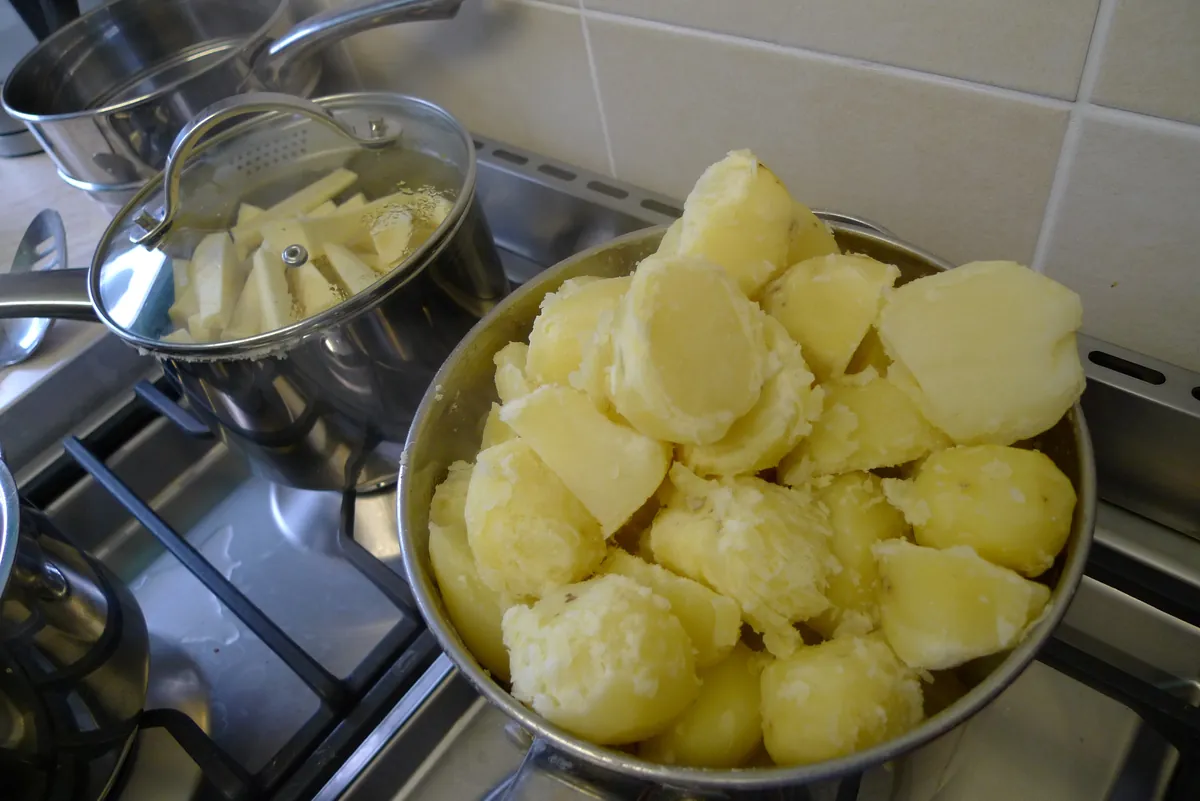
大鍋の沸騰した湯の中でジャガイモが茹でられている場面。野菜を沸騰水で加熱する家庭調理の実施場面を示す。
写っているもの: Solanum tuberosum(ジャガイモ)を沸騰水で加熱する工程部位・状態: 鍋の中で沸騰する湯にジャガイモが浸かっている場面
写真: benjgibbs/ CC BY 2.0/ 原画像/ 台帳の原画像
写真の範囲と来歴
被写体の確認: 原典の記載による同定。
掲載画像: Wikimedia Commons の原寸ファイル。苦味研究所では切り抜き・色調変更なし。 表示用には幅1200px上限のWebPを配信し、台帳の原画像は上のリンクから確認できます。
On this page (7 sections)
Reading the bitterness
Boiling vegetables in water can leach out water-soluble components. Glucosinolates are among them, and certain glucosinolates are known to impart bitterness. A study of broccoli, Brussels sprouts, cauliflower, and green cabbage found no significant decrease in 7 major glucosinolates with steaming, microwaving, or stir-frying, but found a clear decrease with boiling. Another study using Japanese-grown broccoli found no glucosinolate loss with steaming, superheated steam, or vacuum cooking even when the core temperature reached 95°C, supporting the view that the loss is specific to boiling.
Studies differ on why boiling reduces glucosinolates. In one study, about 90% of the lost amount was recovered from cooking water, interpreted as evidence that leaching into water was the main mechanism. In another study using Japanese-grown broccoli, only about 7% of aliphatic glucosinolates and about 18–20% of indole glucosinolates were recovered from the cooking water; the combined amount in cooked vegetables and water remained below the pre-cooking content. Those authors argue that thermal breakdown as well as leaching is involved. Both studies agree that boiling reduces glucosinolates, but the mechanism remains unresolved.
In a 2020 study that boiled cauliflower florets and 4 mm-thick carrot rounds, 300 g each, in stages in 2 L of unsalted boiling water, a principal component analysis combining several instrument measurements linked samples boiled for 10 minutes or longer with electronic-tongue (e-tongue) bitterness, sourness, and astringency variables. This is an instrument response from water extracts measured with artificial lipid-membrane sensors, not a sensory test showing an increase in bitterness perceived by people or the significance of that difference.
In a study that boiled spinach in 1% saline at 5, 7, 10, and 20 times its weight for 1 minute and then rinsed it in water for a total of 5 minutes, there was no significant difference among the water volumes in color, flavor, texture, egumi, or overall evaluation by 12–14 women. The amount of oxalic acid remaining in the spring-harvested sample was about 61% of the raw amount with 5 times water and about 45% with 20 times water, but even with this difference, there was no significant difference in the sensory evaluation of egumi. This is an example in which a difference in chemical quantity does not necessarily translate into a difference in sensation.
In the published abstract of a study in which 82 children aged 5–6 evaluated broccoli and cauliflower, boiled samples had lower flavor and taste intensity than steamed samples, but there was no difference in overall acceptability. Across 3 stages of heating time spanning 2–14 minutes, the intermediate heating time was preferred over the short and long ones. Taste intensity and liking are separate scales, and this result, too, does not compare bitterness alone.
Sources for this overview
Effect of storage, processing and cooking on glucosinolate content of Brassica vegetables
Checked for this overview: Checked the significant decreases and nonsignificant results by cooking method. / Checked the leaching-focused interpretation based on recovering about 90% in cooking water.
Taste and Flavor Perceptions of Glucosinolates, Isothiocyanates, and Related Compounds
Checked for this overview: Evidence in the compound-glucosinolates brief: checked the review statement that certain glucosinolates impart bitterness.
Checked for this overview: Checked the finding of no loss with steam, superheated steam, or vacuum cooking. / Checked the finding that only 7–20% was recovered from cooking water and the argument for a contribution from breakdown.
Checked for this overview: Used for the sample shape and amount, water volume, heating time, the link to electronic-tongue variables in a principal component analysis combining several instrument values, and the limitation that this is not human sensory evaluation or a test of significance.
ゆで水量の違いがホウレンソウの食味やシュウ酸ならびにカリウム含量に及ぼす影響
Checked for this overview: Used for the conditions of 5–20 times water, 1% salt, 1 minute of heating and 5 minutes of rinsing in water, 12–14 women, and no significant difference in the 5 sensory items. / Used for the separation between the oxalic acid retention rate of the spring-harvested sample and the finding of no significant difference in egumi sensory evaluation even with a difference in chemical quantity. The original value of about 100 mg% is kept only in the evidence.
Cooking time but not cooking method affects children’s acceptance of Brassica vegetables
Checked for this overview: Used for the 82 children aged 5–6, 2 vegetables, boiling/steaming, and 3-stage heating times found in the published abstract, the separation between flavor/taste intensity and overall acceptability, and the limitation that this is not bitterness alone.
Follow the connections
boiling of vegetables →reduces→ glucosinolates →are not uniformly→ bitterness
Structured claims — open a section to read each claim's confidence, evidence and limits
Sensory (3)
Scope: Buratti et al. 2020; 2 trials run on separate days; duplicate measurement of water extracts with a Taste-Sensing System SA 402B and PCA.
Note: Not a sensory test in which people tasted the samples. This is a characterization on the PCA, and it does not show a significant amount of increase in bitterness or an effect that generalizes to vegetables in general.
Show data
process-vegetable-boiling —has_sensory_response→ "In a test that boiled cauliflower florets and carrot rounds, 300 g each, in stages in 2 L of unsalted boiling water, samples boiled for 10 minutes or longer showed a PCA configuration linked to electronic-tongue bitterness, sourness, and astringency variables."Scope: Izumi et al. 2005; 12–14 female students and female faculty/staff aged from 19 to their 50s; 1% saline; heated for 1 minute after being added; rinsed in water for a total of 5 minutes; 5-point evaluation.
Note: Not a bitterness scale but 「えぐ味」 (egumi). The decrease is a tendency, not a significant difference, and it is not generalized across seasons.
Show data
process-vegetable-boiling —has_sensory_response→ "In a sensory test that boiled spring and autumn spinach in hot water at 5, 7, 10, and 20 times its weight, there was no significant difference among the water volumes in color, flavor, texture, egumi, or overall evaluation, and flavor and overall evaluation tended to decrease as the water volume increased."Scope: Poelman et al. 2013; 6 preparations from 2 vegetables × boiling/steaming × 3 heating times (2–14 minutes); children's liking evaluation and a trained descriptive panel.
Note: Confirmed only from the published abstract. Covers combined flavor/taste intensity and acceptability, not bitterness intensity alone. The intermediate time's specific value and full conditions per vegetable are unconfirmed from the full text.
Show data
process-vegetable-boiling —has_sensory_response→ "In the published abstract of a study in which 82 children aged 5–6 evaluated broccoli and cauliflower, boiled samples had lower flavor and taste intensity than steamed samples, but there was no difference in overall acceptability, and an intermediate heating time was preferred over the short and long heating times."How processing and cooking change it (3)
Scope: Broccoli, Brussels sprouts, cauliflower, and green cabbage. 7 major glucosinolates quantified by LC-MS/MS
Show data
process-vegetable-boiling —reduces→ compound-glucosinolatesScope: Heating experiments on Brassica vegetables (differences in material, cutting, and target temperature between studies may contribute to the divergence)
Note: The phenomenon (boiling reduces the amount) agrees between the two studies. Only the mechanism is contested.
Show data
process-vegetable-boiling —has_currently_proposed_mechanisms→ "Mechanism of glucosinolate loss from boiling: leaching (about 90% of the amount lost recovered from the boiling water) versus involvement of thermal degradation (boiling-water recovery reaching only about 7% for aliphatic and 18-20% for indolyl types, the total falling short of 100%) — contested between studies"Scope: Izumi et al. 2005; harvested in Sendai in May 2003, cultivar 「アルタイル」 (Altair); HPLC analysis with 6 replicates and sensory evaluation by 12–14 people.
Note: An example in which a difference in chemical quantity cannot simply be read as a difference in perception. This is not a measurement of bitterness.
Show data
process-vegetable-boiling —has_composition→ "The amount of oxalic acid remaining in spring-harvested spinach was about 61% of the raw amount with 5 times water and about 45% with 20 times water, but even with a difference of about 100 mg% in free oxalic acid between the two conditions, there was no difference in the sensory evaluation of egumi."