aromatic cocktail bitters
ingredient / ingredient-aromatic-bitters
芳香ビターズ(カクテルビターズ) / aromatic cocktail bitters (type)
Aromatic cocktail bitters: a category of highly concentrated flavoring liquids made by extracting plant materials with alcohol and added in small amounts to cocktails to impart aroma and flavor (including Angostura-type aromatic bitters and orange bitters). Individual trademarked brands are not made into entities.
Photographs (captions in Japanese)
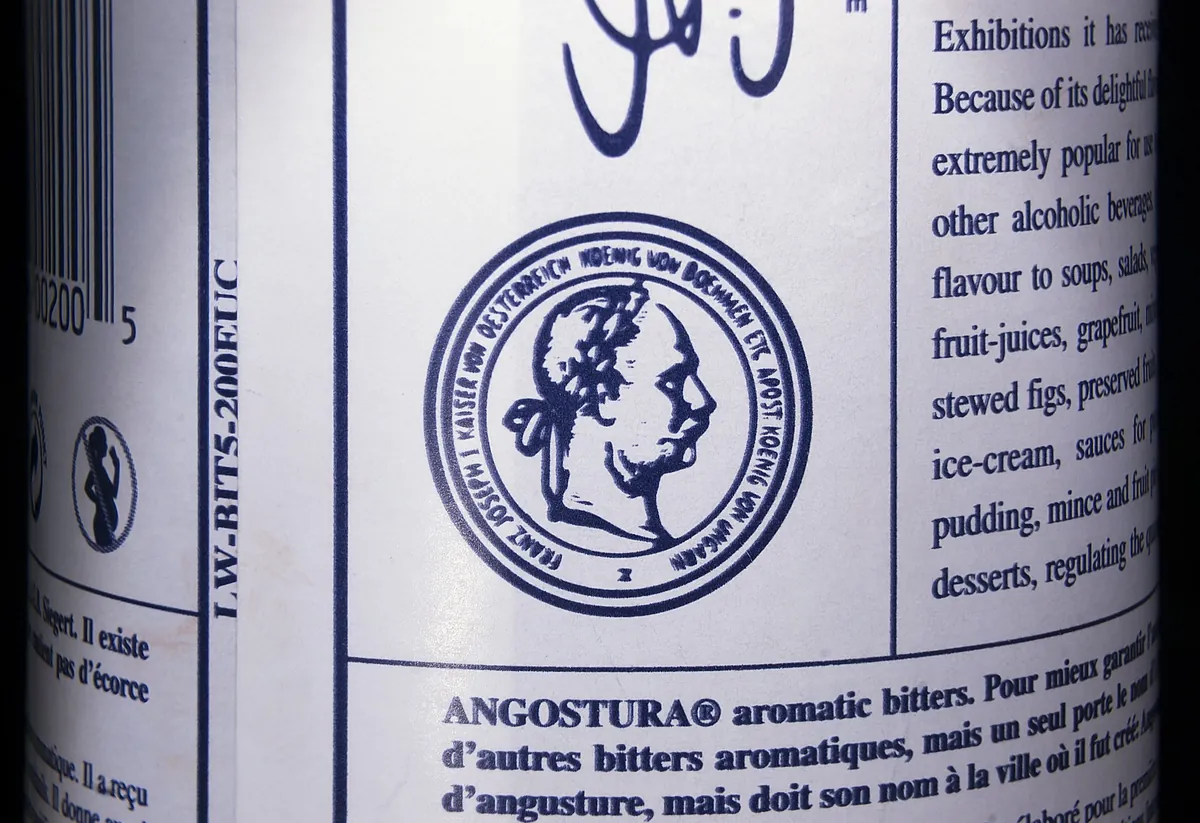
アンゴスチュラ・アロマティック・ビターズの瓶。植物材料のアルコール抽出により作られる高濃度芳香ビターズ類型の、実在する代表的な商品例として撮影されている。
写っているもの: 該当なし(調味液の製品瓶)部位・状態: 製品瓶
写真: Didier Descouens/ CC BY-SA 3.0/ 原画像/ 台帳の原画像
写真の範囲と来歴
被写体の確認: 原典の記載による同定。ラボの命名方針により銘柄そのものはエンティティ化していないが、写真は類型の代表実例として採用。
掲載画像: Wikimedia Commons の原寸ファイルを sips で長辺2400pxに縮小。苦味研究所では切り抜き・色調変更なし(リサイズのみ)。 表示用には幅1200px上限のWebPを配信し、台帳の原画像は上のリンクから確認できます。
On this page (9 sections)
Reading the bitterness
Aromatic bitters (cocktail bitters) are a category of highly concentrated flavoring liquids made by extracting plant materials with alcohol and added in very small amounts to cocktails to impart aroma and flavor. They include Angostura-type aromatic bitters and orange bitters; individual trademarked brands themselves are outside this entry's scope. The reference work 『The Oxford Companion to Spirits & Cocktails』 (2021) lists gentian root, cinchona bark, and wormwood as representative bittering ingredients. A 2015 study subjected 16 commercial bitters brands to gas chromatography–mass spectrometry (GC-MS), tentatively identified 148 volatile compounds, and reported significant differences among brands in citrus, celery, and spice aroma attributes in descriptive sensory evaluation. The study did not measure bitterness intensity itself.
In its May 13, 1806 issue, The Balance, and Columbian Repository, a newspaper in Hudson, New York, answered a reader's question 『cock tailとは何か』 (in translation: "What is a cock tail?") by defining a cocktail as 『あらゆる種類の蒸留酒・砂糖・水・ビターズから成る刺激性の飲み物』 (in translation: "a stimulating drink consisting of spirits of any kind, sugar, water, and bitters") and adding that it was also colloquially called 『bittered sling』 (in translation: "bittered sling"). The source treats this 1806 account as one of the earliest definitions of cocktail, whereas the earlier examples from 1798 and 1803 only show the word in use without defining it. This finding was checked through an article reproducing a facsimile of the newspaper page; the original paper itself was not viewed directly.
Angostura's official website presents the company's account that its founder, Dr. Johann Gottlieb Benjamin Siegert, moved to Angostura (now Ciudad Bolívar), Venezuela, as surgeon general of Simón Bolívar's army, completed the formula 『アマルゴ・アロマティコ』 (in translation: "Amargo Aromatico") in the course of his military medical practice, and that production subsequently moved to Trinidad in his sons' generation. This is the company's own history, not independent verification of the historical events by a third party. In a statement for the company's 200th anniversary (2024), Trinidad and Tobago's Ministry of Trade and Industry stated that its products circulated in more than 170 countries and territories, accounted for 8% of the country's food and beverage export value during 2019–2023, and remained among its top 10 exported products.
A historical article records that when Britain tightened taxation and licensing of gin sales in the 18th century, sellers began adding herbs and selling gin as a 『医療用リキュール』 (in translation: "medicinal liqueur") to evade those rules, and that the method recurred in various countries whenever liquor was regulated. In the United States, Hostetter's Stomach Bitters, launched in Pittsburgh around 1852–1853, is treated as a representative example. Its advertisements at the time claimed efficacy for a range of ailments; this reports a historical advertising claim, not present-day efficacy. The U.S. Pure Food and Drug Act of 1906 required disclosure of alcohol and other ingredients' content, and records of subsequent government analyses judged Hamburg Stomach Bitters 『砂糖水に香味料を加えた酒に過ぎない』 (in translation: "nothing more than liquor made from sugar water with flavoring added") and Kaufmann's Sulfur Bitters' efficacy claims 『虚偽かつ不正』 (in translation: "false and fraudulent"). By contrast, in 1997 the California State Board of Equalization found that Angostura bitters, a concentrate used in small amounts for flavoring, did not qualify as 『飲用に供しうる』 (in translation: "fit for beverage purposes") and was therefore outside the state's alcoholic beverage tax.
Sources for this overview
The Oxford Companion to Spirits and Cocktails — “bitters” entry
Checked for this overview: Confirmed the reference work identifies gentian root as a core bittering ingredient. / Confirmed the reference work identifies cinchona bark as a core bittering ingredient. / Confirmed the reference work identifies wormwood as a core bittering ingredient.
Volatile and sensory profiling of cocktail bitters
Checked for this overview: Checked the overview of GC-MS and descriptive sensory evaluation of 16 brands.
Checked for this overview: Checked the facsimile showing the 1806 newspaper's definition of cocktail.
Checked for this overview: Checked the founder's history as presented on the company's official website.
Minister Gopee-Scoon Congratulates Angostura on its bicentennial anniversary
Checked for this overview: Checked the 8% export share cited in the Trinidad and Tobago government statement.
Checked for this overview: Checked the historical account of evading taxation by selling medicinal liqueurs. / Checked the post-enactment government analysis and its finding of false labeling.
Checked for this overview: Checked the provisions of the 1906 Act requiring disclosure of ingredient content.
Re: Angostura bitters (opinion letter on Alcoholic Beverage Tax applicability)
Checked for this overview: Checked California's 1997 finding that the product was outside the scope of its alcoholic beverage tax.
Follow the connections
cocktail →is defined in that context …→ aromatic cocktail bitters
aromatic cocktail bitters →is flavoured with→ gentian root →— sensory attribute→ bitterness
aromatic cocktail bitters →is flavoured with→ Cinchona succirubra (bark extract) →— sensory attribute→ bitterness
Hypotheses and recipe candidates for this entry are on the Japanese page.
Structured claims — open a section to read each claim's confidence, evidence and limits
Composition and content (3)
Scope: Aromatic bitters for cocktails, in general.
Note: A general statement from a reference-book entry, not an analytical value showing any individual brand's formulation.
Show data
ingredient-aromatic-bitters —is_flavoured_with→ ingredient-gentian-rootScope: Aromatic bitters for cocktails, in general.
Note: A general statement from a reference-book entry, not an analytical value showing any individual brand's formulation. Because this differs in character from the existing ingredient-cinchona-extract entity (defined under Japan's existing food-additive list), it is linked via object_entity_id while keeping the two descriptions distinct.
Show data
ingredient-aromatic-bitters —is_flavoured_with→ ingredient-cinchona-extractScope: Aromatic bitters for cocktails, in general.
Note: This is a general description in a reference entry, not an analytical measurement of the composition of an individual brand.
Show data
ingredient-aromatic-bitters —is_flavoured_with→ ingredient-wormwoodSensory (1)
Scope: 16 commercially available cocktail bitters on the US market (types that are added in small amounts to cocktails as alcoholic extracts of plant materials)
Note: This study centres on aroma profiles and does not quantify bitter (taste) intensity. A primary analysis of the bittering plants in bitters (gentian and others) has not yet been checked.
Show data
ingredient-aromatic-bitters —has_characterized_volatile_and_sensory_profile_of→ "GC-MS of 16 commercial brands tentatively identified 148 volatile compounds. Descriptive sensory evaluation found significant differences among brands in citrus, celery, and spice attributes. PLS analysis found that the correlation between volatile compounds and sensory attributes explained 60% of total variation."Safety and regulation (3)
Scope: California, 1997
Note: This classification is based on administrative opinions from a single state and at a single point in time, and does not generalize to other states or years.
Show data
ingredient-aromatic-bitters —is_classified_by→ "In an opinion dated November 12, 1997, the California State Board of Equalization applied the definition of 『アルコール飲料』 (in translation: "alcoholic beverage") in Section 23004 of the Business and Professions Code, which requires a product to be 『飲用に供しうる(fit for beverage purposes)』 (in translation: "fit for beverage purposes"). It concluded that although Angostura bitters has a high alcohol content, it is a concentrate used in very small amounts for flavoring and does not meet the criterion 『飲用に供しうる』 (in translation: "fit for beverage purposes"); it therefore falls outside the state's Alcoholic Beverage Tax under Section 32001 et seq. of the Revenue and Taxation Code."Scope: United States; enacted June 30, 1906.
Show data
ingredient-aromatic-bitters —is_subject_to_labeling_requirement_of→ "Section 8 of the U.S. Pure Food and Drug Act (34 Stat. 768), enacted June 30, 1906, provides that a product containing alcohol, morphine, opium, cocaine, heroin, or similar substances is misbranded if the amount or proportion is not declared."Scope: United States, from 1906 onward.
Note: [Discourse note] This is a record of the historical fact that a specific brand's labeling was ruled false; this project does not evaluate the effects of that brand or of any current product.
Show data
ingredient-aromatic-bitters —has_history→ "The historical article states that, after the 1906 law came into effect, a government chemical analysis found Hamburg Stomach Bitters to be "nothing more than an alcoholic drink with a small amount of flavoring added to sugar water," and ruled Kaufmann's Sulfur Bitters' labeling — which made claims regarding diabetes and syphilis — to be "false and fraudulent." It records that Hostetter's Stomach Bitters responded by lowering its alcohol content, and that during Prohibition, increasing the herbal content made the flavor "almost unbearable," and the article attributes to this a resulting slump in sales (the brand itself, the article states, survived until 1958)."Culture (4)
Scope: Hudson, New York, United States, 5/13/1806.
Show data
concept-cocktail —is_defined_in_context_as→ ingredient-aromatic-bittersScope: Venezuela → Trinidad and Tobago
Note: [Note on attribution] This company history comes from its official website and is included as the company's own account. It has not been independently verified against third-party historical sources.
Show data
ingredient-aromatic-bitters —has_history→ "Angostura's official website gives the company's own account that its founder, Dr. Johann Gottlieb Benjamin Siegert (「ヨハン・ゴットリープ・ベンヤミン・シーガート」; in translation: "Johann Gottlieb Benjamin Siegert"), moved from Germany to Angostura (now Ciudad Bolívar) in Venezuela as surgeon general of Simón Bolívar's army, and completed the formula 『アマルゴ・アロマティコ』 (in translation: "Amargo Aromatico") in the course of his work as a military doctor. Production is described as having moved to Trinidad in his sons' generation and as continuing there to the present."Scope: Trinidad and Tobago, 2019–2023 (statement issued in 2024).
Note: This is a reference to statistics in a government press release, not the original tabulation of trade statistics.
Show data
ingredient-aromatic-bitters —has_cultural_role_of→ "In a statement celebrating Angostura's 200th anniversary (2024), Trinidad and Tobago's Ministry of Trade and Industry described its products as emblematic national exports distributed in more than 170 countries and territories (including the United States, the Netherlands, South Africa, China, and South Korea). The ministry stated that aromatic bitters accounted for 8% of the country's food and beverage export value from 2019 to 2023 and remained among its top 10 exports."Scope: England to the United States, 18th-19th centuries.
Note: [Discourse note] The advertised claims are a record of period advertising language, and we do not assert that any such effect exists today.
Show data
ingredient-aromatic-bitters —has_history→ "The historical article records that, when taxation and licensing restrictions on gin sales tightened in 18th-century England, sellers began adding various herbs and marketing the product as a 'medicinal liqueur' to get around the restrictions — a technique later reused repeatedly whenever alcohol-distribution regulation tightened in several countries. In the United States, Hostetter's Stomach Bitters, launched around 1852-1853 in Pittsburgh by David Hostetter and George W. Smith, is cited as a representative example; the early product had a high alcohol content (the article states as much as 47%), and it advertised claimed effects for a wide range of ailments, from indigestion to low spirits."