Cinchona succirubra (bark extract)
ingredient / ingredient-cinchona-extract
キナ抽出物
Cinchona succirubra (bark extract) is an extract obtained from red cinchona bark, with quinidine, quinine, and cinchonine as its principal components (according to the definition of Item 83 in Japan's List of Existing Food Additives). It is used in drinks and other products to impart bitterness.
Photographs (captions in Japanese)
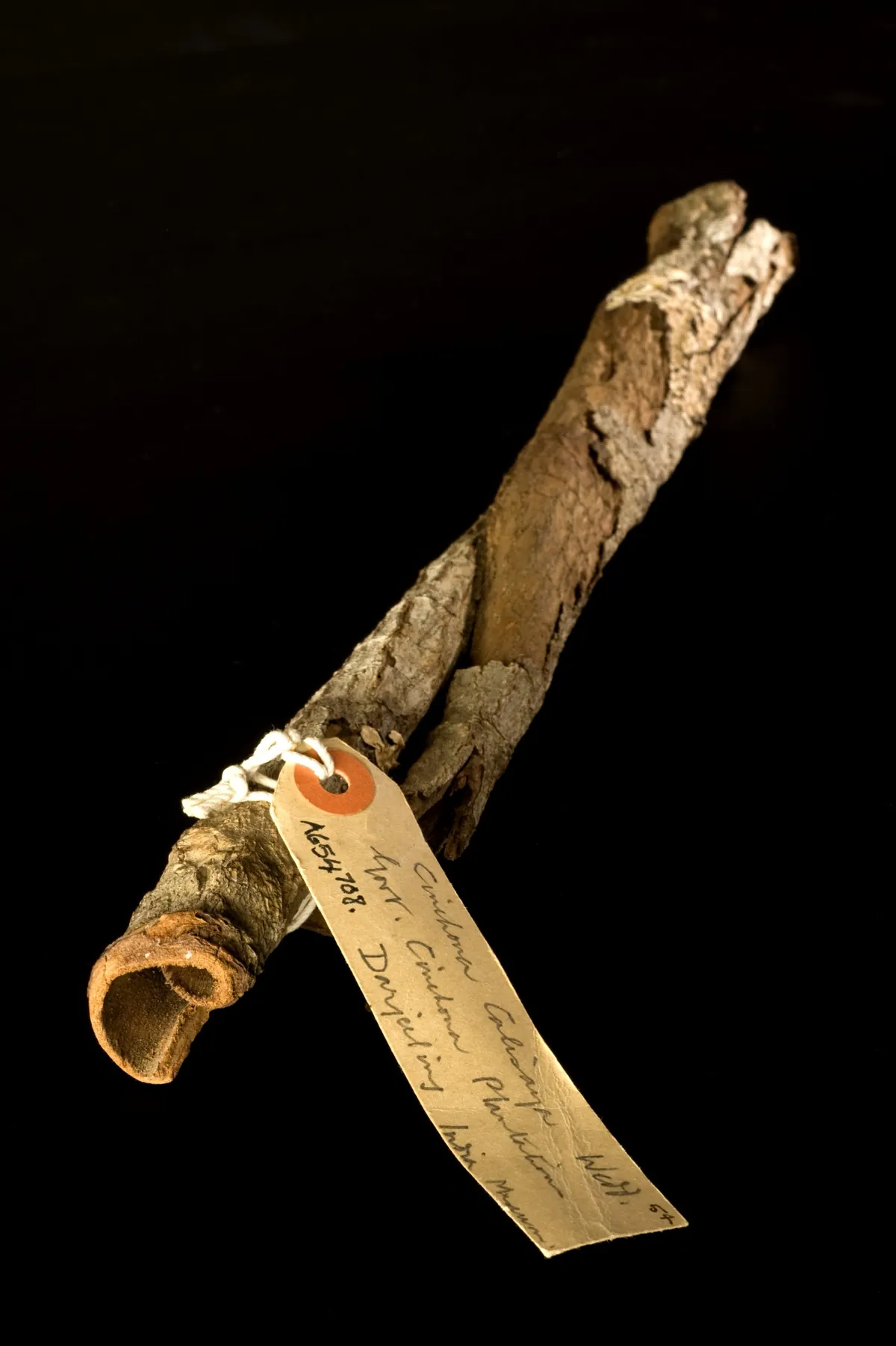
1860〜1910年頃、インドの英領キナ農園で採取・保管されたキナ樹皮の巻き標本。ウェルカム・コレクション所蔵の博物館標本写真で、液体の抽出物ではなく樹皮原料そのものを写している。
写っているもの: Cinchona sp.(原典表記は“Cinchona Calaysia”、種の学術的同定は原典に記載なし)部位・状態: 巻いた樹皮片の標本(1860〜1910年頃、インド産、博物館標本)
写真: Unknown maker; digitized by Wellcome Collection/ CC BY 4.0/ 原画像/ 台帳の原画像
写真の範囲と来歴
被写体の確認: 原典の記載による同定。entities.csv の学名欄は Cinchona succirubra (bark extract) だが、原典ラベルは “Cinchona Calaysia” 系統としており、種同定の一致は確認できていない。抽出物(extract)そのものではなく樹皮標本を写した写真である点に留意。
掲載画像: Wikimedia Commons の原寸ファイルを取得後、苦味研究所にて sips で長辺2400px程度に縮小。切り抜き・色調変更なし。 表示用には幅1200px上限のWebPを配信し、台帳の原画像は上のリンクから確認できます。
On this page (9 sections)
Reading the bitterness
Japan's List of Existing Food Additives (Ministry of Health and Welfare Notification No. 120 of April 16, Heisei 8) includes, as Item 83, 『キナ抽出物(アカキナの樹皮から得られた、キニジン、キニーネ及びシンコニンを主成分とするものをいう。)』 (in translation: "cinchona extract, obtained from red cinchona bark, with quinidine, quinine, and cinchonine as its principal components"). The list gives only the item name and definition; it does not set standards for the foods in which it may be used or amounts of use.
Treccani's china entry says the history of cinchona bark in Europe begins in the early 17th century. A 1638 anecdote in which General López sent powdered cinchona bark to the Countess of Chinchón is described there as the origin of the common name 『伯爵夫人の粉』 (in translation: "the Countess's powder"); the entry also describes its subsequent spread in Europe through the Jesuits. This is a history of introduction as told by the encyclopedia, not a verification that the anecdote itself is historically true.
The bitters entry in The Oxford Companion to Spirits & Cocktails lists gentian, cinchona bark, and wormwood as representative core bittering ingredients in bitters. The reference work places cinchona extract among the ingredients that make up such bitter drinks.
Sources for this overview
Checked for this overview: Checked the wording of Item 83 in the List of Existing Food Additives.
Checked for this overview: Checked the introduction history and Countess of Chinchón anecdote in Treccani's china entry.
The Oxford Companion to Spirits and Cocktails — “bitters” entry
Checked for this overview: Checked the list of core bittering ingredients in the Oxford Companion's bitters entry.
Follow the connections
vino chinato →is defined in a dictionary …→ Cinchona succirubra (bark extract)
aromatic cocktail bitters →is flavoured with→ Cinchona succirubra (bark extract)
Aperol →is flavoured with→ Cinchona succirubra (bark extract)
Cinchona succirubra (bark extract) →— sensory attribute→ bitterness →can be measured separately …→ astringency
Cinchona succirubra (bark extract) →differs from→ gentian root →— sensory attribute→ bitterness
Structured claims — open a section to read each claim's confidence, evidence and limits
Composition and content (2)
Scope: Aromatic bitters for cocktails, in general.
Note: A general statement from a reference-book entry, not an analytical value showing any individual brand's formulation. Because this differs in character from the existing ingredient-cinchona-extract entity (defined under Japan's existing food-additive list), it is linked via object_entity_id while keeping the two descriptions distinct.
Show data
ingredient-aromatic-bitters —is_flavoured_with→ ingredient-cinchona-extractScope: The Aperol official FAQ (the company's own description).
Note: Connected to the existing ingredient-cinchona-extract entry. A direct containment relationship with the existing compound-quinine entry cannot be confirmed from Aperol's official page (we do not make that connection here on the basis of the general-knowledge equation cinchona bark = quinine).
Show data
ingredient-aperol —is_flavoured_with→ ingredient-cinchona-extractSensory (2)
Scope: Codex medicamentarius Gallicus, 1908 edition (Internet Archive item codexmedicamenta0000phar), the relevant body-text entry
Note: A sequential taste description for the yellow cinchona extract: "sweet at first, then a weak bitterness." The same pharmacopoeia's "EXTRAIT DE QUASSIA" entry uses the stronger expression "saveur très amère" (in translation: "a very bitter taste").
Show data
ingredient-cinchona-extract —has_sensory_attribute→ sensation-bitterScope: The CHINA (yellow and red cinchona bark) entry in the 2nd (1902) and 3rd (1909) editions of the Farmacopea Ufficiale
Note: The same statement as the first edition's (1892) CHINA entry, "sapore amaro", is confirmed again in the 1902 and 1909 editions. In the 1909 edition, both the yellow and red cinchona varieties each carry their own "Sapore amaro" entry.
Show data
ingredient-cinchona-extract —has_sensory_attribute→ sensation-bitterSafety and regulation (2)
Scope: Japan; List of Existing Food Additives (Ministry of Health and Welfare Notification No. 120, April 16, Heisei 8)
Show data
ingredient-cinchona-extract —is_listed_in_japan_existing_food_additives_list→ "No. 83, 「キナ抽出物(アカキナの樹皮から得られた、キニジン、キニーネ及びシンコニンを主成分とするものをいう。)」 (in translation: "cinchona extract [refers to a substance obtained from red cinchona bark, whose main components are quinidine, quinine, and cinchonine]")"Scope: Full text of the ANSM public PDF (china-rubra-quinquina-rouge-pph.pdf); in force as of 2026-09-04
Note: A source that does not speak of bitterness (a negative finding). It shows that the taste description itself — where the 1908-edition Codex described the cinchona preparation's properties as "faiblement amère" — has been lost from the equivalent current monograph.
Show data
ingredient-cinchona-extract —differs_from→ ingredient-gentian-rootCulture (2)
Scope: Treccani encyclopedia, entry "china" (Enciclopedia Italiana)
Note: [Discourse note] 'eupeptico,' 'stimulant,' and 'stomachic' are a paraphrase of the dictionary's (an old Enciclopedia Italiana entry's) classificatory description; this project is not verifying or asserting any pharmacological effect. Because this source differs in character from the existing ingredient-cinchona-extract entry (Japan's List of Existing Food Additives definition), the two are connected via object_entity_id without conflating their descriptions.
Show data
ingredient-vino-chinato —is_defined_in_dictionary_as→ ingredient-cinchona-extractScope: Treccani encyclopedia, entry "china" (Enciclopedia Italiana)
Note: A paraphrase of 'La storia della china comincia solo al principio del sec. XVII' (in translation: "The history of cinchona bark begins only at the start of the 17th century"). Not a source that verifies the historicity of the anecdote itself, but recorded as the transmission history the encyclopedia records.
Show data
ingredient-cinchona-extract —has_discovery_history→ "The Treccani encyclopedia states that the history of cinchona bark in Europe begins at the start of the 17th century, and records the 1638 anecdote of General López sending the powder to the Countess of Chinchón (the nickname 『伯爵夫人の粉』, in translation: "the Countess's powder"), along with its spread through the Jesuits."