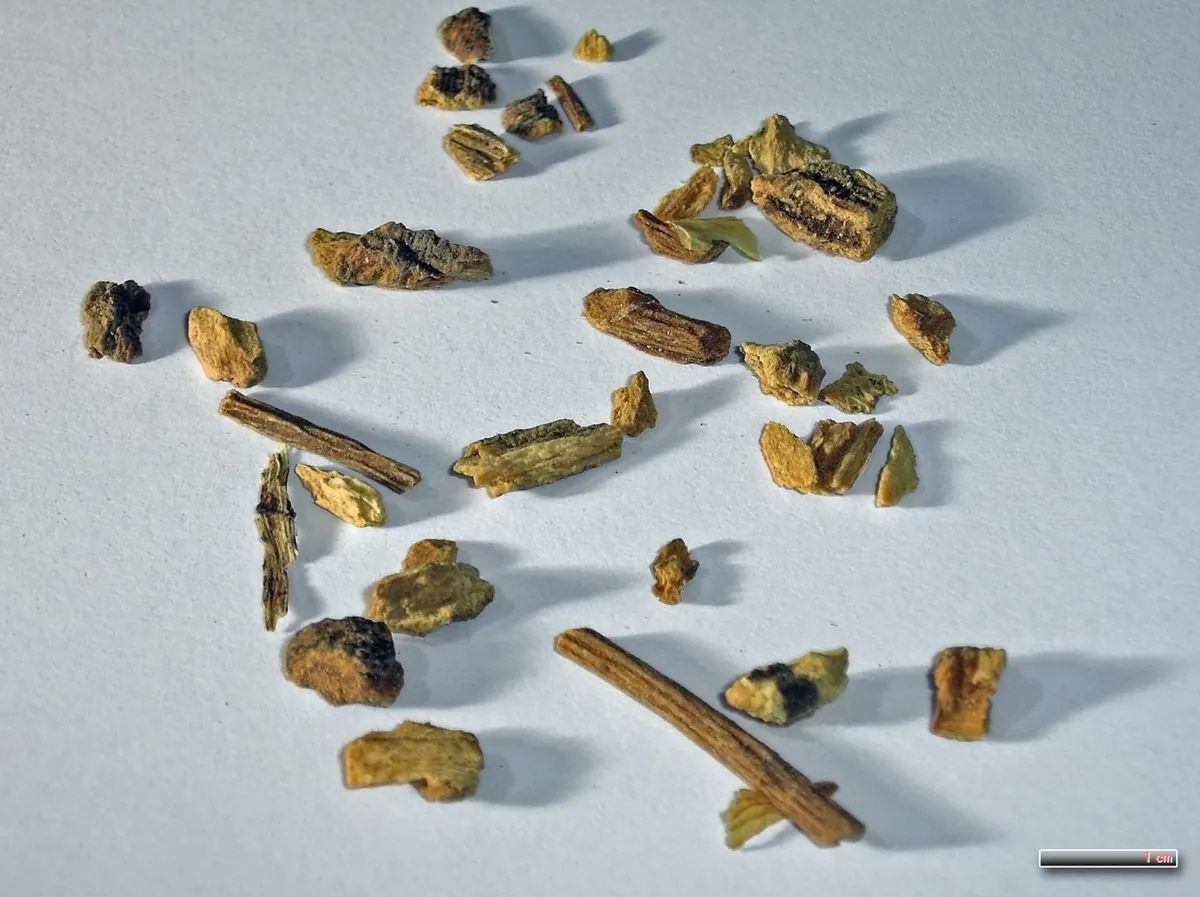
Gentian root is the dried root of yellow gentian in the Gentianaceae family. It contains bitter secoiridoid glycosides such as gentiopicroside and amarogentin and is used as a bitter ingredient in bitter liqueurs, aperitifs, and traditional medicines.
Gentian root is the dried root of yellow gentian (Gentiana lutea L.) in the Gentianaceae family and has long been used to provide bitterness in bitter liqueurs, aperitifs, and traditional medicinal materials. An EU medicines-assessment report gives bitter constituents at 2–8% of the dried root, mostly secoiridoid glycosides. Gentiopicroside is the main constituent, while amarogentin is present separately at only 0.025–0.4%. Content varies with season, root age, and altitude and is described as highest in spring.
According to the same report, gentiopicroside has a bitterness value of 12,000. This value indicates how far a substance can be diluted while people can still perceive its bitterness. Amarogentin, present in much smaller quantity, is described as having a far greater bitterness value, reaching 58,000,000. The root thus contains one compound with an exceptionally high bitterness value and another present in an exceptionally large quantity. This report alone cannot establish which dominates the bitterness that actually lingers in the mouth.
Gentian root also has a history of use as a bitter stomachic intended to stimulate appetite. A 1938 source reports its use as a bitter stomachic and stimulant and describes it as a bitter ingredient in many beverages. The German Kommission E monograph covers material with a bitterness value of at least 10,000 and gives indications for digestive complaints such as loss of appetite, bloating, and flatulence. These are historical and regulatory records of use, not clinical trials proving efficacy.
Committee on Herbal Medicinal Products (HMPC) / 2018 / government document / full text checked
Checked for this overview: Checked the range of bitter constituents at 2–8% and the reported amounts of gentiopicroside and amarogentin. / Checked the stated bitterness value of 12,000 for gentiopicroside. / Checked the traditional use as a bitter stomachic and the Kommission E provisions.
Values are the reported values of each source (with units and conditions). Thresholds and EC50 depend on the panel and method; they are not single true values.
Structured claims — open a section to read each claim's confidence, evidence and limits
Scope: Dried gentian root. Content varies with season, root age, and altitude (highest in spring).
Note: Based on the composition section of an EMA assessment report (a summary of textbook literature).
Bitter constituents are 2-8%, localized mainly in the root bark. Most are secoiridoid glycosides; the main component is gentiopicroside, with amarogentin at 0.025-0.4%. Total content increases with altitude and peaks in spring.
Limitations: Not primary analytical data — a textbook-cited value within a regulatory-authority report.
Scope: The general recipe description in Treccani’s vermut entry.
Note: A general recipe description at encyclopedia level, not analytical values for ingredients in a particular brand.
It describes flavoring and maturing a base wine with an alcoholic herbal infusion of assenzio, centaurea, genziana, thyme, hyssop, marjoram, and others, after adding sugar and alcohol.
Limitations: A general description of a preparation category rather than a particular brand.
Source: vermut - Enciclopedia (Istituto della Enciclopedia Italiana) · full text checked
Show dataingredient-vermouth —is_flavoured_with→ ingredient-gentian-root
Scope: The 1884-edition Codex medicamentarius formula for "Teinture de gentiane alcaline".
"Racine de gentiane en poudre grossière...100 grammes." (in translation: "Coarsely powdered gentian root...100 grams.") is explicitly listed as the main ingredient of Teinture de gentiane alcaline, the reference for Élixir amer de Peyrilhe.
gentian root has a defining sensory theme: A sensory description in which non-crystallizing sugars (zuccheri incristallizzabili) in the roots first produce pleasant sweetness, followed by a strong bitter note.contextual
Scope: A sensory description on the personal or regional blog Sapori del Piemonte.
The source states "La radice contiene degli zuccheri incristallizzabili che caratterizzano la percezione organolettica producendo un'iniziale gusto dolce gradevole a cui succede l'intensa nota amara" (verbatim; in translation: "The root contains non-crystallizing sugars that shape sensory perception, first giving a pleasant sweet taste followed by an intense bitter note").
Limitations: A descriptive introduction, not a sensory-panel or psychophysical measurement.
Show dataingredient-gentian-root —has_defining_sensory_theme→ "A sensory description in which non-crystallizing sugars (zuccheri incristallizzabili) in the roots first produce pleasant sweetness, followed by a strong bitter note."
Scope: Based on the entries GENZIANA and TINTURA DI GENZIANA in the first edition (1892) of the Farmacopea Ufficiale del Regno d'Italia.
States explicitly: "Odore particolare, sapore prima dolciastro, poi amarissimo persistente." (in translation: "A distinctive odor; the taste at first slightly sweet, then a persistent, very bitter taste.")
Limitations: No sensory panel or testing conditions are stated; this is a descriptive expression by the editors of the time.
For the tincture prepared with the ratio "Radice di genziana p.1, Alcool diluito p.5" (gentian root 1 part, diluted alcohol 5 parts), states explicitly: "Color rosso vinoso, sapore molto amaro, di reazione acida" (in translation: "wine-red color, a very bitter taste, acidic reaction").
Note: A direct statement in which the official French pharmacopoeia explicitly gives "amère" (bitter) as a property of the gentian tincture.
Verbatim (as OCR'd; some accent marks are missing in the original): "Caractéres. — Liquide jaune rougeâtre, de saveur amére ne se troublant pas sensiblement par addition de son volume d'eau." (in translation: "Characters. — A yellowish-red liquid, of a bitter taste, not noticeably clouded by the addition of an equal volume of water.")
Limitations: OCR misreadings have garbled some of the spelling (for example, the word corresponding to 'sensiblement' is difficult to make out in places), but the phrase 'de saveur amére' itself was clearly legible.
Scope: Full text of the ANSM public PDF (gentiana-lutea-pph.pdf); in force as of 2026-09-04
Note: Even in the current official French pharmacopoeia, the word "amère" (bitter) is stated explicitly in the description of gentian root's properties.
Verbatim: "La racine de Gentiana lutea L. a une odeur caractéristique, une saveur amère, forte et persistante." (in translation: "The root of Gentiana lutea L. has a characteristic odor, a strong and persistent bitter taste.")
Limitations: The monograph is a specification for homeopathic preparations (mother tinctures), and makes no mention of use in liqueurs or other consumer beverages.
Source: GENTIANA LUTEA POUR PRÉPARATIONS HOMÉOPATHIQUES (ANSM (Agence nationale de sécurité du médicament et des produits de santé) / Autorité française de Pharmacopée, 1989) · full text checked
Show dataingredient-gentian-root —has_sensory_attribute→ sensation-bitter
Scope: The entries GENZIANA and TINTURA DI GENZIANA in the 2nd (1902) and 3rd (1909) editions of the Farmacopea Ufficiale del Regno d'Italia
Note: The same wording as the first edition (1892) of the same entry (the existing claim (w58h4b) on gentian-root bitterness in the 1892 Farmacopea) — "sapore prima dolciastro, poi amarissimo persistente" and "sapore molto amaro" — is confirmed again in the 1902 and 1909 editions, bearing out the continuity. Because the GENZIANA (root) entry in the 1902 edition was hard to read owing to OCR column misalignment, the verbatim confirmation for this claim rests on the TINTURA DI GENZIANA entry ("sapore molto amaro" in both the 1902 and 1909 editions) and the GENZIANA entry ("sapore prima dolciastro, poi amarissimo persistente" in the 1909 edition).
"Odore particolare, sapore prima dolciastro, poi amarissimo persistente" (in translation: "A distinctive odor; the taste at first slightly sweet, then a persistent, very bitter taste"). The same wording as the first edition (1892).
Limitations: There are OCR typesetting errors, but they did not hinder reading the relevant passage.
"Colore rosso-vinoso, sapore molto amaro, di reazione acida; diluita con acqua si intorbida" (in translation: "wine-red color, a very bitter taste, acidic reaction; becomes cloudy when diluted with water").
gentian root is processed by A maceration method in which dried roots are steeped in ethanol for at least 40 days before being combined with sugar and water.contextual
Scope: A household or regional method from Piedmont described on the personal or regional blog Sapori del Piemonte.
Note: Note that this differs in production method from the existing ingredient-gentian-spirit entry (the 『ジェンチアナ・スピリット』 (in translation: "gentian spirit") in EU Regulation 2019/787, Annex I, category 18, a distilled-spirit category made from fermented liquid). The present claim concerns a sweetened regional liqueur made by maceration, a separate category from that spirit drink. The preparation is described directly without assigning it a separate named process.
After the roots are washed, dried, and ground, the source describes their use with ethyl alcohol, sugar, and water and states "messe a macerare in alcool etilico...lasciato a riposo per almeno 40 giorni" (in translation: "placed to macerate in ethyl alcohol ... left to rest for at least 40 days").
Limitations: Specific production parameters such as quantities and temperature are not given, and the source does not clearly distinguish industrial from household methods.
Show dataingredient-gentian-root —is_processed_by→ "A maceration method in which dried roots are steeped in ethanol for at least 40 days before being combined with sugar and water."
gentian root — conservation status: It grows wild in mountain grasslands and subalpine pastures of central and southern Europe, including the Alps and Apennines. The wild plant is described as protected (under wildlife protection), and raw-material production is described as relying mainly on cultivation in Germany and France.contextual
Scope: Background section (1.1) of the EMA (HMPC) assessment report.
"It grows in grassy alpine and sub-alpine pastures, usually on calcareous soils native to the mountains of central and southern Europe. It grows naturally on uncultivated ground in France, Spain and the Balkan mountains. The plant is under wildlife protection; therefore it is cultivated for plant production mostly in Germany and France (Blaschek et al., 2016, Hänsel and Sticher, 2007)."(verbatim)
Limitations: The report itself cites secondary literature and does not identify specific Italian protection laws, such as regional statutes or species designations.
Show dataingredient-gentian-root —has_conservation_status→ "It grows wild in mountain grasslands and subalpine pastures of central and southern Europe, including the Alps and Apennines. The wild plant is described as protected (under wildlife protection), and raw-material production is described as relying mainly on cultivation in Germany and France."
gentian root is documented in Listed as the crude drug 『Genziana(Genziana maggiore)』 (in translation: "gentian (greater gentian)") in the first edition (1892) of Farmacopea Ufficiale del Regno d'Italia, the official pharmacopoeia of the Kingdom of Italy.supported
Scope: Description in the 1892 edition (1a edizione). Continued inclusion in later editions has not been verified.
The first passage reads 『Genziana maggiore ... Gentiana lutea L. (Fam. Gentianeae), erba dei prati delle Alpi e di alcune parti dell'Appennino (Umbria ed Abruzzi). Si adopera la radice.』 (in translation: "Greater gentian ... Gentiana lutea L. (family Gentianeae), a plant of Alpine meadows and parts of the Apennines (Umbria and Abruzzi). The root is used."); it is followed by 『Contiene genziopicrina, gentisina: non contiene amido.』 (in translation: "Contains gentiopicrin and gentisin; contains no starch").
Limitations: The OCR scan has some misread letter forms (for example, 'Genlianu laica'), but the passages quoted above are legible.
Show dataingredient-gentian-root —is_documented_in→ "Listed as the crude drug 『Genziana(Genziana maggiore)』 (in translation: "gentian (greater gentian)") in the first edition (1892) of Farmacopea Ufficiale del Regno d'Italia, the official pharmacopoeia of the Kingdom of Italy."
gentian root is documented as having In the 1837 Codex medicamentarius (French official pharmacopoeia), a tincture using gentian root is listed as 『TEINTURE DE GENTIANE AMMONIACALE』 (in translation: "ammoniacal gentian tincture"); the word 『amer』 (in translation: "bitter") appears in neither its heading nor its description. A full-text search of that edition found no entry corresponding to 『ÉLIXIR AMER DE PEYRYLHE』 (in translation: "Peyrylhe's bitter elixir"). However, immediately after the tincture entry it mentions 『l'Elixir anti-scrophuleux du docteur Perylhe』 (in translation: "Dr. Perylhe's anti-scrofulous elixir"), referring to a related preparation under another name without amer.supported
Scope: Full text of the 1837 Codex medicamentarius (Internet Archive b21700655).
Note: A negative finding: 『ÉLIXIR AMER DE PEYRYLHE』 (in translation: "Peyrylhe's bitter elixir"), included in the 1884 edition (the existing ingredient-elixir-amer-de-peyrilhe entry), is not yet present in the 1837 edition.
The heading is "326. TEINTURE DE GENTIANE AMMONIACALE" (in translation: "326. ammoniacal gentian tincture"). The formula uses gentian root, ammonium carbonate, and alcohol; the word 『amer』 (in translation: "bitter") appears in neither the heading nor the description.
Limitations: Because OCR misreads some numbers and symbols, this evidence row does not quote quantities or prices. The 1837 edition mentions 『l'Elixir anti-scrophuleux du docteur Perylhe』 (in translation: "Dr. Perylhe's anti-scrofulous elixir"); the OCR spelling is Perylhe, and a preparation bearing Peyrilhe's name is referenced without amer in its name.
Source: Codex, pharmacopée française (rédigé par ordre du gouvernement (commission des professeurs de la Faculté de médecine et de l'École de pharmacie de Paris), 1837) · full text checked
Context: A full-text search found no word containing 『peyr』 (in translation: "the letter sequence peyr") (Peyrilhe/Peyrylhe). Nor does 『amer』 (in translation: "bitter") occur within 2 lines before or after any quinquina-related entry, such as TEINTURE DE QUINQUINA or EXTRAIT DE QUINQUINA.
Limitations: This was a mechanical proximity search of 2 lines on either side, so mentions farther away may have escaped it. The 1837 edition mentions 『l'Elixir anti-scrophuleux du docteur Perylhe』 (in translation: "Dr. Perylhe's anti-scrofulous elixir"), spelled Perylhe by OCR; a preparation bearing Peyrilhe's name is therefore referenced without amer in its name.
Source: Codex, pharmacopée française (rédigé par ordre du gouvernement (commission des professeurs de la Faculté de médecine et de l'École de pharmacie de Paris), 1837) · full text checked
Show dataingredient-gentian-root —is_documented_as_having→ "In the 1837 Codex medicamentarius (French official pharmacopoeia), a tincture using gentian root is listed as 『TEINTURE DE GENTIANE AMMONIACALE』 (in translation: "ammoniacal gentian tincture"); the word 『amer』 (in translation: "bitter") appears in neither its heading nor its description. A full-text search of that edition found no entry corresponding to 『ÉLIXIR AMER DE PEYRYLHE』 (in translation: "Peyrylhe's bitter elixir"). However, immediately after the tincture entry it mentions 『l'Elixir anti-scrophuleux du docteur Perylhe』 (in translation: "Dr. Perylhe's anti-scrofulous elixir"), referring to a related preparation under another name without amer."
Scope: Full text of the ANSM public PDF (china-rubra-quinquina-rouge-pph.pdf); in force as of 2026-09-04
Note: A source that does not speak of bitterness (a negative finding). It shows that the taste description itself — where the 1908-edition Codex described the cinchona preparation's properties as "faiblement amère" — has been lost from the equivalent current monograph.
Context: The "CARACTÈRES" section states only Aspect: liquide brun-rouge, and everything after it is limited to specifications for chromatography, ethanol concentration, and the assay method. A full-text search finds no hits at all for any word containing "amer".
Limitations: The definition section requires conformity to the European Pharmacopoeia monograph "Quinquina (0174)", but the content of that European Pharmacopoeia entry itself has not been checked (this evidence line is limited to what the French PPH document itself states).
gentian root — documented traditional use as: Classified as a "bitter stomachic" (a pharmacopoeial term for this category of bittering agent) and appetite stimulant. The German Kommission E monograph (revised 1985/1990) specifies a bitterness value of 10,000 or higher and lists the indications as loss of appetite, bloating, and flatulence.contextual
Scope: A record of use as a traditional herbal medicinal product in Europe (the EU adopted a traditional-use monograph in 2018).
Note: A historical and regulatory-context claim, not a demonstration of effect. We make no recommendation to drink it for this purpose.
Madaus (1938) records its use as a bitter stomachic and stimulant. It is also known as a bittering ingredient in many beverages. The Kommission E monograph specifies a bitterness value of 10,000 or higher, with indications for digestive complaints such as loss of appetite.
Limitations: A record of traditional use, not evidence of effect.
Show dataingredient-gentian-root —has_documented_traditional_use_as→ "Classified as a "bitter stomachic" (a pharmacopoeial term for this category of bittering agent) and appetite stimulant. The German Kommission E monograph (revised 1985/1990) specifies a bitterness value of 10,000 or higher and lists the indications as loss of appetite, bloating, and flatulence."
claim: clm-gentian-root-traditional-bitter-use / type: cultural / updated: 2026-08-31
gentian root — cultural role: The root is described as an ingredient of a regional liqueur in the middle and upper Susa Valley of Turin Province, Piedmont, where both industrial production, mainly for export to France, and household preparation are reported to continue.contextual
Scope: Account on the personal or regional blog Sapori del Piemonte.
Note: This is not a comprehensive academic survey of the region.
The source locates production in "media ed alta Valle di Susa (Torino)" (in translation: "middle and upper Susa Valley, Turin Province") and describes the continuing industrial-scale production, mainly for export to France, alongside homemade methods handed down in many valley households.
Limitations: No author or publication date is given, and this is not a comprehensive regional survey.
Show dataingredient-gentian-root —has_cultural_role_of→ "The root is described as an ingredient of a regional liqueur in the middle and upper Susa Valley of Turin Province, Piedmont, where both industrial production, mainly for export to France, and household preparation are reported to continue."
claim: clm-w25-gentian-susa-valley-tradition / type: cultural / updated: 2026-09-01