fernet
ingredient / ingredient-fernet
フェルネット
Fernet is an aperitivo category of spirits/liqueurs based on extracts of bitter and aromatic plants. Article 1129 of Chapter XIV of the Argentine Food Code (CAA) recognizes FERNET, BITTER, AMARGO, and AMARO as equivalent designations where bitterness predominates, treating them legally as names within the same category. The most widely circulated traditional origin account attributes its creation to the Milan pharmacist Bernardino Branca in 1845, but alternative accounts involving French, Czech, or Swedish physicians also coexist. It is described as arriving in Argentina with Italian immigration in the late 19th century.
Photographs (captions in Japanese)
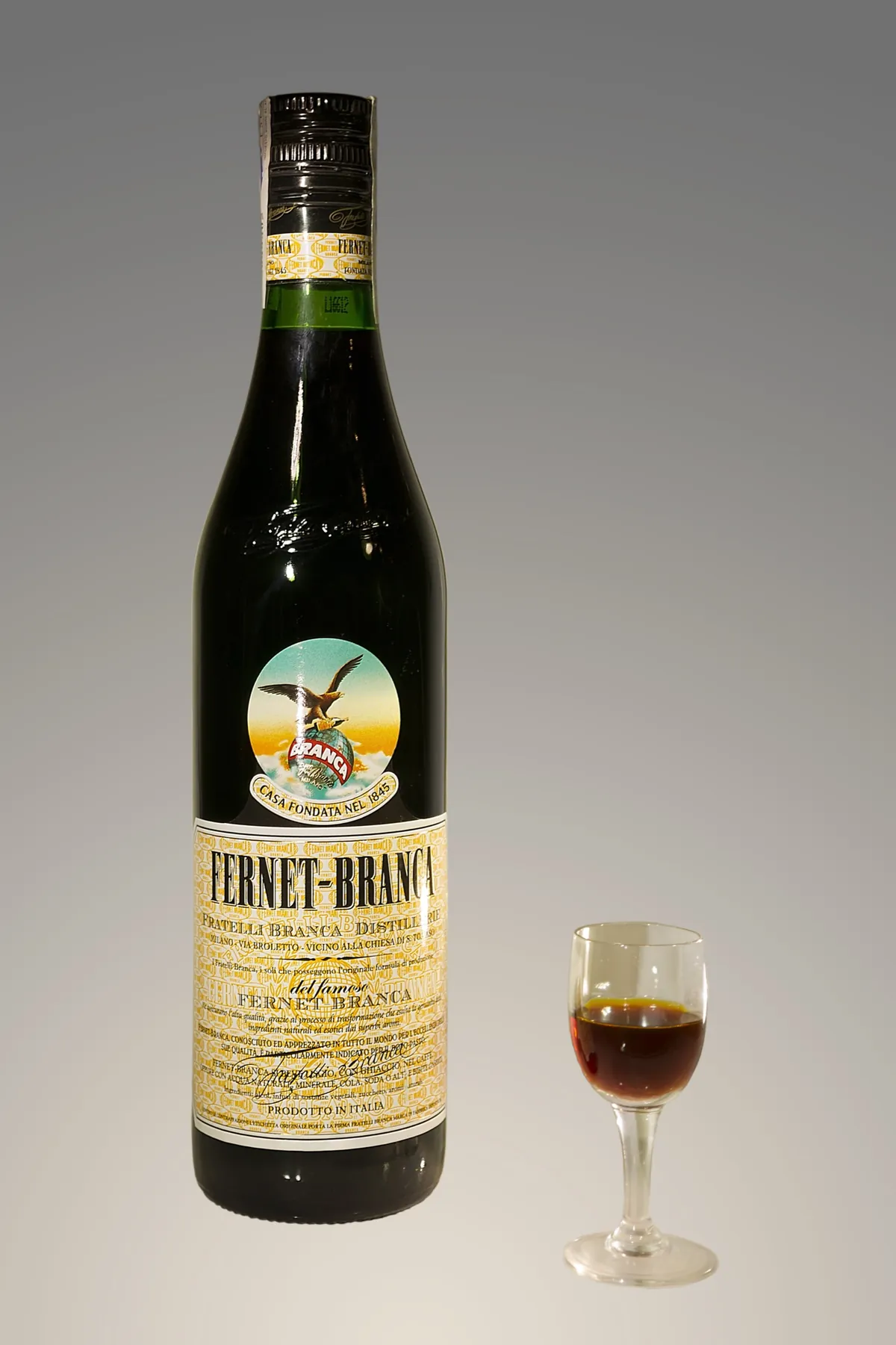
Fernet-Branca(ミラノの薬剤師ベルナルディーノ・ブランカによる1845年創製説が広く流布する苦味系リキュール)700ml瓶のスタジオ撮影。特定銘柄の瓶を被写体としているが、フェルネット全般の代表例として扱う。
写っているもの: 該当分類群なし(Fernet-Branca の瓶)部位・状態: Fernet-Branca 700ml瓶、単体のスタジオ撮影
写真: Didier Descouens/ CC BY-SA 4.0/ 原画像/ 台帳の原画像
写真の範囲と来歴
被写体の確認: 原典の記載による同定。商標登録された銘柄ラベル(Fernet-Branca)が写り込むが、Wikimedia Commonsのライセンスは有効。フェルネット一般を代表する例として扱う。
掲載画像: Wikimedia Commons の原寸ファイルを取得後、苦味研究所にて sips で長辺2400px程度に縮小。切り抜き・色調変更なし。 表示用には幅1200px上限のWebPを配信し、台帳の原画像は上のリンクから確認できます。
On this page (10 sections)
Reading the bitterness
Fernet is a type of spirit or liqueur aperitivo based on extracts of bitter and aromatic plants. Article 1129 of Chapter XIV of the Argentine Food Code (CAA) places FERNET, BITTER, AMARGO, and AMARO on an equal footing as names for products with a predominantly bitter flavor; legally, they are designations in the same category. The article allows an alcohol content of 0.5% to 54% vol at 20°C for aperitivos as a whole; it does not specify separate upper or lower limits for fernet alone. It also limits the alcohol content to 15% vol when served diluted with soda.
Fernet has several competing origin accounts rather than a settled history. The most widely circulated attributes its creation in 1845 to the Milan pharmacist Bernardino Branca; this is an origin account that the manufacturer Fratelli Branca has itself institutionalized. Literature also mentions French and Czech origin accounts and an account attributing its invention to a Swedish doctor surnamed 『フェルネ』 (in translation: "Fernet"); none has been established as historical fact. As for composition, a thesis quoting Ablin (2012) describes it as a dark-colored, strongly aromatic alcoholic beverage made with multiple herbs including myrrh, rhubarb, chamomile, cardamom, and saffron, with an alcohol content described as around 45 degrees. This is a secondary quotation, however, and the original source has not been checked.
Fernet is described as reaching Argentina with Italian immigrants in the late 19th century. In 1925, Hofer & C. in Buenos Aires began local production using extracts sent from the Italian headquarters. Fratelli Branca Destilerías Argentina was then founded in 1941 and opened its own factory on a site of approximately 11,000 square meters in the Parque Patricios district of Buenos Aires. The company itself describes this as the only Fernet Branca production site outside Italy. However, it should be noted that this company history is the manufacturer's own narrative, told from the standpoint of an interested party.
Consumption of fernet in present-day Argentina is markedly concentrated. Córdoba Province has only about 8% of the national population, but the province and its surrounding cities have been reported to account for about a third of national fernet consumption (2015 reporting based on 2013 Kantar Worldpanel data). National output was reported as 56 million litres in 2016, attributed to industry association Cámara Argentina de Destiladores Licoristas (2017 reporting). A 2015 news report also attributed to market-research firm IWSR the claim 『アルゼンチン人は世界のフェルネット生産の4分の3を飲む』 (in translation: "Argentines drink three-quarters of the world's fernet production"). Manufacturer Fratelli Branca itself has disclosed that 90% of its annual output of about 50 million litres is consumed domestically (2017 reporting).
Sources for this overview
Checked for this overview: Confirmed the text of the aperitivo definition in CAA Article 1129. / Confirmed the provision treating FERNET, AMARGO, and the other designations equally. / Confirmed the permitted alcohol range and the upper limit for soda mixtures.
Deleite de la plebe: música, identidad y fernet con coca
Checked for this overview: Confirmed the account that several origin theories coexist. / Confirmed the second-hand description of composition and alcohol content. / Confirmed the immigration route and year local production began.
La empresa (historia de Fratelli Branca en Argentina)
Checked for this overview: Confirmed the company's own history and its dates.
En Córdoba se consume un tercio del fernet del país
Checked for this overview: Confirmed the figures for Córdoba's disproportionate consumption. / Confirmed the statement attributing a world-production share to IWSR.
Quién se ha tomado todo el fernet
Checked for this overview: Confirmed the reported national output of 56 million litres. / Confirmed the company's statement that 90% of its own output is consumed domestically.
Other names: amargo (es)
Follow the connections
Córdoba (Argentina) →— reported consumption share→ fernet
fernet con coca →is prepared through→ fernet
fernet →is associated with→ Italy
Hypotheses and recipe candidates for this entry are on the Japanese page.
Structured claims — open a section to read each claim's confidence, evidence and limits
Composition and content (2)
Scope: Argentina
Note: CAA Article 1129 lists FERNET, BITTER, AMARGO, and AMARO as co-equal designations for "an aperitivo with a predominantly bitter flavour." This is a bridging claim connecting the existing ingredient-amaro entry (describing the Italian-language-sphere category) with the designations placed side by side under Argentine law.
Show data
ingredient-fernet —is_listed_as→ "One of the co-equal designations under Article 1129 of the Argentine Food Code for "an aperitivo with a predominantly bitter flavour" (FERNET, BITTER, AMARGO, and AMARO are listed side by side)."Scope: Argentina
Note: This is a second-hand quotation in a UBA undergraduate thesis, not the primary source itself (Ablin 2012). The original was not checked; it is included here as a second-hand quotation, with verification of the original referred to leads.
Show data
ingredient-fernet —has_documented_traditional_use_as→ "『色が濃く香りの強いアルコール飲料で、没薬・ルバーブ・カモミール・カルダモン・サフランなど複数種のハーブから作られる。度数はおよそ45度』 (in translation: "A dark-colored, strongly aromatic alcoholic beverage made from several herbs, including myrrh, rhubarb, chamomile, cardamom, and saffron, with an alcohol content of about 45 degrees") (a description by Ablin, 2012, quoted in a UBA undergraduate thesis)."How processing and cooking change it (1)
Scope: Argentina
Note: All cited sources take it as given that this drink combines fernet with a cola soft drink. No source directly confirmed a specific mixing ratio (such as the colloquial 『90-10』 (in translation: "90–10")), so no ratio is recorded.
Show data
dish-fernet-con-coca —is_prepared_with→ ingredient-fernetSafety and regulation (2)
Scope: Argentina
Show data
ingredient-fernet —is_defined_in_regulation_as→ "A type of "Aperitivos" (beverages with an alcohol content of 0.5% to 54% vol at 20°C, containing bitter and/or aromatic components to which an appetite-stimulating property may be attributed, obtained from extracts of one or more plants or plant parts permitted under the code), for which the designations FERNET, BITTER, AMARGO, and AMARO are recognized for products with a predominantly bitter flavour."Scope: Argentina
Note: CAA Article 1129 also limits the alcohol content of soda mixtures (such as BITTER SODA) to 15% vol.
Show data
ingredient-fernet —has_permitted_alcohol_range→ "The regulatory range for aperitivos as a whole is 0.5%–54% vol at 20°C. The article does not specify upper or lower limits specific to fernet alone."Culture (6)
Scope: Italy
Note: Recorded as-is the point that the thesis lists multiple accounts side by side while itself noting the caveat 『確定的な情報は十分でない』 (in translation: "there is not enough definitive information").
Show data
ingredient-fernet —has_historical_origin_narrative→ "Multiple competing origin narratives exist side by side. The most widely circulated is the account institutionalized by Fratelli Branca itself, that the Milan pharmacist Bernardino Branca created it in 1845. Others mentioned in the literature include an origin story pointing to France, one pointing to Czechia, and one pointing to a Swedish physician surnamed Fernet (『フェルネ』)."Scope: Argentina
Note: The account of the immigration route is stated consistently, independently, by both a UBA thesis and the manufacturer's own history page (though the company's version is its own self-account). Note that the company is an interested party, and its explanation for why consumption grew — 『顧客が有機的に広めた』 (in translation: "customers spread it organically") — is a narrative favorable to itself.
Show data
ingredient-fernet —has_historical_origin→ "The source states that it arrived in Argentina along with the wave of Italian immigration in the late 19th century. In 1925, Hofer & C. of Buenos Aires began local production using extract sent from the Italian head office. In 1941, Fratelli Branca Destilerías Argentina was established and opened its own factory in the Parque Patricios district of Buenos Aires (a site of about 11,000 m²). According to the company, this is the only Fernet Branca production site outside Italy."Scope: Argentina
Note: 2 different industry association names, Cámara Argentina de Destiladores Licoristas and Cámara Nacional de Destiladores, appear in separate news reports; whether they are variants of one name or distinct organizations has not been determined here. Both figures are mediated by news reports, and neither association's original statistics were obtained (a government market-report PDF from alimentosargentinos.magyp.gob.ar could not be retrieved because of a connection error).
Show data
ingredient-fernet —has_reported_production_volume_of→ "National output in 2016 was reported as 56 million litres (56 millones de litros), attributed to the industry association Cámara Argentina de Destiladores Licoristas (2017 report). A separate 2015 report, citing data from Cámara Nacional de Destiladores, describes production growing severalfold from its level about 10 years earlier to 2013. The units and converted numerical value depend on the article's English processing and could not be settled in this review, so only the growth trend is recorded."Scope: Argentina
Show data
ingredient-fernet —is_reported_as_predominantly_consumed_in→ "Trade-press reports repeatedly state that most of the world's fernet production is consumed in Argentina. A 2015 news article, attributing the figure to the market research firm IWSR (International Wine and Spirit Research), reports 『アルゼンチン人は世界のフェルネット生産の4分の3を飲む』 (in translation: "Argentines drink three-quarters of the world's fernet production"). The manufacturer Fratelli Branca itself has also disclosed that 90% of its roughly 50 million litres of annual production is consumed domestically (2017 news report)."Scope: Argentina/Italy (migration route)
Show data
ingredient-fernet —is_associated_with→ region-italy