Yerba mate infusion is a South American drink brewed from the leaves of Ilex paraguariensis. It contains purine alkaloids such as caffeine and phenolic compounds, and is also used in sensory research as a bitter drink.
Photographs (captions in Japanese)
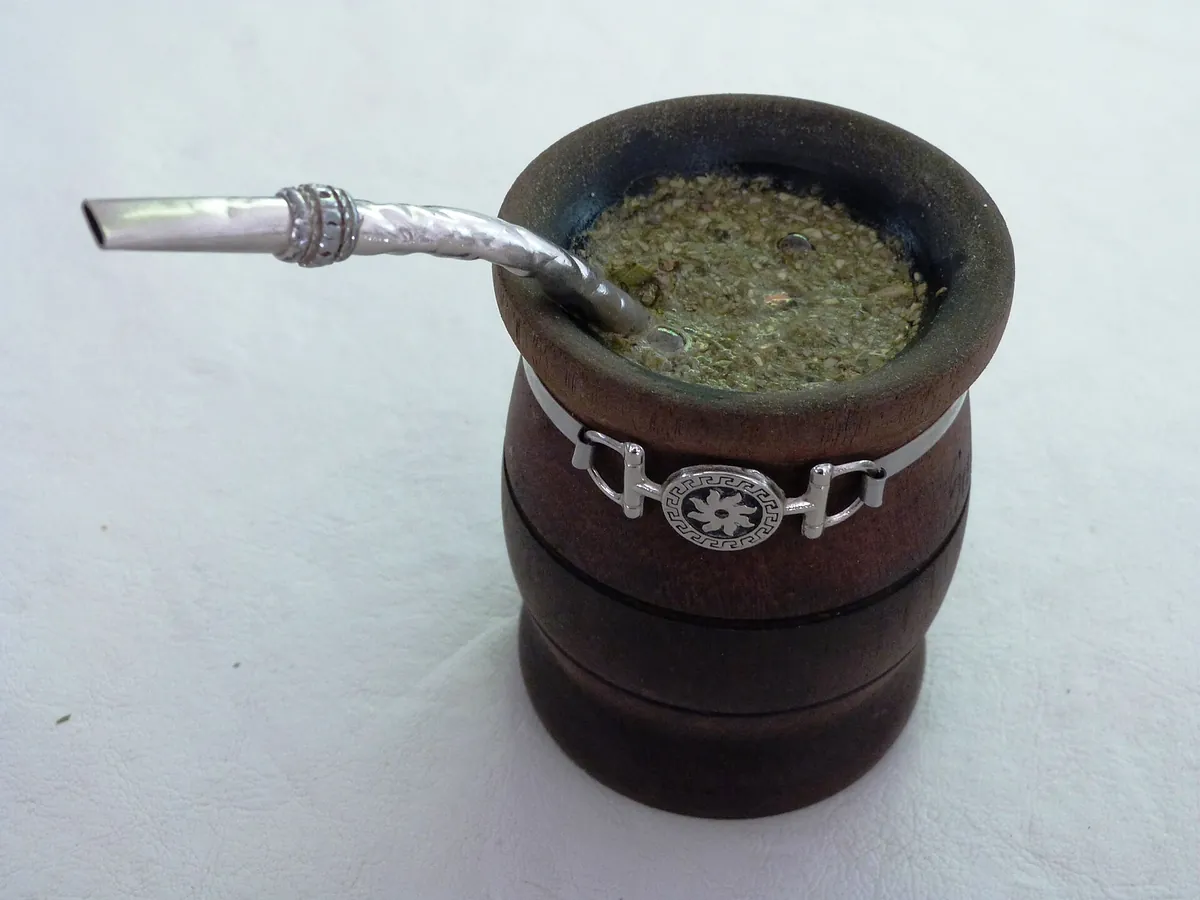
マテ茶(イェルバ・マテの葉を用いた抽出液)を、伝統的な木製のマテ壺に詰め、金属製のボンビージャを差した状態。原典ページは『Infusión nacional criolla(クリオージョ式の国民的インフュージョン)』と記載している。この一杯はアルゼンチンでの淹れ方の一例。
Mate tea is an infusion made by pouring water (usually 65–95 degrees) over roasted, dried, and aged leaves and twigs of the South American tree Ilex paraguariensis; it has been discussed in sensory research as a drink accompanied by bitterness. This drink has been consumed in South America for centuries as part of Indigenous social life, and the manner of drinking it is described as having strict etiquette. Argentina accounts for 54% of production, Brazil 40%, and Paraguay 6%. However, examples have been reported in which commercial products contained the related species Ilex guayusa, so the source species cannot always be established from the name or labeling alone.
The infusion of mate tea contains purine alkaloids such as caffeine, theobromine, and theophylline (a group of compounds often accompanied by bitterness), and its caffeine content is described as close to that of coffee. In sensory research addressing bitterness, mate tea has been used as a representative bitter drink alongside coffee and grapefruit juice, and an effect has been confirmed in which the maximum bitterness increases cumulatively with each sip from the time it is held in the mouth until it is swallowed. However, the abstract of this study does not state a numerical value for the bitterness intensity of mate tea alone.
Płatkiewicz J; Okołowicz A; Frankowski R; Grześkowiak T; Jeszka-Skowron M; Zgoła-Grześkowiak A / 2024 / journal article / full text checked
Checked for this overview: Confirmed the preparation method of roasting, drying, and hot-water infusion. / Confirmed the description of production-country shares and cultural practices. / Confirmed an example in which admixture of a related species prevents the source species from being established. / Confirmed the description of purine-alkaloid composition and caffeine content.
Checked for this overview: Confirmed its positioning as a bitter drink used in sensory research. / Confirmed the cumulative bitterness effect in the bitter-drink category.
Note: The object_entity is caffeine. Theobromine and theophylline are recorded in object_text.
Lists caffeine, theobromine, and theophylline as the purine alkaloids of the infusion, and states in the background section that mate tea's caffeine content is close to that of coffee.
Limitations: The comparison with coffee is a background statement, not a parallel measurement under the same conditions.
Scope: Used as a bitter-beverage category item in a multiple-sip time-intensity study with an Argentine consumer panel
Note: The same study confirmed a cumulative effect in which maximum bitterness intensity increased with each successive sip. The intensity value for mate alone is not given in the abstract.
Used commercial beverages (coffee, mate tea infusion, grapefruit juice) alongside PROP solution as the bitter-product category. Confirmed a cumulative bitterness effect in the multiple-sip evaluation (maximum intensity increased with each sip).
Limitations: The bitterness intensity value and panel size for mate alone are not given in the abstract.
States that the leaves and twigs go through roasting, drying, and aging, and that most commonly hot water at 65-95°C is poured over them and it is drunk through a straw.
Limits: Survey product No. 8 was not Ilex paraguariensis but the closely related Ilex guayusa, and the same paper states that a comparison based on this single product needs confirmation in a separate study. This shows the limitation of settling the raw-material species from name and product labeling alone.
Limitations: I. guayusa is only 1 product; the rate of admixture or mislabeling across the wider market is not shown.
yerba mate infusion is defined in a standard as "The infusion prepared based on the food product yerba mate, which, placed in a container and moistened with hot water, is drunk through a bombilla (a metal straw)" (Ley 26.871, Article 2. Original: "la infusión preparada en base al alimento de yerba mate, que colocada en un recipiente y mojada con agua caliente, es bebida mediante una bombilla")contextual
Scope: Argentina, national law (enacted 2013)
Confirmed that Article 2 of the law sets out the definition of mate as a drink.
Limitations: A general statutory definition; it does not address differences in preparation such as amargo, dulce, or tereré.
Show dataingredient-yerba-mate-infusion —is_defined_in_regulation_as→ ""The infusion prepared based on the food product yerba mate, which, placed in a container and moistened with hot water, is drunk through a bombilla (a metal straw)" (Ley 26.871, Article 2. Original: "la infusión preparada en base al alimento de yerba mate, que colocada en un recipiente y mojada con agua caliente, es bebida mediante una bombilla")"
yerba mate infusion — cultural role: A non-alcoholic beverage widely drunk in South America. Centuries of social consumption by indigenous peoples is described, along with the drinking custom itself being part of the culturecontextual
Scope: South America (production centered on Argentina, Brazil, and Paraguay)
Note: No claim is made about health or medicinal effects.
Describes mate tea as a non-alcoholic beverage widely drunk in South America, and records centuries of social consumption by indigenous peoples. Descriptions of health or medicinal effects are not adopted for this claim.
Limitations: The cultural description is at the abstract level and does not go back to primary ethnographic sources.
"The consumption of yerba mate is defined by strict rules and has been part of the culture of South American countries for centuries." Production: Argentina 54%, Brazil 40%, Paraguay 6%.
Show dataingredient-yerba-mate-infusion —has_cultural_role_of→ "A non-alcoholic beverage widely drunk in South America. Centuries of social consumption by indigenous peoples is described, along with the drinking custom itself being part of the culture"
claim: clm-mate-social-beverage / type: cultural / updated: 2026-08-31
yerba mate infusion — cultural role: Designated "Infusión Nacional" (National Infusion) by Ley 26.871 (enacted July 3, 2013), which provides that official national cultural, social, and sporting events shall display the expression "mate, national infusion" and its logo, and shall promote its consumption and customs.contextual
Scope: Argentina, national-level official events
Confirmed that Article 1 declares mate the national infusion, and Article 3 requires the display of the expression and logo at official events and the promotion of its customs.
Limitations: Only the statutory wording; the actual state of compliance and how widely it has taken hold are not recorded.
Show dataingredient-yerba-mate-infusion —has_cultural_role_of→ "Designated "Infusión Nacional" (National Infusion) by Ley 26.871 (enacted July 3, 2013), which provides that official national cultural, social, and sporting events shall display the expression "mate, national infusion" and its logo, and shall promote its consumption and customs."
claim: clm-w26-mate-national-infusion-status / type: cultural / updated: 2026-09-01
yerba mate infusion has the variant The main preparation styles are set side by side: mate amargo (drunk bitter, with no sugar or other sweetener added), mate dulce (with sugar added), and cold tereré, traditional in summer, made with yerba that has only been dried, crushed, and packaged with no other ingredients added. The same article also touches on the spread of modern packaging and new ways of drinking aimed at younger people and sports enthusiasts.contextual
Scope: Argentina
Confirmed that the 3 preparation styles amargo, dulce, and tereré are listed side by side, along with a mention of new products aimed at younger people and sports enthusiasts.
Limitations: This is a journalistic promotional article, not a primary survey that quantifies the regional or generational distribution of amargo/dulce.
Show dataingredient-yerba-mate-infusion —has_variant→ "The main preparation styles are set side by side: mate amargo (drunk bitter, with no sugar or other sweetener added), mate dulce (with sugar added), and cold tereré, traditional in summer, made with yerba that has only been dried, crushed, and packaged with no other ingredients added. The same article also touches on the spread of modern packaging and new ways of drinking aimed at younger people and sports enthusiasts."
claim: clm-w26-mate-amargo-dulce-terere-variants / type: cultural / updated: 2026-09-01
yerba mate infusion has a perceived frequency of Mate is reported to be present in over 90% of households within Argentina, with figures reported for annual per-capita consumption of about 6.4kg (Argentina.gob.ar) and an increase from 5.90kg to 6.17kg (INYM article).contextual
Scope: Argentina, household consumption
Confirmed that over 90% of households in Argentina have yerba mate, with a figure of about 6.4kg per person per year given.
Limitations: No source or survey method is stated. The figure differs by year from other material's numbers.
Confirmed figures of annual per-capita consumption increasing from 5.90kg to 6.17kg, and total consumption of 316.1 million kg (275.8 million kg domestic, 40.3 million kg exported).
Limitations: These are reported figures that differ by year and source, and the details of methodology are not stated.
Show dataingredient-yerba-mate-infusion —has_perceived_frequency_of→ "Mate is reported to be present in over 90% of households within Argentina, with figures reported for annual per-capita consumption of about 6.4kg (Argentina.gob.ar) and an increase from 5.90kg to 6.17kg (INYM article)."
claim: clm-w26-mate-consumption-stats-argentina / type: cultural / updated: 2026-09-01
yerba mate infusion — cultural role: An ethnographic study in Chile (Cayul & Pessoa, 2020) contrasts the two: in the southern Los Lagos region (Osorno, Castro, and others), it is described as a shared, passed-around drink grounded in an aesthetic of co-presence, while in the capital, Santiago, it has become more technologized and individualized, pushed along by the appearance of new products and new spaces of consumption, and has become one element of distinción (distinction) signaling 'good taste among the upper-middle class.'contextual
Scope: Chile (southern Los Lagos region vs. Santiago)
Confirmed the contrast between shared, co-present consumption in the south and individualized, technologized consumption in Santiago (one element of upper-middle-class distinction). A study based on 12 in-depth interviews (June-October 2019, ages 20-90, Santiago/Osorno/Castro/rural areas), participant observation, and content analysis.
Limitations: Confirmation stopped at the abstract level; whether the distinction between amargo and dulce itself is discussed in the body text is not confirmed.
The preference in Santiago for bitter, unsweetened mate is described as linked to a cult of health and to distinction; in the south, there is a norm that 'correct' mate amargo has no sugar or herbs added, while those who prefer sweetness adjust it with sweeteners. Verbatim: 'El gusto santiaguino por el mate amargo y sin sabores añadidos se estructura en parte por un culto a la salud, por el cual las clases medias han tendido a asociar con una "exaltación ascética de la sobriedad y del rigor dietético" (Bourdieu 1988, 210).'
Limitations: An interpretation from a single paper. The word amargo is also used idiomatically to mean unsweetened.
Show dataingredient-yerba-mate-infusion —has_cultural_role_of→ "An ethnographic study in Chile (Cayul & Pessoa, 2020) contrasts the two: in the southern Los Lagos region (Osorno, Castro, and others), it is described as a shared, passed-around drink grounded in an aesthetic of co-presence, while in the capital, Santiago, it has become more technologized and individualized, pushed along by the appearance of new products and new spaces of consumption, and has become one element of distinción (distinction) signaling 'good taste among the upper-middle class.'"
claim: clm-w26-chile-mate-community-vs-distinction / type: cultural / updated: 2026-09-01
yerba mate infusion — reported consumption share: In a survey of 207 people in Paraguay's Central Department (Figueroa et al., 2024), respondents reported consuming tereré (81.6%), mate (the hot preparation, 69.1%), and mate cocido (boiled, 80.2%), with the most common combination being 'mate+tereré+cocido' (43.96%). The most preferred type of yerba was one 'blended with medicinal herbs' (compuesta con hierbas medicinales), at an average of 1.5 liters per day.contextual
Scope: Paraguay's Central Department, a sample centered on university students and employed people (n=207)
Confirmed the consumption share for each of tereré, mate, and cocido, that the combined use of mate+tereré+cocido was the most common, and that herb-blended yerba was the most preferred.
Limitations: A non-probability sample skewed toward women, university students, and a specific income bracket (more than 2 times the minimum wage). It is not nationally representative. Confirmation was limited to the abstract and results table on the journal page; the full-text PDF was not checked.
Context: In Paraguay too, mate is distinguished between 'mate dulce,' with sugar added, and 'mate cimarrón (amargo),' drunk bitter as it is. The body text attributes the characteristic bitterness to methylxanthines, polyphenols, saponins, and tannins (a citation). Verbatim: "Puede agregársele azúcar (\"mate dulce\") o tomarse tal cual, amargo (\"mate cimarrón\")."
Limitations: The attribution of the bitter compounds is not this paper's own measurement, but a citation.
Show dataingredient-yerba-mate-infusion —has_reported_consumption_share_of→ "In a survey of 207 people in Paraguay's Central Department (Figueroa et al., 2024), respondents reported consuming tereré (81.6%), mate (the hot preparation, 69.1%), and mate cocido (boiled, 80.2%), with the most common combination being 'mate+tereré+cocido' (43.96%). The most preferred type of yerba was one 'blended with medicinal herbs' (compuesta con hierbas medicinales), at an average of 1.5 liters per day."
claim: clm-w26-paraguay-consumption-survey / type: cultural / updated: 2026-09-01
yerba mate infusion — reported preparation style: In a cross-sectional survey of 649 university students in Uruguay (Araújo, Barreto, Beltramelli / Udelar School of Nutrition, 2021), among the students who actually drink mate (n=470), 94.7% reported amargo (unsweetened), 4.0% both amargo and dulce, and 1.3% dulce (sweetened); there was no statistically significant difference by region of origin (interior 93.6% vs. Montevideo 97.5%; p=0.142).contextual
Scope: Uruguay, university students in Montevideo (n=649, 2021)
Confirmed, in the table figures for preparation type (Tipo de preparación), a breakdown of amargo 94.7%, amargo y dulce 4.0%, and dulce 1.3% (overall, n=470), with no significant difference between the interior and Montevideo (p=0.142).
Limitations: A non-probability sample skewed toward women (85.7%). Centered on university students in Montevideo, it is not nationally representative.
Show dataingredient-yerba-mate-infusion —has_reported_preparation_style_of→ "In a cross-sectional survey of 649 university students in Uruguay (Araújo, Barreto, Beltramelli / Udelar School of Nutrition, 2021), among the students who actually drink mate (n=470), 94.7% reported amargo (unsweetened), 4.0% both amargo and dulce, and 1.3% dulce (sweetened); there was no statistically significant difference by region of origin (interior 93.6% vs. Montevideo 97.5%; p=0.142)."
claim: clm-w26-uruguay-mate-amargo-dominance / type: cultural / updated: 2026-09-01
yerba mate infusion — observed together with: In the same survey, 85.3% of the students who drink mate reported drinking it 'with companions' (acompañado). Comparing before and after the pandemic, the share drinking 'alone' (sólo) rose from 0.7% before the pandemic to 14.7% at the time of the survey, while the share drinking 'with companions' (acompañado) fell from 99.3% to 85.3% (p<0.001).observation
Scope: Uruguay, university students in Montevideo
Confirmed, in the table figures, that the share of ingesta compartida (shared consumption) changed from 99.3% to 85.3% before and after the pandemic, and 'sólo' (alone) changed from 0.7% to 14.7% (p<0.001).
Limitations: This is a single-timepoint retrospective self-report, not an experiment that isolates the pandemic's effect. It is treated here as the source's own time-series record.
Show dataingredient-yerba-mate-infusion —was_observed_with→ "In the same survey, 85.3% of the students who drink mate reported drinking it 'with companions' (acompañado). Comparing before and after the pandemic, the share drinking 'alone' (sólo) rose from 0.7% before the pandemic to 14.7% at the time of the survey, while the share drinking 'with companions' (acompañado) fell from 99.3% to 85.3% (p<0.001)."
claim: clm-w26-uruguay-shared-consumption-covid / type: cultural / updated: 2026-09-01
yerba mate infusion — cultural role: It is treated as one of the customs representing Uruguay's food culture, positioned as one of the most frequent habits passed down across generations from early childhood. Original text (introduction, quoting Barreto 2006): "representa a la cultura alimentaria uruguaya, siendo uno de los hábitos más frecuentes que se transmite de generación en generación desde edades muy tempranas."contextual
Scope: Uruguay
Confirmed that mate is positioned as representing Uruguay's food culture and as one of the customs passed down across generations from early childhood (as a quotation of Barreto 2006).
Limitations: This is a general background statement at the start of a poster; the primary study itself (Barreto 2006) was not confirmed.
Show dataingredient-yerba-mate-infusion —has_cultural_role_of→ "It is treated as one of the customs representing Uruguay's food culture, positioned as one of the most frequent habits passed down across generations from early childhood. Original text (introduction, quoting Barreto 2006): "representa a la cultura alimentaria uruguaya, siendo uno de los hábitos más frecuentes que se transmite de generación en generación desde edades muy tempranas.""
claim: clm-w26-uruguay-mate-intergenerational-transmission / type: cultural / updated: 2026-09-01