日本語版

coffee brew

ingredient / ingredient-coffee-brew

コーヒー(抽出液)

Coffee brew is a beverage made by grinding roasted beans and extracting the components in water or hot water. Bitterness arises not only from caffeine but is rearranged by roasting byproducts and extraction conditions.

Photographs (captions in Japanese)
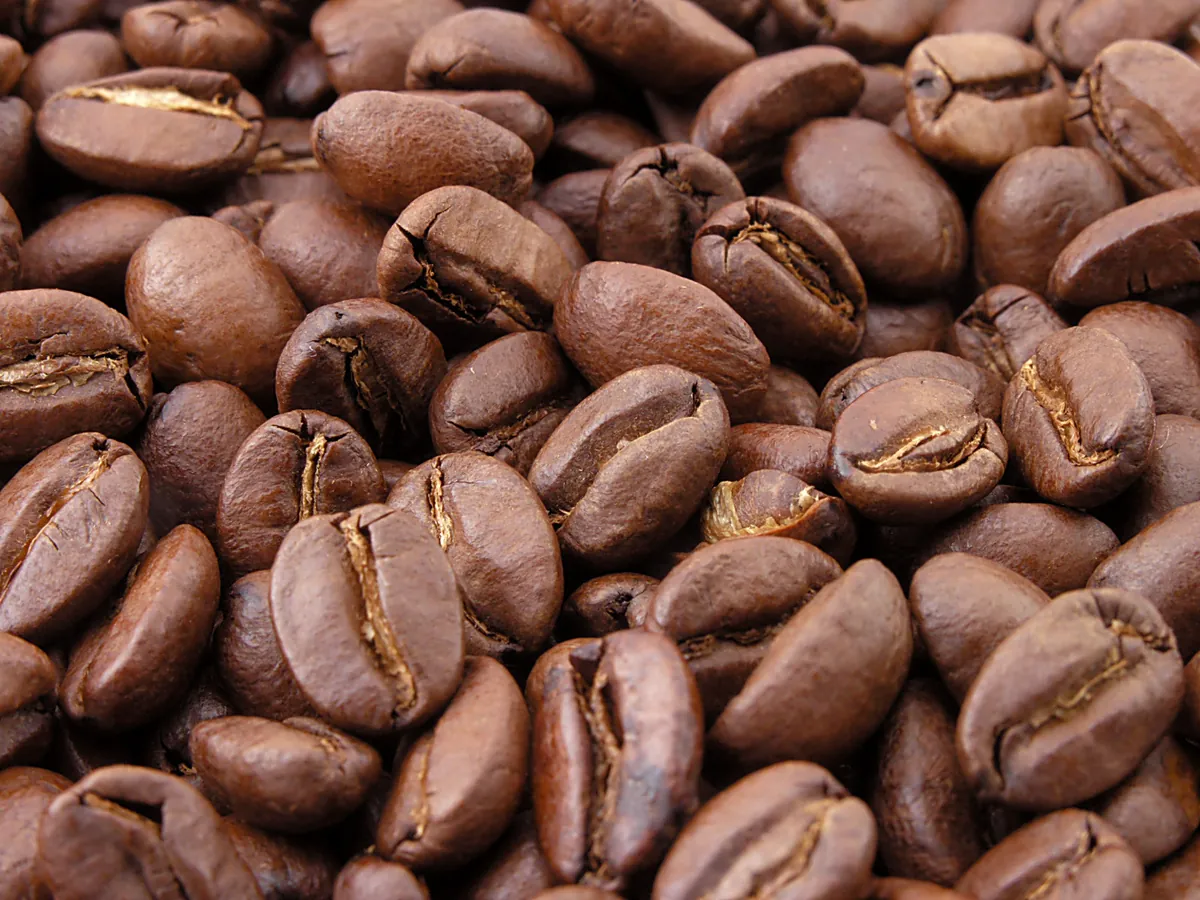
画面いっぱいに並ぶ茶褐色の焙煎コーヒー豆

コーヒー抽出液の原料となる焙煎豆。写真の原典には種・品種・焙煎度が記されていないため、抽出後の液体そのものの色や濃度を示す写真ではない。

原料写っているもの: Coffea spp.(種・品種は原典未記載)部位・状態: 焙煎された種子

写真: MarkSweep/ Public domain/ 原画像/ 台帳の原画像

写真の範囲と来歴

被写体の確認: 原典の記載による同定。図鑑項目との関係は原料。抽出液そのものではない。

掲載画像: Wikimedia Commons の原寸ファイル。苦味研究所では切り抜き・色調変更なし。 表示用には幅1200px上限のWebPを配信し、台帳の原画像は上のリンクから確認できます。

On this page (8 sections)
  1. Overview
  2. Sources for this overview (6)
  3. Topic hubs
  4. Follow the connections
  5. Related entries (10)
  6. Composition and content (5)
  7. Sensory (9)
  8. How processing and cooking change it (1)
↑

Reading the bitterness

The photograph shows roasted beans, but the subject of this entry is a single cup of coffee made by grinding them and extracting the components in water or hot water. As the roasting method and the conditions for passing the hot water through the ground coffee vary, so too does the assembly of bitterness that reaches the cup. This bitterness cannot be explained by the word caffeine alone; multiple component groups are involved, including quinides, oligomers of 4-vinylcatechol, and mozambioside roasting byproducts.

For this reason, it is not possible to determine the bitterness of the extracted liquid on the basis of the bean name alone. Roasting conditions change the generation of bitter compounds, and the manner in which hot water passes through changes the amount of those compounds that reach the cup. Which candidate appears strongest is also influenced by the analytical method, and instrument taste-sensor responses cannot be equated with the breakdown of bitterness perceived by humans.

Nor is taste sensation on the drinking side fixed. In a trial with 155 subjects, a change occurred immediately after drinking coffee in which sweetness perception increased and bitterness perception decreased; this change was repeated even in decaffeinated coffee. In large-scale genetic statistics, bitterness sensitivity to quinine and PROP was negatively related to coffee intake, while bitterness sensitivity to caffeine was positively related. Simple logic does not hold — that a person sensitive to bitterness will necessarily avoid coffee.

Sources for this overview

  1. Quantitative studies on the influence of the bean roasting parameters and hot water percolation on the concentrations of bitter compounds in coffee brew

    Blumberg S; Frank O; Hofmann T / 2010 / journal article / abstract checked

    Checked for this overview: Quantitative chemistry and sensory research treating roasting byproducts and extraction conditions / Research showing that roasting conditions and water extraction alter bitter-compound concentrations

  2. Contribution of mozambioside roasting products to coffee's bitter taste

    Bichlmaier C; Froehlich SM; Brychcy V; Grassl A; Behrens M; Lang R / 2025 / journal article / abstract checked

    Checked for this overview: Research on the bitterness contribution of mozambioside roasting byproducts

  3. The Taste of Caffeine

    Poole RL; Tordoff MG / 2017 / review / full text checked

    Checked for this overview: A review article organizing the fact that caffeine cannot serve as a universal representative of bitterness

  4. Bitterness compounds in coffee brew measured by analytical instruments and taste sensing system

    Fujimoto H; Narita Y; Iwai K; Hanzawa T; Kobayashi T; Kakiuchi M; Ariki S; Wu X; Miyake K; Tahara Y; Ikezaki H; Fukunaga T; Toko K / 2021 / journal article / abstract checked

    Checked for this overview: Methodological limitations of candidate identification by electronic taste sensor and statistical model

  5. Chemosensory Sensitivity after Coffee Consumption Is Not Static: Short-Term Effects on Gustatory and Olfactory Sensitivity

    Fjaeldstad Alexander W; Fernandes Henrique M / 2020 / journal article / full text checked

    Checked for this overview: A trial with 155 subjects comparing taste-sensitivity immediately after normal and decaffeinated coffee consumption

  6. Understanding the role of bitter taste perception in coffee, tea and alcohol consumption through Mendelian randomization

    Ong JS; Hwang LD; Zhong VW; An J; Gharahkhani P; Breslin PAS; Wright MJ; Lawlor DA; Whitfield J; MacGregor S; Martin NG; Cornelis MC / 2018 / journal article / full text checked

    Checked for this overview: Negative association between quinine and PROP bitterness sensitivity and coffee intake / Result showing that the direction of the relationship between caffeine bitterness sensitivity and intake reverses

Follow the connections

coffee brew →shows the sensory response→ bitterness →can be measured separately …→ astringency

coffee brew →has bitter contributors oth…→ caffeine →is a poor universal prototy…→ bitterness

chlorogenic acid →has a measured content in→ coffee brew

coffee brew →— perceived bitterness is s…→ sweetness →can reduce the perceived bi…→ bitterness

Structured claims — open a section to read each claim's confidence, evidence and limits

Composition and content (5)

coffee brew has candidate contributors to its bitterness: Nicotinic acid, L-lactic acid, and nicotinamide in the research fractionpreliminary

Scope: 4 stages of roast level evaluated by instrumental chemical analysis and electronic taste sensor

Note: Candidate ranking was by PLS-R and taste sensor, not by human sensory panel.

By PLS-R, nicotinic acid, L-lactic acid, and nicotinamide were identified as candidates; addition of these substances increased the bitter response of the taste sensor.
Limitations: The abstract contains no mention of human sensory panel.
Source: Bitterness compounds in coffee brew measured by analytical instruments and taste sensing system (Fujimoto H; Narita Y; Iwai K; Hanzawa T; Kobayashi T; Kakiuchi M; Ariki S; Wu X; Miyake K; Tahara Y; Ikezaki H; Fukunaga T; Toko K, 2021) · abstract checked
Limits: Research combining human sensory and receptor systems has identified quinides and mozambioside byproducts as bitter contributors, whereas the list of candidates from electronic taste sensor (nicotinic acid, lactic acid, nicotinamide) does not overlap. Candidates depend on the measurement system.
Limitations: Not a direct replication, but rather a note on the divergence of candidate lists due to methodological differences.
Source: Contribution of mozambioside roasting products to coffee's bitter taste (Bichlmaier C; Froehlich SM; Brychcy V; Grassl A; Behrens M; Lang R, 2025) · abstract checked
Show dataingredient-coffee-brew —has_candidate_bitterness_contributors→ "Nicotinic acid, L-lactic acid, and nicotinamide in the research fraction"
claim: clm-coffee-sensor-candidates / type: composition / updated: 2026-08-30
coffee brew has bitter contributors other than caffeinesupported

Scope: Multiple lines of evidence: human sensory testing, receptor assays, and quantitative chemistry

Note: A group of counterexamples to the common belief that 「コーヒーの苦味=カフェイン」 (in translation: "coffee's bitterness equals caffeine"). The quantitative contribution ratio is not recorded, since the full text was not confirmed.

Roasting-generated compounds other than caffeine (quinides, 4VC oligomers) define the bitterness quality, and the bitterness signature can be controlled through roasting/extraction conditions.
Limitations: Only the abstract was checked.
Suggests that the group of roasting-degradation products of mozambioside contributes to coffee's bitterness profile.
Limitations: Only the abstract was checked.
Source: Contribution of mozambioside roasting products to coffee's bitter taste (Bichlmaier C; Froehlich SM; Brychcy V; Grassl A; Behrens M; Lang R, 2025) · abstract checked
Context: Given that caffeine itself is not a suitable representative of bitterness, coffee's bitterness cannot be reduced to caffeine alone.
Limitations: This is not direct contribution-ratio data.
Source: The Taste of Caffeine (Poole RL; Tordoff MG, 2017) · full text checked
Show dataingredient-coffee-brew —has_bitter_contributors_other_than→ compound-caffeine
claim: clm-coffee-bitter-beyond-caffeine / type: composition / updated: 2026-08-30
chlorogenic acid has a measured content in coffee brewsupported

Scope: Quantification by UV-Vis spectrophotometry (330 and 272 nm, 70% ethanol extraction), compared against a standard calibration curve

Note: หนองน้ำดำ (Nong Nam Dam) village is not necessarily the same growing area as Doi Tung/Doi Chang, but it connects to this cluster in the context of arabica grown under a Royal Project in northern Thailand. Only the abstract was checked (the full-text PDF was rasterized and could not be extracted).

「ปริมาณกรดคลอโรจีนิกในสารสกัดกาแฟทุกชนิดในเมล็ดดิบ 2.46-3.82%...สูงกว่าในเมล็ดคั่วที่มีปริมาณ 0.78-1.75%(confirmed by agreement between the full text's Table 1 and running text; the abstract's stated "0.78-1.78%" is an error)...ปริมาณคาเฟอีนในสารสกัดเมล็ดกาแฟคั่วทุกชนิดมีปริมาณ 1.76-4.15% สูงกว่าในเมล็ดดิบ(the green-bean side is 0.43-0.82%, newly confirmed in Table 2)」 (in translation: "The chlorogenic acid content in extracts of every coffee type in green beans was 2.46-3.82%...higher than the 0.78-1.75% in roasted beans...the caffeine content in extracts of every roasted coffee type was 1.76-4.15%, higher than in green beans") (both statistically significant at the 0.05 level). The full text confirms the extraction method (moka pot, 12 g beans/120 ml water, about 6 minutes, filtered hot and then cooled, diluted 1:100 and 1:200 with 70% ethanol), the measuring instrument (Metertech SP8001 UV-Vis spectrophotometer, CGA at 330 nm/caffeine at 272 nm, calibration curve R²=0.9998/0.9996), and the pH range (5.34-6.03, weakly acidic in both groups).
Limitations: The full text was OCR-extracted (because the PDF was rasterized, pdftotext could extract only 8 bytes, so it was read using Tesseract OCR). The roasted-bean CGA upper bound stated in the abstract, "0.78-1.78%," is an error; based on agreement between the full text's Table 1 and the running text, the correct figure is "0.78-1.75%" (FF=1.755% is the maximum). Descriptions of physiological-effect claims (blood glucose, inflammation, antioxidant activity, lipid reduction) were excluded from coverage.
Confirmed in the full text (OCR) the quantitative data underlying the abstract's summary values. 6 green-bean samples (CA-CF) and 6 roasted-bean samples (FA-FF), 1 of which was arabica from Nong Nam Dam village (the remaining 5 were commercially purchased arabica from areas in northern Chiang Rai province run by the Royal Project Foundation). Extraction used a moka pot (12 g beans/120 ml water/about 6 minutes, filtered hot and then left to cool at room temperature, diluted 1:100 and 1:200 with 70% ethanol); a UV-Vis spectrophotometer (Metertech SP8001) measured CGA at 330 nm and caffeine at 272 nm, with 3 replicates. The calibration curve followed the method of Belay and Gholap (2009), with R²=0.9998 (CGA)/0.9996 (caffeine). pH across all samples was in the weakly acidic range of 5.34-6.03. All roasted samples met the minimum caffeine content of 1% required for 『真正コーヒー』 (in translation: "genuine coffee") under Thai Industrial Product Standard มผช.268/2558 and Ministry of Public Health Notification 197/2543.
Limitations: Because the data were OCR-extracted, there is a risk that some digits were misread; the figures in this row are limited to those confirmed as mutually consistent across the Table itself and its multiple restatements in the running text. The authors themselves note the limitation: 『先行研究(Belay and Gholap 2009)より低いCGA値が出たのは抽出時の加熱条件(モカポットは沸騰水使用)の違いによる可能性がある』 (in translation: "the lower CGA values compared with the prior study (Belay and Gholap 2009) may be due to a difference in the heating conditions during extraction (the moka pot uses boiling water)"). Descriptions of health effects (blood glucose, inflammation, antioxidant activity, lipid reduction) were excluded from coverage.
Show datacompound-chlorogenic-acid —has_measured_content_in→ ingredient-coffee-brew
claim: clm-northern-arabica-chlorogenic-caffeine / type: composition / updated: 2026-09-01

Sensory (9)

coffee brew shows the sensory response bitternesspreliminary

Scope: Electronic taste-sensor response to fractionated coffee extract

Note: The cited experiment does not provide confirmation by human sensory evaluation.

Fractionated coffee extract generated a bitter response value in an electronic taste-sensing system.
Limitations: Instrument response is not human bitterness rating.
Source: Bitterness compounds in coffee brew measured by analytical instruments and taste sensing system (Fujimoto H; Narita Y; Iwai K; Hanzawa T; Kobayashi T; Kakiuchi M; Ariki S; Wu X; Miyake K; Tahara Y; Ikezaki H; Fukunaga T; Toko K, 2021) · abstract checked
Show dataingredient-coffee-brew —has_sensory_response→ sensation-bitter
claim: clm-coffee-bitter / type: sensory / updated: 2026-08-30
coffee brew has_consumption_reduced_by Genetically high bitterness perception (the classical bitterness aversion model)contested

Scope: Mendelian randomization in UK Biobank (n = 438,870, white British ancestry)

Note: This holds for quinine and PROP bitterness (-0.081 / -0.021 cups/day per SD), but reverses for caffeine bitterness, in which higher intake increases. Because the direction differs by substance, the rule 『苦味感受性が高いほど苦味飲料を避ける』 (in translation: "the higher the bitterness sensitivity, the more one avoids bitter beverages") cannot be treated as general.

Genetically predicted PROP and quinine bitterness 1 SD higher was associated with decreased coffee intake (respectively -0.021 [-0.031, -0.011] and -0.081 [-0.108, -0.054] cups/day). This is consistent with the classical bitterness aversion model.
Limitations: Single SNP per trait. Instrumental variables estimated from a small twin sample (n = 1757). Intake was self-reported.
Source: Understanding the role of bitter taste perception in coffee, tea and alcohol consumption through Mendelian randomization (Ong JS; Hwang LD; Zhong VW; An J; Gharahkhani P; Breslin PAS; Wright MJ; Lawlor DA; Whitfield J; MacGregor S; Martin NG; Cornelis MC, 2018) · full text checked
Contradicts: The direction reverses for caffeine: genetically predicted caffeine bitterness 1 SD higher was associated with increased coffee intake (+0.146 [0.103, 0.189] cups/day) and higher odds of heavy consumption (>4 cups/day) (OR 1.207 [1.126, 1.294]); tea showed a mirror pattern (caffeine bitterness -0.045 [-0.061, -0.030]).
Limitations: Instrumental variable caveats are the same as in the supporting row; the reversal is compound-specific and is not a general contradiction of bitterness aversion.
Source: Understanding the role of bitter taste perception in coffee, tea and alcohol consumption through Mendelian randomization (Ong JS; Hwang LD; Zhong VW; An J; Gharahkhani P; Breslin PAS; Wright MJ; Lawlor DA; Whitfield J; MacGregor S; Martin NG; Cornelis MC, 2018) · full text checked
Show dataingredient-coffee-brew —has_consumption_reduced_by→ "Genetically high bitterness perception (the classical bitterness aversion model)"
claim: clm-bitter-perception-lowers-coffee-intake / type: sensory / updated: 2026-08-30
coffee brewImmediately after intake, sweetness sensitivity rose and bitterness sensitivity fell. The same was true for both regular coffee and decaf can remain changed at: supported

Scope: Taste and smell sensitivity testing before and after coffee intake in 155 people

Note: Smell sensitivity did not change, and the effect was reproduced with decaf, so it cannot be attributed to caffeine alone. A short-term effect.

After regular coffee intake, sweetness sensitivity increased and bitterness sensitivity decreased, and the same held when repeated with decaf. Smell sensitivity did not change.
Limitations: A short-term sensitivity effect; does not measure food preference or long-term adaptation.
Source: Chemosensory Sensitivity after Coffee Consumption Is Not Static: Short-Term Effects on Gustatory and Olfactory Sensitivity (Fjaeldstad Alexander W; Fernandes Henrique M, 2020) · full text checked
Context: The decrease in bitter sensitivity (F(1,99)=4.7975, p=0.031) was larger among participants who did not drink coffee daily (n=25) and smaller among daily drinkers. Verbatim: "the decrease in bitter sensitivity (F(1,99) = 4.7975, p = 0.031) was found to be larger in participants that did not consume coffee daily (n = 25; decrease in mean bitter sensitivity score of -1.0)... We found no effects of gender on the changes in sensitivity"
Limitations: A moderating factor not in the abstract. An exploratory subgroup analysis.
Source: Chemosensory Sensitivity after Coffee Consumption Is Not Static: Short-Term Effects on Gustatory and Olfactory Sensitivity (Fjaeldstad Alexander W; Fernandes Henrique M, 2020) · full text checked
Show dataingredient-coffee-brew —can_remain_changed_after→ "Immediately after intake, sweetness sensitivity rose and bitterness sensitivity fell. The same was true for both regular coffee and decaf"
claim: clm-coffee-short-term-taste-sensitivity / type: sensory / updated: 2026-08-31
coffee brew — perceived bitterness is suppressed by: sweetnesspreliminary

Scope: Layer: food. A human psychophysical test of mixtures of brewed coffee and sucrose (abstract only; concentration and number of participants not confirmed).

The source measured taste-taste and flavor-taste interactions (suppression) for caffeine-sucrose mixtures and coffee-sucrose mixtures. Both mixtures showed broad hypoadditivity in overall taste/flavor intensity, with a suppression rate of roughly 30-40%. Mutual suppression between components was also observed (within the scope of the abstract).
Limitations: The full-text original has not been obtained; this is based on the abstract and a secondary summary. The coffee cultivar and roast conditions used were not confirmed.
Source: Interactions in caffeine–sucrose and coffee–sucrose mixtures: evidence of taste and flavor suppression (Calvino Amalia Mirta; García-Medina María Rosa; Cometto-Muniz J Enrique, 1990) · abstract checked
Show dataingredient-coffee-brew —has_perceived_bitterness_suppressed_by→ sensation-sweet
claim: clm-w67a-coffee-sucrose-flavor-suppression / type: sensory / updated: 2026-09-06
coffee brew — perceived bitterness is affected by: Brew temperature (for dark roast, raising it 4°C → 22°C → 92°C significantly increased bitterness) and total dissolved solids. Sourness was also higher at 92°C; bitterness and sourness did not cancel each other out but moved in the same directionsupported

Scope: Layer: food. Full-immersion-brewed coffee (light roast and dark roast) was brewed at 4°C, 22°C, and 92°C, and a trained panel of 14 (10 women, 4 men) evaluated 27 attributes. Bitterness, sourness (sour), burnt, smoky, and rubber notes all increased together with rising total dissolved solids (TDS), and for dark roast these attributes increased significantly with rising brew temperature (Liang, Batali, Ristenpart & Guinard 2024).

Note: An example where bitterness and sourness do not suppress each other, but move in the same direction depending on brew strength. Placed here as an example of co-variation rather than mutual suppression between sourness and bitterness.

A trained panel of 14 (10 women, 4 men) performed a descriptive analysis of 27 attributes. For dark roast, “bitter, burnt, smoky, rubber, astringent, whiskey, and earthy notes significantly increased with brewing temperature” (4°C → 22°C → 92°C). Sourness is reported in a separate sentence: “sour and citrus were significantly higher in the 92 °C brews for both roast levels.” Bitterness and sourness showed a positive correlation with total dissolved solids (TDS).
Limitations: The pattern of temperature dependence differs by roast degree — for example, for light roast the attributes barely changed between 4°C and 22°C but rose sharply at 92°C.
Source: Sensory analysis of the flavor profile of full immersion hot, room temperature, and cold brewed coffee over time (Liang Jiexin; Batali Mackenzie E; Ristenpart William D; Guinard Jean-Xavier, 2024) · full text checked
Show dataingredient-coffee-brew —has_perceived_bitterness_affected_by→ "Brew temperature (for dark roast, raising it 4°C → 22°C → 92°C significantly increased bitterness) and total dissolved solids. Sourness was also higher at 92°C; bitterness and sourness did not cancel each other out but moved in the same direction"
claim: clm-w67b-coffee-bitter-sour-covary-tds / type: sensory / updated: 2026-09-06
coffee brew — perceived bitterness is unchanged by: Under conditions where brew strength (TDS) and percent extraction (PE) were fixed at target values, varying the brew water temperature across 87°C, 90°C, and 93°C showed no statistically significant difference in the trained panel's bitterness score (the effect of brew temperature was p=0.11 in multivariate analysis). Attributes including bitterness changed together with TDS, but did not correlate with brew temperature itself.supported

Scope: Layer: food. Drip-brewed coffee. This is a comparison under conditions where brew strength and percent extraction were experimentally controlled, so it may not generalize directly to home brewing, where raising the water temperature also tends to move the concentration. A descriptive sensory analysis of 31 attributes by a trained panel of 12 (8 women, 4 men, ages 19-30).

Note: A counterexample to the naive expectation that “changing the water temperature changes the bitterness.” Note that this is conditional on TDS being held constant.

With brew strength (TDS) and percent extraction (PE) fixed at target values, 3 brew-temperature levels — 87°C, 90°C, and 93°C — were compared. Many attributes, including bitterness, changed together with TDS, while the main effect of brew temperature was not statistically significant in multivariate analysis (p=0.11).
Limitations: This is a result under drip brewing at a specific brew strength/percent extraction setting; whether it generalizes to home brewing, where TDS tends to vary, needs separate confirmation.
Show dataingredient-coffee-brew —has_perceived_bitterness_unchanged_by→ "Under conditions where brew strength (TDS) and percent extraction (PE) were fixed at target values, varying the brew water temperature across 87°C, 90°C, and 93°C showed no statistically significant difference in the trained panel's bitterness score (the effect of brew temperature was p=0.11 in multivariate analysis). Attributes including bitterness changed together with TDS, but did not correlate with brew temperature itself."
claim: clm-w68c-coffee-brew-temperature-unchanged / type: sensory / updated: 2026-09-06
coffee brew — perceived bitterness is unchanged by: caffeinesupported

Scope: Layer: food. Sensory evaluation on a 5-point scale, 0 (not detectable) to 5 (strongly detected), by 18 panelists (8 women, 10 men, ages 23-31). Caffeine was added to a decaffeinated roasted coffee beverage (a commercial capsule, equivalent to 54 g/L).

"Surprisingly, there was no significant difference in the bitter taste between the decaffeinated sample (3.8) and the sample...where caffeine was added with a value...of 4.0"
Limitations: Limited to a single commercial decaffeinated product (an arabica blend, espresso strength 6/12).
Source: Impact of Interactions between Melanoidins and Caffeine on the Bitter Taste of Coffee Beverages (Gigl M; Kreissl J; Frank O, 2026) · full text checked
Show dataingredient-coffee-brew —has_perceived_bitterness_unchanged_by→ compound-caffeine
claim: clm-w70a-decaf-roast-caffeine-added-no-bitterness-increase / type: sensory / updated: 2026-09-07
coffee brew — perceived bitterness is affected by: caffeinepreliminary

Scope: Layer: Food. QDA by a trained panel of 18 and consumer preference survey of 120. Traditional and decaffeinated espresso sweetened with sucrose, sucralose, or stevia (multiple rebaudioside A concentrations) were compared.

traditional espressos presented higher scores for brown coffee color, crema creaminess, roasted aroma, and bitterness than decaffeinated samples, while decaffeinated samples showed higher acidity and lower pH.
Limitations: Only abstract-level information; precise scales and values have not been confirmed.
Source: Between Bitterness and Sweetness: How Decaffeination and Sweeteners Shape the Sensory Experience of Espresso Coffee (Cusielo KVC; Medeiros AC; Hiramatsu EY; Bolini HMA, 2026) · abstract checked
Show dataingredient-coffee-brew —has_perceived_bitterness_affected_by→ compound-caffeine
claim: clm-w70a-decaf-espresso-lower-bitterness / type: sensory / updated: 2026-09-07
coffee brew — perceived bitterness is affected by: In a sensory evaluation adding quaker beans (from immature beans, in 3 color grades) to natural-processed specialty coffee at 7 levels of contamination, quaker beans increased bitterness and astringency and brought negative sensory descriptors to aroma and flavor. For quaker beans with an Agtron color of 82.8 or above, a significant sensory difference appeared only once contamination reached 7 beans (10.8%) or more in 1 cup (equivalent to 65 beans).preliminary

Scope: Layer: food. An experiment contaminating natural-processed specialty coffee with quaker beans (from immature beans), with sensory evaluation and volatile compound analysis. The number and training status of the sensory panel are not stated in the abstract.

"Beans with color equal to or above Agtron 82.8 negatively affected the sensory characteristics of natural specialty coffee only from the presence of 7 Quaker beans in one cup (65 beans)." "Quaker beans caused greater astringency and bitterness to the beverage and negative aroma and flavor sensory notes."
Limitations: The number and training status of the sensory panel, and details of the statistical method, were not confirmed at the abstract stage.
Source: Impacts of quaker beans over sensory characteristics and volatile composition of specialty natural coffees (Rabelo MHS; Borém FM; Lima RR; Alves APC; Pinheiro ACM; Ribeiro DE; Santos CMD; Pereira RGFA, 2021) · abstract checked
Show dataingredient-coffee-brew —has_perceived_bitterness_affected_by→ "In a sensory evaluation adding quaker beans (from immature beans, in 3 color grades) to natural-processed specialty coffee at 7 levels of contamination, quaker beans increased bitterness and astringency and brought negative sensory descriptors to aroma and flavor. For quaker beans with an Agtron color of 82.8 or above, a significant sensory difference appeared only once contamination reached 7 beans (10.8%) or more in 1 cup (equivalent to 65 beans)."
claim: clm-w70a-quaker-beans-increase-bitterness-astringency / type: sensory / updated: 2026-09-07

How processing and cooking change it (1)

↑ Top of page · ← Encyclopedia (English entries)