edible chrysanthemum
ingredient / ingredient-edible-chrysanthemum
食用ぎく
Edible chrysanthemum. In Yamagata Prefecture the petals are used in ohitashi and other dishes and valued for their crisp texture and mild bitterness.
Photographs (captions in Japanese)
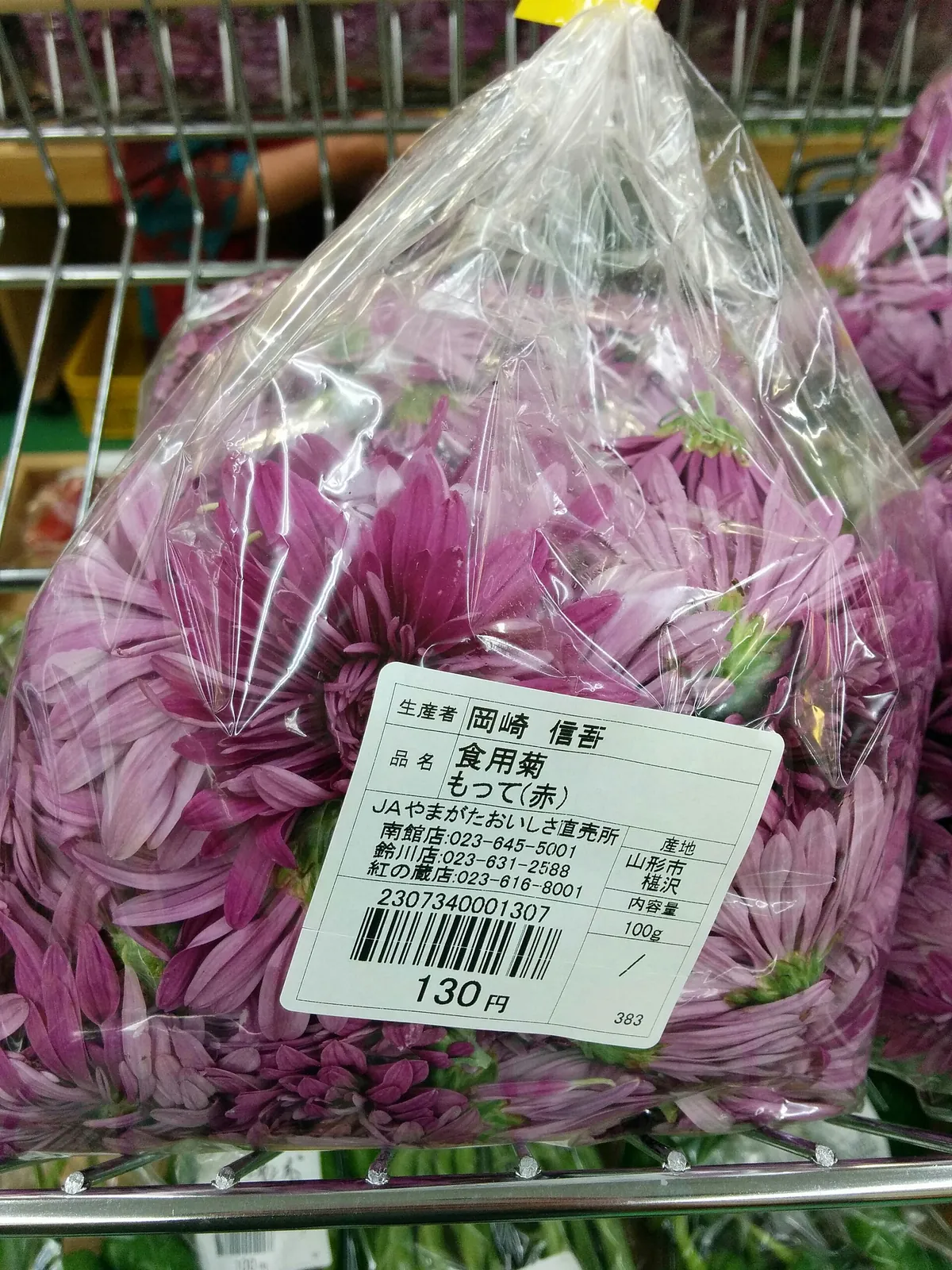
食用菊(品種「もって(赤)」)。山形県山形市産で、JAの直売所向けに透明な袋詰めにされ、赤紫色の花弁が密集した状態で売り場のカゴに入っている。
写っているもの: Chrysanthemum morifolium(食用品種「もって」)部位・状態: 収穫後にパック詰めされた、赤紫色の食用菊の花(品種名「もって」)
写真: Hanonimas/ CC BY-SA 3.0/ 原画像/ 台帳の原画像
写真の範囲と来歴
被写体の確認: 原典の記載による同定。ラベルの品種表記「もって」を原典の同定情報としてそのまま転記。栽培品種名であり、学名の記載は原典にない。
掲載画像: Wikimedia Commons の1920px版。苦味研究所では切り抜き・色調変更なし。 表示用には幅1200px上限のWebPを配信し、台帳の原画像は上のリンクから確認できます。
On this page (7 sections)
Reading the bitterness
Edible chrysanthemum is a chrysanthemum grown for its petals, which are used in ohitashi and other dishes in Yamagata Prefecture. A Ministry of Agriculture, Forestry and Fisheries account of local cuisine says many residents appreciate its distinctively crisp bite and mildly bitter taste. Here the flower is an ingredient valued for both texture and bitterness, not merely a garnish.
The season runs from autumn into early winter; the cultivar 「もってのほか」 (in translation: "Mottenohoka") is described as appearing on the market from late October to early November. A custom of serving yellow chrysanthemums on September 9 for the Chōyō no Sekku festival is also recorded. Breeding has extended the harvest period, however, so this timing does not apply uniformly to all producing regions and cultivars.
One cooking article explaining preparation states that because the center of the edible chrysanthemum is bitter, only the petals are gathered and used. The same article also states that edible chrysanthemums prepared thoroughly have no bitterness, but as a description from an individual cooking article, it has no support from sensory evaluation or chemical analysis. Two other explanations of adding vinegar to the boiling water likewise describe the role of the vinegar as preserving a vivid color, not as a treatment for suppressing bitterness.
Sources for this overview
Checked for this overview: Confirmed the description that crisp texture and mild bitterness are appreciated. / Confirmed the season, cultivar harvest period, and Chōyō no Sekku custom.
Checked for this overview: Connects to the bitterness given as the reason for removing the center, the bitterness after preparation, and the limitation of being an individual article. / Connects to an independent explanation that describes vinegar as color preservation.
Checked for this overview: Connects to an explanation that describes the role of vinegar as color development and does not mention bitterness.
Hypotheses and recipe candidates for this entry are on the Japanese page.
Structured claims — open a section to read each claim's confidence, evidence and limits
Sensory (2)
Scope: a MAFF (Ministry of Agriculture, Forestry and Fisheries) resource introducing Yamagata Prefecture's edible-chrysanthemum culture
Note: Not a sensory panel test, but an official explanation of local cuisine.
Show data
ingredient-edible-chrysanthemum —has_sensory_attribute→ "a crisp, crunchy texture and a favored horonigai (gently bitter) flavor"Scope: An article on preparing edible chrysanthemums by porridge researcher 「鈴木かゆ」 (Suzuki Kayu) on note.com.
Note: An individual cooking researcher’s description, not a sensory-panel test. It cites bitterness as the reason for collecting only the petals and removing the flower center.
Show data
ingredient-edible-chrysanthemum —has_perceived_bitterness_associated_with→ "The flower center, the tightly closed part corresponding to the stamens and receptacle."How processing and cooking change it (1)
Scope: 2 independent sources on boiling edible chrysanthemums: FoodsLink’s 「旬の野菜百科」 (in translation: "Seasonal Vegetable Encyclopedia"; Shun no Yasai Hyakka) and note.com by Suzuki Kayu.
Note: The 2 sources describe the role of vinegar as 「発色」 (in translation: "color development"), preventing browning and preserving vivid color; neither describes a bitterness-reducing effect. An initial automatic web-search summary had incorrectly paraphrased the FoodsLink text as 「苦味を抑える」 (in translation: "suppressing bitterness"), so the original was checked directly and the account corrected.
Show data
ingredient-edible-chrysanthemum —is_prepared_by→ "Adding vinegar when boiling, a preparation step described as intended to preserve color and prevent discoloration."Culture (1)
Scope: Yamagata Prefecture. 「もってのほか」 (in translation: "Mottenohoka") appears from late October to early November; yellow chrysanthemums are served on September 9.
Note: Breeding has broadened the period in which flowers can be harvested.
Show data
ingredient-edible-chrysanthemum —is_consumed_in→ "The season from autumn to early winter and the food custom of Chōyō no Sekku."