akebi peel
ingredient / ingredient-akebi-peel
アケビの皮 / Akebia spp.
Akebi peel is the thick peel surrounding akebi fruit pulp. An account of a visit to Ōkura, Yamagata, records meat stuffing that uses the peel's shape, miso toppings, and boiled, dressed preparations, with bitterness varying among dishes.
Photographs (captions in Japanese)
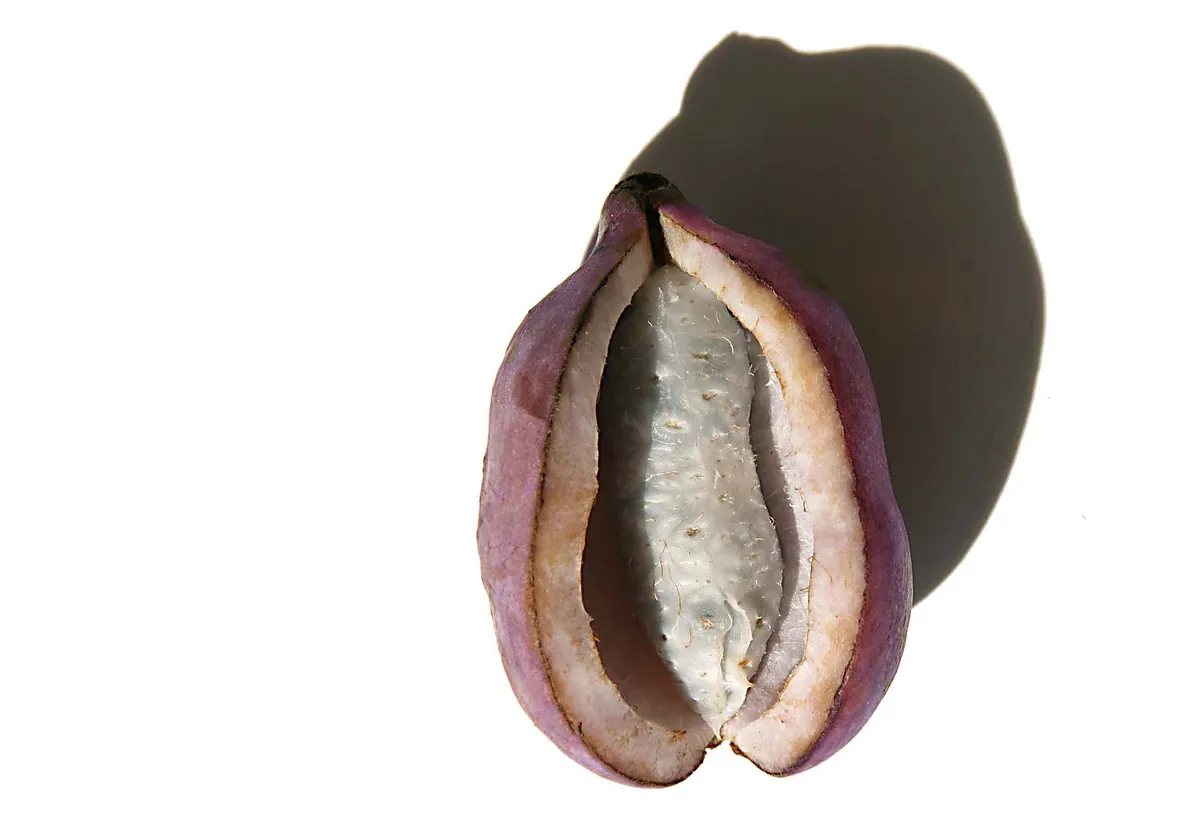
熟して裂開した Akebia quinata の果実。紫色の厚い果皮が開き、内側の白い果肉が見えている。料理に使われるアケビの皮は、この果肉を包んでいる厚い部分である。
写っているもの: Akebia quinata部位・状態: 裂開した成熟果と厚い果皮
写真: Jpbrigand/ CC BY-SA 4.0/ 原画像/ 台帳の原画像
写真の範囲と来歴
被写体の確認: 原典の記載による同定。写真原典は被写体を Akebia quinata と記載している。アケビ属にはほかの種もあるため、この写真はその一種の例として見る必要がある。専門家による再同定は行っていない。
掲載画像: Wikimedia Commons の1920px版。苦味研究所では切り抜き・色調変更なし。 表示用には幅1200px上限のWebPを配信し、台帳の原画像は上のリンクから確認できます。
On this page (8 sections)
Reading the bitterness
An account of a visit to Ōkura village, Yamagata, published in a Forestry Agency magazine begins with the writer's expectations about eating akebi being overturned. The writer had thought that the edible part was the translucent pulp containing black seeds, but heard locally that people ate little of the pulp and prepared the thick surrounding peel in various ways. Here the peel is not a discarded shell but an ingredient cooked to use its shape and thickness.
The dishes at that one dinner were stuffed akebi, mushroom sauce, boiled peel dressed with zunda, and mushroom miso on the peel. In the published recipe, an akebi fruit cut in half lengthwise is grilled peel-side down until soft, then topped generously with pork-and-mushroom miso and finished with shichimi (seven-spice seasoning) or cheese. The account says the peel can retain its bowl-like form to hold a filling or be chopped for a prepared side dish.
What is striking in this account is that, even among akebi dishes served at the same dinner, the writer tasted no bitterness in some and described others as faintly bitter in a way characteristic of akebi. Akebi peel cannot be grouped as an ingredient that is always bitter to the same degree. At this table, at least, bitterness varied once the peel was prepared as different dishes. This is one food writer's record of a single visit and tasting, however, not a survey of the whole village's food customs or a sensory test quantifying bitterness by dish.
The Ministry of Agriculture, Forestry and Fisheries' record of Yamagata Prefecture's local cuisine introduces the food culture of eating akebi peel and describes its flavor as mildly bitter. What can be confirmed here is a description of the peel's flavor in Yamagata Prefecture's dish introduction, not a measurement result showing that the same bitterness intensity appears in every akebi or every dish. The material is an introduction to Yamagata Prefecture, and it does not indicate the peel's plant species, cultivation conditions, or bitterness intensity by dish.
In a publicly available undergraduate thesis abstract from Akita University, the peel was compared across 10 conditions, and the sample treated with 1% added salt, heated for 3 minutes, and soaked in water for 8 hours ranked best by the ranking method. Separately, the author sums up that heating with added salt and water-soaking reduced the bitterness to some degree. The ranking-method result cannot be read as identifying a specific optimal condition for bitterness reduction, and the abstract does not give the number of evaluators, a bitterness scale, or statistical testing.
Sources for this overview
Checked for this overview: The passage saying the writer heard that people in Ōkura prepare the peel in varied ways rather than eating much of the pulp. / The four akebi dishes served at one dinner. / The ingredients and cooking steps for the meat-miso topping in the published recipe. / The writer's tasting record of differences in perceived bitterness among dishes.
Checked for this overview: Used to describe the peel's mild bitterness and preserved use in Yamagata Prefecture's local-cuisine introduction
アケビ種子油及び果皮の調理学的特性と栄養学的評価に関する研究
Checked for this overview: Used to describe the 10-condition comparison of peel pretreatment, the salted-water heating and water-soaking conditions, and the limitations noted in the material / Used to describe the extent to which the author's general discussion summed up some reduction in bitterness, and the limitation that no specific optimal method is shown
Follow the connections
akebi peel miso stir-fry →includes→ akebi peel
akebi peel with meat miso →includes→ akebi peel
akebi peel →— sensory attribute→ bitterness →can be measured separately …→ astringency
Structured claims — open a section to read each claim's confidence, evidence and limits
Sensory (2)
Scope: A single dining experience in Okura Village by the article's author
Note: Not a sensory test using a trained panel or a bitterness-intensity scale.
Show data
ingredient-akebi-peel —has_sensory_attribute→ "The author's tasting record that, depending on the dish, ranged from ones with no perceived bitterness to ones that were faintly bitter and tasted distinctly of akebi"Scope: The expression that the Ministry of Agriculture, Forestry and Fisheries' 『うちの郷土料理』 (in translation: "Our Local Cuisine") gives for the flavor of the peel in Yamagata Prefecture
Show data
ingredient-akebi-peel —has_sensory_attribute→ sensation-bitterHow processing and cooking change it (5)
Scope: A candidate structural component of a dish. Regional variation in ingredients is unconfirmed
Note: Source not connected. Does not indicate quantities or cooking conditions.
No source connected — this claim has not been verified yet. It is a general-knowledge placeholder, not a confirmed statement.
Show data
dish-akebi-peel-miso-itame —includes→ ingredient-akebi-peelScope: Recipe published in the October 2015 issue of the Forestry Agency's 『林野』 (in translation: "Rinya," literally "forests and fields") magazine
Note: In the published recipe the peel is used like a bowl, topped with a pork-and-mushroom miso. The process differs from a typical miso stir-fry.
Show data
dish-akebi-meat-miso —includes→ ingredient-akebi-peelScope: Dishes the writer saw at a dinner in Ōkura in the same article.
Note: These are dishes listed from one visit, not an exhaustive inventory of the region's cuisine.
Show data
ingredient-akebi-peel —is_eaten_as→ "Stuffed akebi, mushroom sauce, boiled peel dressed with zunda, and mushroom miso on the peel."Scope: A comparison of akebi peel pretreatments recorded in a publicly available undergraduate thesis abstract from Akita University
Note: The public PDF is an undergraduate thesis abstract and does not give the number of sensory evaluators, statistical testing, or a bitterness scale in detail. The ranking-method result is not treated as identifying a specific optimal condition for bitterness reduction. The body text does not state that the samples were stored frozen.
Show data
ingredient-akebi-peel —is_documented_as_having→ "In a comparison of peel pretreatments, the sample treated with 1% added salt, heated for 3 minutes, and soaked in water for 8 hours ranked best by the ranking method"Scope: The description of the peel pretreatment comparison in the general discussion of a publicly available undergraduate thesis abstract from Akita University
Note: This is the summary of an undergraduate thesis abstract, and which treatment is optimal for bitterness reduction, the number of evaluators, a bitterness scale, and statistical testing cannot be confirmed from the body text. The body text does not state that the samples were stored frozen.
Show data
ingredient-akebi-peel —is_documented_as_having→ "The author's summary that pretreatment by heating with added salt and water-soaking reduced the bitterness to some degree"Culture (2)
Scope: A candidate at the level of general knowledge. Regional and naming differences have not been confirmed.
No source connected — this claim has not been verified yet. It is a general-knowledge placeholder, not a confirmed statement.
Show data
ingredient-akebi-peel —is_used_as→ "A vegetable/ingredient carrying bitterness"Scope: A food writer's visit account in the Forestry Agency's 『林野』 (in translation: "Forestry") magazine, October 2015 issue.
Note: This is something the writer heard locally, not a food-culture survey of the whole village.
Show data
ingredient-akebi-peel —is_documented_as_having→ "A local account that in Ōkura, Yamagata, people prepare and eat the peel in various ways more often than the pulp."