Phyllostachys edulis
ingredient / ingredient-takenoko
たけのこ
Young underground stems (bamboo shoots) of moso bamboo (mōsōchiku). Toyama local-cuisine records state that bitterness and astringency vary with the soil of the production area.
Photographs (captions in Japanese)
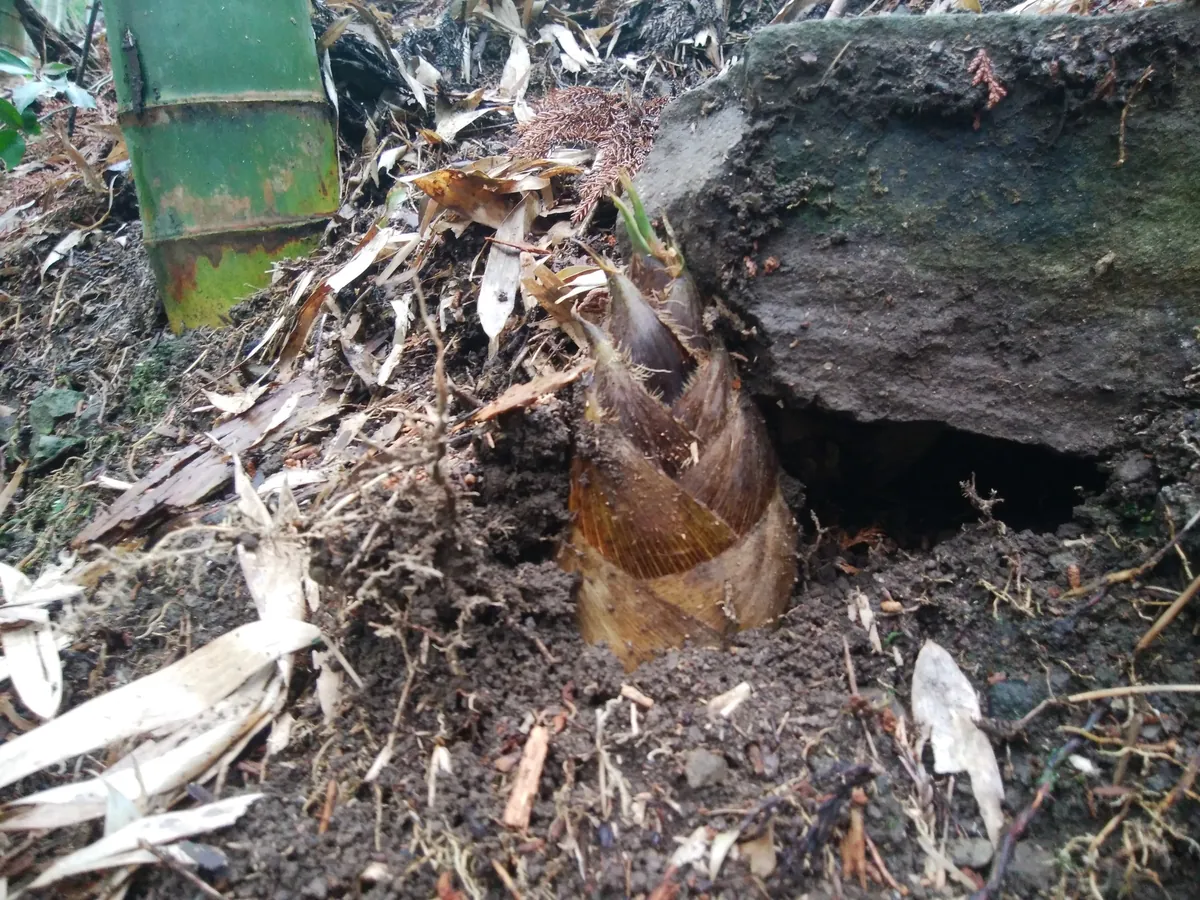
土から顔を出した孟宗竹の筍。石を押しのけるように隆起した地面から先端が突き出ている
写っているもの: 孟宗竹(モウソウチク、原典表記どおり。学名Phyllostachys edulisはentities.csvの記載)部位・状態: 土中から地表に突き出た若い筍。表皮に短い毛が生えた褐色の皮に包まれ、先端がまだ土に半ば埋もれている
写真: サフィル (User:サフィル)/ CC BY-SA 4.0/ 原画像/ 台帳の原画像
写真の範囲と来歴
被写体の確認: 原典の記載による同定。説明文(日本語)に「活力で石を押しのける孟宗竹の筍」と明記。原寸4128x3096 画像を開いて確認。褐色の皮に覆われた筍の先端が土から突き出し、隣接する石を押しのけている様子が写る
掲載画像: Wikimedia Commons の原本を長辺2400pxへ縮小。切り抜き・色調変更なし。 表示用には幅1200px上限のWebPを配信し、台帳の原画像は上のリンクから確認できます。
On this page (7 sections)
Reading the bitterness
An official database recording Toyama cuisine states that bamboo-shoot bitterness and astringency vary by production area within the prefecture. Shoots from the Kurokawa area of Imizu are described as having distinctive slight bitterness derived from black soil in the bamboo grove. This is a regional 「いわれ・特徴」 (in translation: "origin and characteristics") description, not a chemical analysis confirming a soil relationship.
The same record contrasts shoots from Nishida, Takaoka: grown in clay soil, they are soft yet firm and have little astringency. Thus one local-cuisine record contains differing descriptions of bitterness and astringency by production area.
In the Ministry of Agriculture, Forestry and Fisheries' record for the Yamashiro area of Kyoto Prefecture, 「京たけのこ」 (Kyō takenoko) is harvested before it emerges from the ground, and shoots dug in the morning are boiled in water that same day, using local groundwater. Preparing it as boiled-in-water is introduced as a way to enjoy it 1 year-round, and it is used in clear soup, 「木の芽和え」 (kinome-ae), 「若竹煮」 (wakatake-ni), tempura, and sashimi.
Sources for this overview
Checked for this overview: Used the description of slight bitterness attributed to black soil as the basis for this paragraph. / Used the contrasting description of low astringency as the basis for this paragraph.
Checked for this overview: Used to describe the harvest before emergence from the ground, same-day boiling of morning-dug shoots, the use of local groundwater, and the introduction that preparing it as boiled-in-water allows it to be enjoyed 1 year-round. / Used to describe its use in clear soup, kinome-ae, wakatake-ni, tempura, and sashimi.
Follow the connections
takenoko miso-ni (bamboo shoot simmered in miso) →includes→ Phyllostachys edulis
Hypotheses and recipe candidates for this entry are on the Japanese page.
Structured claims — open a section to read each claim's confidence, evidence and limits
How processing and cooking change it (3)
Scope: The Toyama local-cuisine record
Note: The record lists 320g of bamboo shoots as an ingredient for 4 people.
Show data
dish-takenoko-misoni-toyama —includes→ ingredient-takenokoScope: The Kyoto Prefecture boiled-bamboo-shoot introduction in the Ministry of Agriculture, Forestry and Fisheries' 「にっぽん伝統食図鑑」 (Nippon Dentōshoku Zukan)
Note: A production introduction for the Yamashiro area, not a nationwide standard for boiled bamboo shoots or home cooking.
Show data
ingredient-takenoko —is_processed_by→ "The Ministry of Agriculture, Forestry and Fisheries' record for the Yamashiro area of Kyoto Prefecture states that Kyō takenoko is harvested before it emerges from the ground, and shoots dug in the morning are boiled in water that same day using local groundwater. It introduces this as a way of preserving it as boiled-in-water so it can be enjoyed 1 year-round"Scope: The Kyoto Prefecture boiled-bamboo-shoot introduction in the Ministry of Agriculture, Forestry and Fisheries' 「にっぽん伝統食図鑑」 (Nippon Dentōshoku Zukan)
Note: A listing of dish names, not a survey that measured the frequency or cooking conditions of each dish.
Show data
ingredient-takenoko —is_used_in→ "The Ministry of Agriculture, Forestry and Fisheries' Kyoto Prefecture boiled-bamboo-shoot page states that boiled bamboo shoots are used in clear soup, kinome-ae, wakatake-ni, tempura, and sashimi"Culture (2)
Scope: The Toyama local-cuisine record 「たけのこの味噌煮」 (in translation: "bamboo shoots simmered with miso") (Kurokawa production area).
Note: This is a Ministry of Agriculture, Forestry and Fisheries (MAFF) public database's 「いわれ・特徴」 (in translation: "origin and characteristics") description, not a chemical analysis confirming a soil relationship.
Show data
ingredient-takenoko —has_sensory_attribute→ "Shoots from Kurokawa, Imizu, Toyama are recorded as having distinctive slight bitterness attributed to black soil."Scope: The Toyama local-cuisine record 「たけのこの味噌煮」 (in translation: "bamboo shoots simmered with miso") (Nishida production area).
Note: This is a comparison of production areas within the same record. It is recorded separately by area rather than being flattened into one claim with Kurokawa.
Show data
ingredient-takenoko —has_sensory_attribute→ "Shoots from Nishida, Takaoka are recorded as grown in clay soil, with little astringency and a soft texture."