pharmaceutical taste masking
process / process-pharmaceutical-taste-masking
医薬品の苦味マスキング
Formulation strategies used to reduce perception of an active pharmaceutical ingredient's unpleasant taste by interfering with taste transmission or preventing drug release in the mouth.
Photographs (captions in Japanese)
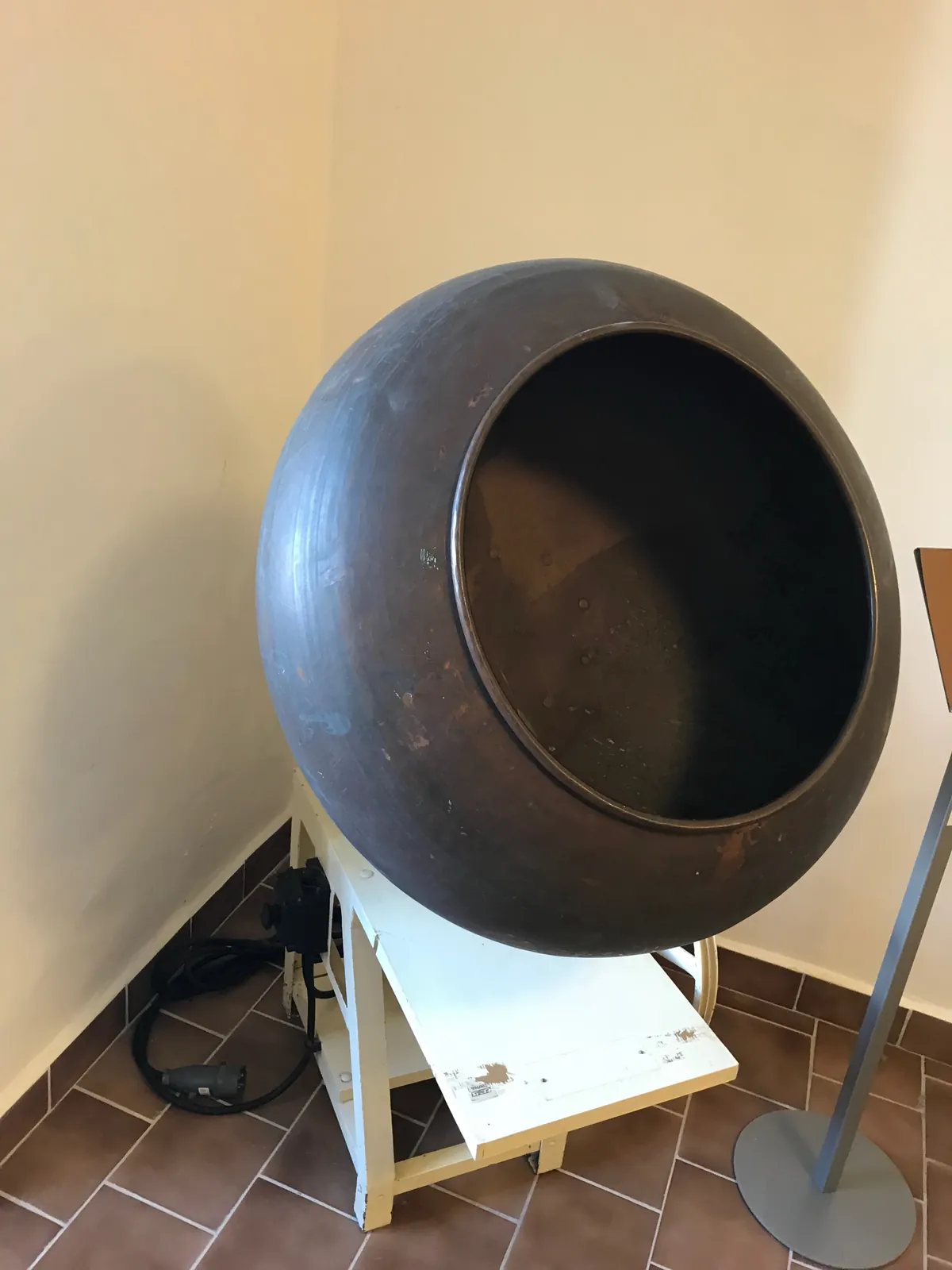
チェコ・クックス病院「医薬品製造の歴史」展示にある糖衣がけ用の歴史的装置(糖衣鍋)。糖衣がけは原薬の不快な味を低減する製剤的方策の歴史的な一手法であり、この写真は装置そのものの博物館展示を示すもので、現代の製剤ラインの記録ではない。
写っているもの: 該当なし(製剤的な味覚マスキングという工程)部位・状態: 糖衣がけ用の歴史的装置(博物館展示)
写真: Jiří Sedláček/ CC BY-SA 4.0/ 原画像/ 台帳の原画像
写真の範囲と来歴
被写体の確認: 原典の記載による同定。現代の製薬工程の写真ではなく、歴史的展示物であることをキャプションに明記。
掲載画像: Wikimedia Commons の原寸ファイルを sips で長辺2400pxに縮小。苦味研究所では切り抜き・色調変更なし(リサイズのみ)。 表示用には幅1200px上限のWebPを配信し、台帳の原画像は上のリンクから確認できます。
On this page (6 sections)
Reading the bitterness
Pharmaceutical bitterness masking encompasses dosage-form design methods to soften the taste of an active ingredient that is difficult to take. One review divides the mechanisms into 2 broad groups. One uses flavors or bitterness-suppressing additives to compete with the drug and interfere with taste transmission to tongue receptor cells. The other prevents the unpleasant-tasting drug from dissolving in the mouth, through approaches including ion-exchange resins, solid dispersions, polymer coatings, prodrugs, microcapsules, liposomes, nanoemulsions, and cyclodextrin inclusion.
A European medicines regulator's guideline for developing pediatric medicines lists more practical choices: selecting excipients such as bitterness maskers, sweeteners, and flavors; changing particle size of the active ingredient or excipients; changing the active ingredient's salt form; coating the active ingredient or final dosage form; using inclusion agents such as cyclodextrins; and, for liquids, reducing the amount of active ingredient dissolved in solution. Neither this guideline nor the review gives data comparing the size of effects across these methods.
A decoction containing Platycodon for children gives a concrete example of these methods. Adding hydroxypropyl-β-cyclodextrin at 6.5% relative to the crude drug and xylitol at 10% changed its rating from 「受け入れがたい」 (in translation: "difficult to accept") to 「後に苦味の残らない甘さ」 (in translation: "sweet with no lingering bitterness"); electronic-tongue measurements also supported the change. Cyclodextrin was described as suppressing lingering bitterness and astringency, while xylitol improved mouthfeel, but this result was confirmed for 2 formulations.
A prior study cited by the review presents a commercial dry-syrup formulation of clarithromycin, known for pronounced bitterness, made with a physical coating. Compared with a powder suspension at the same concentration, sensory bitterness intensity was estimated to fall to about 1%. Both human sensory assessment and prediction by a taste sensor supported this masking.
Another prior study cited by the same review reports pediatric quinine-sulfate pellets prepared by extrusion-spheronization and given an Eudragit EPO bitterness-masking coating at 10%, 20%, or 30%. As coating concentration increased, dissolution during the first 5 minutes fell to 9.2%, 5.9%, and 2.1%, respectively. This trend corresponded to lower bitterness scores from an Astree taste-sensor system. The prior study judged a 20% coating optimal for forming a uniform film while suppressing bitterness sufficiently.
Sources for this overview
Review of Applications of Cyclodextrins as Taste-Masking Excipients for Pharmaceutical Purposes
Checked for this overview: Checked the review's division of bitterness masking into 2 mechanism groups.
Checked for this overview: Checked the regulator guideline's list of practical options.
Checked for this overview: Checked the effect of HP-β-CD plus xylitol in the kikyo decoction.
Taste Sensor Assessment of Bitterness in Medicines: Overview and Recent Topics
Checked for this overview: Checked the decrease in sensory bitterness intensity to about 1% with a dry syrup. / Checked coating-level dissolution rates and corresponding taste-sensor bitterness scores.
Follow the connections
Platycodon grandiflorus →— perceived bitterness is s…→ pharmaceutical taste masking
pharmaceutical taste masking →reduces→ clarithromycin
pharmaceutical taste masking →reduces→ quinine →elicits→ bitterness
Structured claims — open a section to read each claim's confidence, evidence and limits
How processing and cooking change it (5)
Scope: Oral pharmaceutical dosage forms. A classification presented in a 2023 systematic review of cyclodextrin taste masking
Note: EMA lists a compatible but differently organized set of measures (choice of excipients including taste maskers, changing particle size, an alternative salt, coating the active substance, coating the dosage form, complexing agents such as cyclodextrins, and reducing free drug in solution). Neither source reports a comparison of effectiveness between the classes.
Show data
process-pharmaceutical-taste-masking —is_divided_into→ "2 mechanism classes: (1) Interference with taste transmission. Uses flavor chemicals or bitterness inhibitors that compete with the drug in exciting taste receptor cells. (2) Prevention of the release of the unpleasant-tasting drug into the oral cavity. Uses ion-exchange resins, solid dispersions, polymer coatings, prodrugs, microencapsulation, liposomes, nanoemulsions, and cyclodextrin inclusion complexes"Scope: A water decoction of a pediatric formulation containing Platycodon root
Note: The division of roles: HP-beta-CD suppresses residual bitterness and astringency, while xylitol improves mouthfeel.
Show data
organism-platycodon-grandiflorus —has_perceived_bitterness_suppressed_by→ process-pharmaceutical-taste-maskingScope: Layer: food. A case of bitterness masking by physical coating, using the commercial clarithromycin dry syrup (CAMD) as the subject.
Show data
process-pharmaceutical-taste-masking —reduces→ compound-clarithromycinScope: Layer: food. Quinine sulfate pellets by extrusion-spheronization, 3 levels of Eudragit EPO coating concentration, bitterness evaluation by the Astree electronic-tongue system.
Show data
process-pharmaceutical-taste-masking —reduces→ compound-quinineScope: Layer: food. Microencapsulation and dry-suspension formulation of clarithromycin (CLM) using ethylcellulose as the base material through emulsion solvent-diffusion method, with sensory evaluation conducted by 9 healthy volunteers.
Show data
process-pharmaceutical-taste-masking —reduces→ compound-clarithromycin