fukinoto (butterbur flower bud)
ingredient / ingredient-fukinoto
ふきのとう
Fukinoto (butterbur flower bud) is the flower buds of Petasites japonicus, gathered from late winter to early spring. A representative bitter Japanese wild vegetable.
Photographs (captions in Japanese)
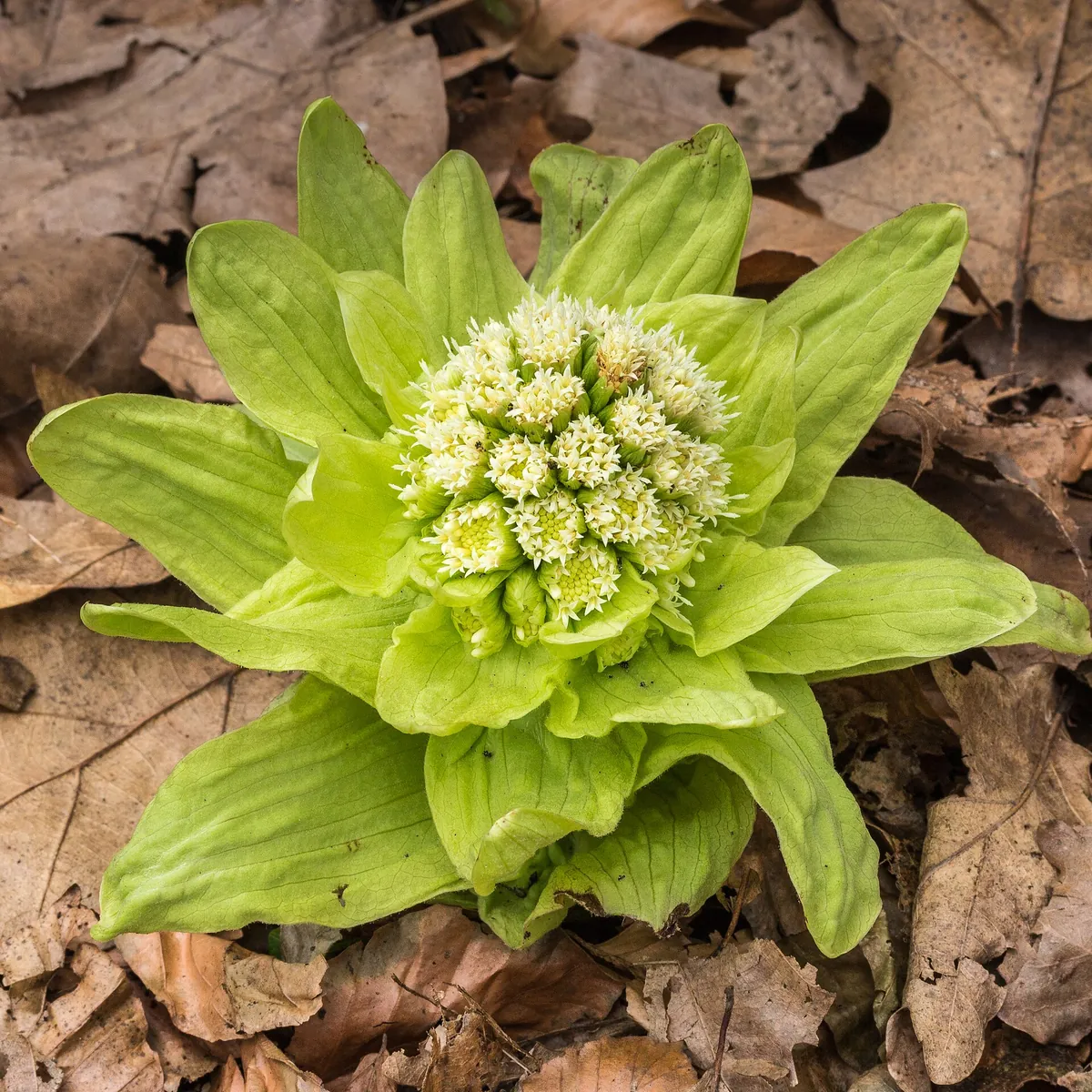
フキ(Petasites japonicus)の花茎「ふきのとう」。土からロゼット状に開いた淡緑色の苞葉に囲まれて、中心に白い頭花の集合が見える、開花し始めの状態。撮影地はオランダの庭園で、日本国内で収穫される個体とは生育環境が異なる。
写っているもの: Petasites japonicus部位・状態: 地表に顔を出したフキ(Petasites japonicus)の花序(ふきのとう)。苞葉に包まれ、中心に白い頭花が集まった蕾〜開花初期の状態
写真: Dominicus Johannes Bergsma/ CC BY-SA 4.0/ 原画像/ 台帳の原画像
写真の範囲と来歴
被写体の確認: 原典の記載による同定。撮影地はオランダの栽培個体で、日本国内で山菜として収穫される「ふきのとう」の産地・生育環境の代表例ではない。学名は原典キャプション(Petasites japonicus)に基づく。
掲載画像: Wikimedia Commons の1920px版。苦味研究所では切り抜き・色調変更なし。 表示用には幅1200px上限のWebPを配信し、台帳の原画像は上のリンクから確認できます。
On this page (10 sections)
Reading the bitterness
Fukinoto is the flower bud of Japanese butterbur (Petasites japonicus) that emerges from late winter into early spring and is known as a representative bitter Japanese wild vegetable. A Miyagi Prefecture record of regional cuisine says the plant is called 「ばっけ」 (in translation: "bakke") in local dialect and that tender buds are picked before flowering because bitterness grows stronger and flavor worsens once the flowers open. The time of picking thus shapes fukinoto's character as a food eaten in the bud stage.
Bakkenolide B was isolated as a principal component of its bitterness. Working with air-dried fukinoto gathered within roughly 50 km of Sendai, a Tohoku Pharmaceutical University group separated this white crystalline compound by organic-solvent extraction and alumina column chromatography in work spanning the 1960s to 1972. Its melting point was 101–102°C, and it accounted for about 0.1% of the air-dried plant. It was first named petasinolide, then renamed because the name overlapped with a component of European butterbur; it was also confirmed to be the same substance as fukinolide reported by another researcher.
The same extraction process found other bitter components. Isopetasin, with a melting point of 95°C, accounted for 0.09% of the air-dried plant; oily fukinone was obtained by vacuum distillation at a yield of about 0.2%. Both were described as bitter. The researchers also found that very little fukinoto bitterness passed into hot water or dilute alcohol extracts. In response, they abandoned their initial leading view, 「苦味は配糖体による」 (in translation: "bitterness comes from glycosides"), and switched to organic-solvent extraction. This record suggests that the bitter components may be poorly soluble in water.
Fukinoto is described in a Shimane Prefecture record as a spring food sold from January through early April. The record describes fukinoto miso, made by boiling the buds in water with salt and baking soda, soaking them in water for a while to remove harshness, chopping them, and mixing them with white or barley miso. A Miyagi record similarly describes bakke miso as a spring home dish prepared in households. The isolation of bitter components, however, rests on an explanatory article from one laboratory. No sensory test quantifying bitterness intensity or source quantifying how much bitterness is reduced by boiling and discarding the water has yet been identified.
A cooking article in the Forestry Agency's February 2016 issue includes a paste made by chopping 100 g of fukinoto with 2 tablespoons of salad oil, stir-frying it for 1 to 2 minutes, and then cooking it for 4 to 5 minutes with seasoning and water. The cooking researcher who wrote the article explains that cooking with oil makes the bitterness milder, and states that the finished paste can be served on rice or tofu, and also used to season stir-fried vegetables.
Sources for this overview
Checked for this overview: Checked the dialect name bakke and the reason for picking before flowering. / Checked the description of Miyagi bakke miso as a spring home dish.
Checked for this overview: Checked the materials, methods, and renaming history for the isolation of bakkenolide B. / Checked the descriptions of isopetasin and fukinone bitterness and their yields. / Checked the account that bitterness did not transfer into hot-water or dilute-alcohol extracts.
Checked for this overview: Checked the selling season and method for making fukinoto miso in the Shimane record. / Checked the parboiling with salt and baking soda and the harshness-removal step.
春の香り 豆腐とふきのとうの炒め煮とふきのとうの万能ペースト
Checked for this overview: Used to describe the ingredient amounts, stir-frying time, additional cooking time, the cooking researcher's explanation of cooking with oil, and its use on rice, tofu, and stir-fried vegetables
Other names: ばっけ (ja)
Follow the connections
fukinoto (butterbur flower bud) →— principal bitter compound→ bakkenolide B
bakke miso →includes→ fukinoto (butterbur flower bud)
fukinoto (butterbur flower bud) →is prepared through→ aku-nuki (blanch-and-soak treatment)
Hypotheses and recipe candidates for this entry are on the Japanese page.
Structured claims — open a section to read each claim's confidence, evidence and limits
Composition and content (2)
Scope: Air-dried fukinoto collected around Sendai and studied by a group at Tohoku College of Pharmacy (1960s-1972)
Note: After the author initially named it Petasinolide, it was renamed Bakkenolide-B in consultation with Abe and Kitahara to avoid a name conflict with a European fuki constituent. It is the same substance as Naya et al.'s Fukinolide. Based on an expository article from a single research group; the primary experimental paper has not been read.
Show data
ingredient-fukinoto —has_principal_bitter_compound→ compound-bakkenolide-bScope: The same air-dried fukinoto material used for the isolation of Bakkenolide-B
Note: Neither the intensity, threshold, nor contribution ratio of the bitterness is recorded — only a qualitative description that it possesses bitterness. An antimicrobial assay is recorded as showing that none of the bitter substances exhibited antimicrobial activity.
Show data
ingredient-fukinoto —contains→ "Isopetasin (melting point 95 C, 0.09% of the air-dried plant, bitter) and fukinone (oily, 0.2% yield by vacuum distillation, bitter)"Sensory (1)
Scope: Santoka Taneda's diary (held in Aozora Bunko; see the source for bibliographic data)
Note: A subjective taste description in a personal diary, not a standardized sensory panel test. Notes that bitterness is described positively, placed alongside 『うまさ』 (in translation: "deliciousness").
Show data
ingredient-fukinoto —has_sensory_attribute→ "The taste of fuki and fukinoto, recorded as 『蕗のうまさ、ほろにがい味は何ともいへない。』 (in translation: "the deliciousness of fuki, its faintly bitter taste, is beyond words") — a passage from Santoka Taneda's diary. A diary entry from the same year also contains the passage 『蕗のほろにがさには日本的老心といつたやうな味がある。』 (in translation: "the faint bitterness of fuki has a taste like a Japanese old-soul quality")."How processing and cooking change it (4)
Scope: An extraction experiment on fukinoto reported by Kurihara (1972)
Show data
ingredient-fukinoto —has_bitterness_poorly_extracted_by→ "Almost no bitterness transfers into hot-water extracts or dilute-alcohol extracts. The author abandoned the bitter-glycoside hypothesis and used organic-solvent extraction instead."Scope: The Shimane fukinoto-miso recipe in MAFF's "Uchi no Kyodo Ryori" (Our Local Cuisine) database
Show data
ingredient-fukinoto —is_prepared_with→ process-aku-nukiScope: A candidate structural component of a dish. Regional variation in ingredients is unconfirmed
Note: Source not connected. Does not indicate quantities or cooking conditions.
No source connected — this claim has not been verified yet. It is a general-knowledge placeholder, not a confirmed statement.
Show data
dish-fukinoto-tempura —includes→ ingredient-fukinotoScope: Cooking researcher Horie Sawako's 「ふきのとうの万能ペースト」 (in translation: "All-purpose fukinoto paste"), published in the February 2016 issue of Rinya (RINYA), the Forestry Agency's magazine
Note: A single recipe by one cooking researcher. The article states that cooking with oil makes the bitterness milder, but this is not a sensory test with comparison samples, evaluators, and a scale.
Show data
ingredient-fukinoto —is_documented_as_having→ "A cooking article in the Forestry Agency's public-relations magazine records a paste made by chopping 100 g of fukinoto with 2 tablespoons of salad oil, stir-frying it for 1 to 2 minutes, and then adding seasoning and water and cooking for 4 to 5 minutes"Culture (3)
Scope: A Miyagi home dish recorded in the Ministry of Agriculture, Forestry and Fisheries' 「うちの郷土料理」 (in translation: "Our Regional Cuisine") database.
Note: Bakke is the Miyagi dialect name for fukinoto. The record says 「花が咲いてしまうと苦味も強く不味くなるので、花が咲く前のやわらかい蕾を摘みとって用いる」 (in translation: "once the flowers bloom, bitterness becomes stronger and the taste worsens, so tender buds are picked before flowering"), showing that bitterness governs harvest timing.
Show data
dish-bakke-miso —includes→ ingredient-fukinotoScope: Records from Shimane (fukinoto miso) and Miyagi (bakke miso) in MAFF's "Uchi no Kyodo Ryori"
Note: A record of cultural positioning in a public database. Not a claim about safety or health effects.
Show data
ingredient-fukinoto —is_presented_as→ "A beloved spring taste, and a sansai that heralds the arrival of spring"Scope: Kigosai Saijiki
Show data
ingredient-fukinoto —has_cultural_role_of→ "A kigo (season word) for early spring in haiku. Its related child-kigo include "fuki no me," "fuki no hana," and "fuki no shūtome," and the Kigosai Saijiki explains that it is "valued for its distinctive fragrance and slightly bitter flavor." It records as an example verse Sugita Hisajo's haiku "horonigaki koi no aji nari fuki no tō" (a slightly bitter taste of love, this fukinoto)."