Japanese butterbur (fuki)
organism / organism-petasites
フキ / Petasites japonicus
Japanese butterbur (fuki) is a daisy-family plant native to Japan. Its flower buds (fukinoto) and leaf stalks (fuki) are traditional foods.
Photographs (captions in Japanese)
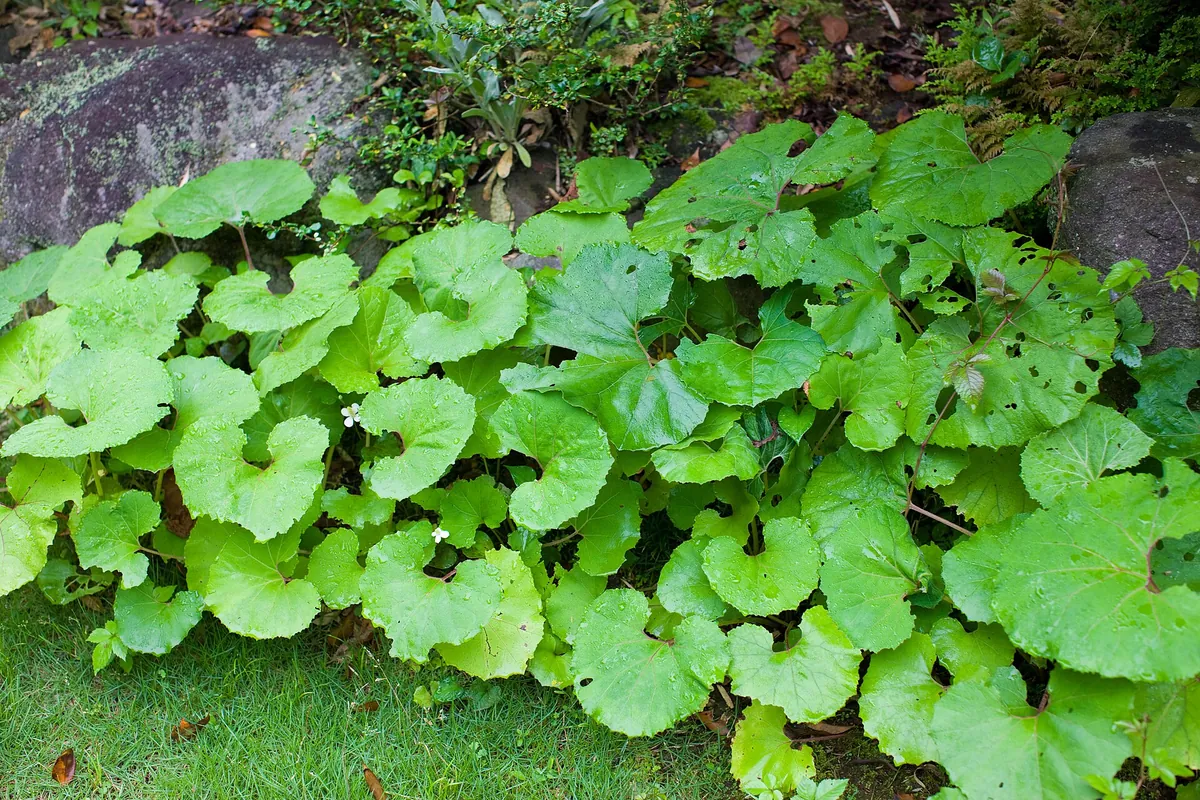
フキ(Petasites japonicus)の群生。丸みを帯びた大きな葉が斜面を覆うように茂っている。
写っているもの: Petasites japonicus部位・状態: 群生する株の丸みを帯びた大きな葉(葉柄・葉身)
写真: Joi Ito/ CC BY 2.0/ 原画像/ 台帳の原画像
写真の範囲と来歴
被写体の確認: 原典の記載による同定。原典に生育地の詳細記載なし。専門家による再同定は行っていない。
掲載画像: Wikimedia Commons の1920px版。苦味研究所では切り抜き・色調変更なし。 表示用には幅1200px上限のWebPを配信し、台帳の原画像は上のリンクから確認できます。
On this page (6 sections)
Reading the bitterness
Fuki (Petasites japonicus) is a daisy-family plant native to Japan. Both its flower buds, fukinoto, which emerge in early spring, and its elongated leaf stalks, fuki, are treated as traditional food ingredients. However, the evidence currently available for this entry concerns not records of bitterness itself but a different naturally occurring group of constituents in this plant, pyrrolizidine alkaloids (PA).
A public information page from Japan's Ministry of Agriculture, Forestry and Fisheries states that PA was detected in most commercially available fuki and fukinotō, that concentrations were higher in fukinotō than in fuki, and that no PA-related health harm suspected to result from eating fuki or fukinotō has been reported in Japan. A 2023 review refers to this ministry survey from Heisei 27-29 (2015-2017) and says that its authors themselves quantified petasin and PA (petasitenine, neopetasitenine, and senkirkine) in fukinotō extracts, finding that nonpolar hexane extraction could retain a high amount of petasin while keeping PA content low. The public page itself gives neither individual concentration values nor details of the survey design, and the extract findings do not give concentrations in fuki or fukinotō as foods.
Sources for this overview
Checked for this overview: Checked as an introduction the statement that PA was detected in most fuki and fukinotō.
キク科山菜に含まれる機能性成分:野生植物として生き抜いてきた山菜の化学戦略を利用する
Checked for this overview: Checked the ministry survey years and the description of quantification of PA and petasin in extracts.
Follow the connections
Japanese butterbur (fuki) →contains→ pyrrolizidine alkaloids
Structured claims — open a section to read each claim's confidence, evidence and limits
Safety and regulation (1)
Scope: Japanese commercial fuki and fukinotou summarized on the Ministry of Agriculture, Forestry and Fisheries' publicly available information page.
Note: The same page also states that no health harm suspected to be caused by eating fuki and fukinotou has been reported in Japan. This description summarizes publicly available information and is not health advice.
Show data
organism-petasites —contains→ compound-pyrrolizidine-alkaloids