namul
dish / dish-namul
ナムル
Namul is a collective term for Korean side dishes in which edible grasses, shoots, and similar ingredients are boiled, stir-fried, or otherwise prepared and dressed with yangnyeom (seasoning).
Photographs (captions in Japanese)
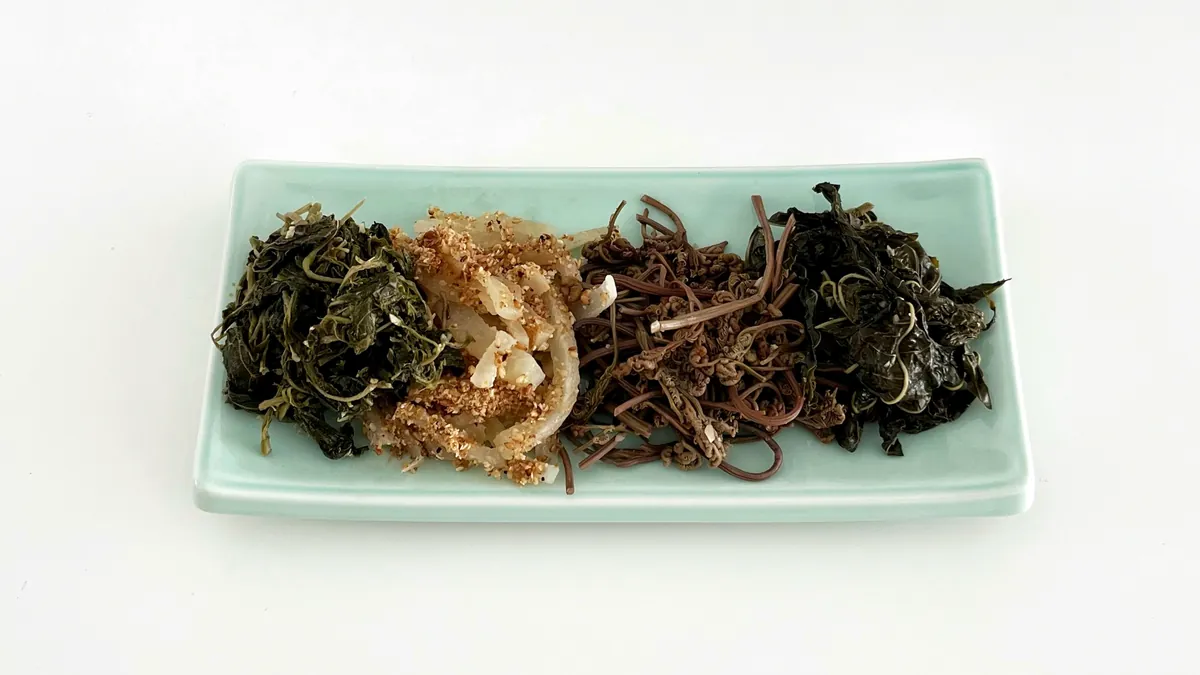
正月大보름(ポルム)行事で食べる干しナムル各種を皿に盛った写真。複数種のナムルを一皿に盛り合わせた複合的な被写体である点に留意。
料理写っているもの: 該当なし(料理)部位・状態: 盛り付け(乾燥ナムル各種)
写真: Garu Gim/ CC BY-SA 2.0/ 原画像/ 台帳の原画像
写真の範囲と来歴
被写体の確認: 原典の記載による同定。
掲載画像: リサイズ・トリミング・色調変更なし。Wikimedia Commons のオリジナル画像をそのまま使用。 表示用には幅1200px上限のWebPを配信し、台帳の原画像は上のリンクから確認できます。
On this page (8 sections)
Reading the bitterness
Namul (나물) is a collective term for Korean side dishes in which edible grasses, tree shoots, and similar ingredients are prepared by methods such as boiling, stir-frying, or serving raw, then dressed with a blended seasoning called yangnyeom. A literature review explains this collective term as broadly divided into saengchae (items dressed raw) and sukchae (items seasoned after being heated by boiling or stir-frying). In both lineages, the additional step of seasoning by dressing is essential to the finish.
The review states that many of the wild grasses and tree shoots used for namul have a strong aroma or bitterness and are difficult to chew as they are. It treats adding yangnyeom as the key that developed such ingredients into 「おいしい」 (in translation: "tasty") dishes in Korea. Rather than placing bitter plants on the table as they are, the idea of making them edible by combining preparation and seasoning is at the core of the namul group of dishes. However, it does not provide individual data on how bitter each plant is.
In a descriptive sensory analysis of 4 kinds of wild-vegetable namul (samnamul, miyeokchwi, daraesoon, and bangpung namul) prepared by 3 soaking treatments (soaked both before and after boiling / soaked only after boiling / not soaked), the abstract indicates that unsoaked miyeokchwi and bangpung namul samples had relatively high sensory-attribute scores for bitterness, together with astringency and roughness, and were least preferred in evaluations by 115 consumers. Attributes such as bitterness and astringency were analyzed as factors affecting this evaluation of 「好まれない」 (in translation: "disliked").
Sources for this overview
Namul, the driving force behind health and high vegetable consumption in Korea
Checked for this overview: The extent checked for the classification of saengchae and sukchae and the definitions of whether heating is used. / The extent checked for the review's description of the bitterness of wild plants and their transformation through seasoning.
Sensory Properties and Drivers of Liking Sanchae namul (seasoned dish with wild edible greens)
Checked for this overview: The finding that unsoaked samples had high bitterness sensory-attribute scores and were not preferred by consumers.
Other names: 나물 (ko)
Structured claims — open a section to read each claim's confidence, evidence and limits
Sensory (1)
Scope: Layer: food. Descriptive analysis by a trained panel of 10 people and 9-point-scale preference evaluation by 115 consumers.
Show data
dish-namul —has_perceived_bitterness_affected_by→ "In a descriptive sensory analysis of 4 kinds of wild-vegetable namul (samnamul, miyeokchwi, daraesoon, and bangpung namul) prepared using 3 soaking methods (soaked both before and after boiling / soaked only after boiling / not soaked), unsoaked miyeokchwi and bangpung namul samples had relatively high sensory-attribute scores for bitterness, along with astringency and roughness, and were least preferred by consumers. Bitterness and astringency, among other attributes, were analyzed as drivers of 「嫌われる」 (in translation: "disliking")."How processing and cooking change it (1)
Scope: Korea
Show data
dish-namul —is_classified_by→ "A broad division into saengchae (dressed raw) and sukchae (dressed after boiling or stir-frying). Both are seasoned with yangnyeom."Culture (1)
Scope: Namul of wild plants in Korea
Note: An example of cultural devices for accepting bitterness (seasoning and heating).
Show data
dish-namul —has_defining_sensory_theme→ "Many namul dishes using wild grasses and woody plants have a strong aroma or bitterness and are difficult to chew. The addition of yangnyeom is treated as the key that turned namul into 「おいしい料理」 (in translation: "tasty dishes")."